
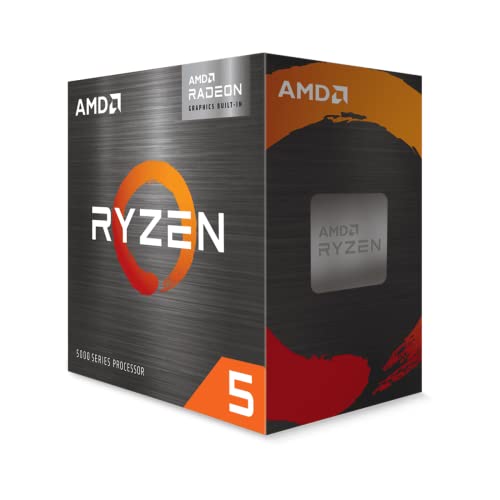
Both exist for the same buyer: someone building a PC without a graphics card, at least for now. The 5600G is ₹11,500 on AM4 with DDR4; the 8500G is ₹15,200 on AM5 with DDR5. The ₹3,700 gap is only the beginning of the difference.
The 8500G's integrated graphics are newer than the 5600G's, and its platform will accept future CPUs. But it carries a genuine catch worth knowing: its six CPU cores are a mix of two Zen 4 and four compact Zen 4c cores, and its graphics link is PCIe 4.0 x4. A discrete card therefore gets less bandwidth than it would with a standard desktop Ryzen chip. The 5600G also has six cores and a cheaper platform, but older integrated graphics.
The honest way to choose: is this permanently an iGPU machine, or a GPU build waiting for budget? Permanent iGPU box, office or light gaming, AM5 future wanted - 8500G. Cheapest possible working PC now, with a proper graphics card coming and full lanes needed - 5600G, or better, a 5500 plus a cheap card. Do not buy an 8500G expecting it to become a strong gaming PC later.
The 8500G runs a graphics card at reduced PCIe bandwidth compared with a full desktop Ryzen chip. For an entry card the practical loss is small, but it is a real ceiling and shops rarely mention it. If your plan is to add a strong GPU within a year, a 5500 or 7500F plus a cheap card is the better structure than an 8500G you intend to upgrade around.
Faster integrated graphics and a platform that takes future CPUs. The better permanent iGPU machine.
AM4 plus DDR4 is the lowest total cost in India, and six full cores handle everyday work comfortably.
If a graphics card is the plan, buy a cheaper CPU with full lanes and put the saving toward the card.
It has newer integrated graphics and sits on AM5, which still receives new CPUs. Both processors have six cores and twelve threads, but the 8500G combines two Zen 4 cores with four Zen 4c cores and gives a discrete GPU a PCIe 4.0 x4 link. That makes it better suited to an iGPU-first machine than a base for a powerful future graphics card.
Yes, but it runs at reduced PCIe bandwidth compared with a standard desktop Ryzen chip. With an entry-level card the practical impact is small; with a strong card it becomes a real limitation.
The 5600G, comfortably. AM4 boards with DDR4 remain the cheapest complete platform here, while the 8500G requires an AM5 board and DDR5 memory.
Yes, more than with any other CPU choice. Integrated graphics use system memory, so running a single stick roughly halves the available bandwidth and noticeably reduces graphics performance.
Ryzen 5 8500G
Ryzen 5 5600G
Useful for an AM4 PC that must run without a dedicated GPU. Compare the live price with the Ryzen 5 5600GT; if a GPU is included from day one, the Ryzen 5 5600 is usually better value.