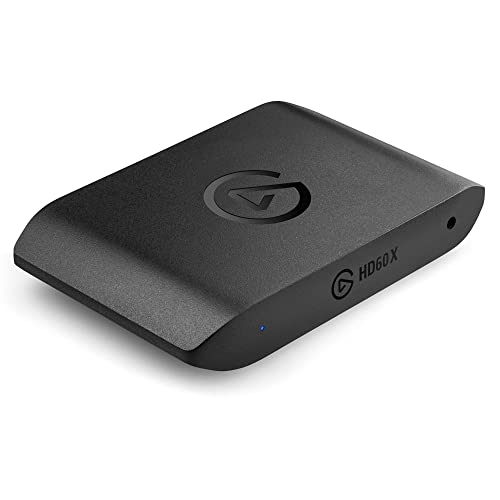
Elgato HD60 S+
Elgato HD60 S+
The HD60 S+ at ₹17,999–18,999 is a capable USB 3.0 capture card for PS5/Xbox console players. It passes through 4K30 HDR10 without compression, captures at 1080p60 for streaming, and works natively with OBS. Main limitation: no 4K60 capture, and at this India price you need to be
Official India stock. Full warranty through the brand's India service network, standard RMA if anything goes wrong.
Full specs
Where to buy Elgato HD60 S+ in India
Expect to pay roughly ₹17,800-19,600 for the Elgato HD60 S+ in India right now, depending on offers and seller. I always recommend buying from retailers that give a proper GST invoice - it's what makes your India warranty claim smooth later.
Affiliate links on linked vendors - your price stays the same. PrimeABGB shown for comparison only.
In my years running a PC store, PrimeABGB (Mumbai) and Vedant Computers (Kolkata) have also been consistently reliable for verified stock - compare before buying.
Elgato HD60 S+ Review India 2026: 4K HDR Passthrough for Console Streamers
The Discounted Flagship That's Still Worth Your Money in 2026
If you've been circling the Elgato HD60 S+ waiting for the right moment to buy - that moment is now. With the HD60 X pushing prices on the previous generation down, this card sits at ₹17,999–18,999 and offers 4K30 HDR passthrough, 1080p60 capture, and the full Elgato software stack. For PS5 and Xbox Series X/S owners who want HDR gaming untouched while streaming in 1080p60, this is still a legitimate option in mid-2026. It's not the newest card in the lineup, but on Indian pricing it hits a sweet spot that the newer model doesn't.
The HD60 S+ at ₹17,999–18,999 is a capable USB 3.0 capture card for PS5/Xbox console players. It passes through 4K30 HDR10 without compression, captures at 1080p60 for streaming, and works natively with OBS. Main limitation: no 4K60 capture, and at this India price you need to be a consistent streamer to justify it. If you're only streaming occasionally, the AVerMedia LGE3 at ₹3,000–4,000 less does nearly the same job.
Capture Quality and Latency - What Actually Matters
The HD60 S+ does two things that matter for console streaming: it passes your 4K HDR signal through to your TV without downgrading it, and it captures that signal at 1080p60 for your stream or recording. These are separate paths - your TV sees 4K HDR30 exactly as the console outputs it, while OBS or 4K Capture Utility sees a 1080p60 stream.
Latency on the passthrough is under one frame. Elgato's Instant Gameview preview inside 4K Capture Utility is genuinely usable - I've seen it on PS5 at roughly 60–80ms of preview latency, which isn't zero but is fine for most console games. If you need sub-frame preview (fighting games, FPS where you're watching the preview monitor), you should route your display through the HDMI passthrough, not the software preview.
The captured 1080p60 footage is clean. Elgato uses hardware H.264 encoding on the device itself, so your CPU load stays low. The card doesn't rely on your PC to encode - it handles compression onboard, then hands the data to the PC over USB 3.0. On a machine with USB 3.0 (not 2.0 masquerading as 3.0 - this matters on budget Indian builds), the throughput is stable.
VRR support exists on passthrough - so if your PS5 or Xbox is pushing variable refresh at 4K, the card passes that through cleanly without breaking your display's VRR mode. That was missing on older Elgato cards and is worth noting here.
India Pricing, Availability, and the Bandwidth Reality
At ₹17,999–18,999, the HD60 S+ is available on Amazon India and occasionally through MDComputers and PrimeABGB. The card is imported, which means GST and customs duties have pushed it roughly 25–30% above global pricing when you convert USD street prices. That's not unique to Elgato - it affects every capture card in this category.
The honest question for Indian buyers: do you have the internet to stream at the quality this card enables? At 1080p60, OBS with x264 needs 6,000–8,000 kbps upload for a clean stream. If you're on a 50Mbps plan with shared bandwidth (common in metro apartments), you're uploading about 6Mbps headroom if the rest of the household isn't hammering the connection. That works, but barely. YouTube India recommends 9,000–18,000 kbps for 1080p60 uploads, which means for live streaming you'll need a dedicated, stable connection - not a peak-hour Jio Fiber shared plan.
The 4K capture option (4K30) requires even more bandwidth if you're recording locally to edit - expect 20–40 GB files for hour-long sessions at uncompressed or high-bitrate capture. That's a local storage and editing concern, not just internet. Make sure your NVMe or at least a fast HDD is on hand.
USB 3.0 is required for this card to function properly. Budget Indian builds with B450/B550 boards or older Intel H-series boards sometimes have USB 3.0 ports that are bandwidth-shared with USB 2.0 on the controller. If you're plugging the HD60 S+ into such a port and also have a USB hub attached nearby, you can see stuttering. Plug it directly into a rear USB-A 3.0 port on your motherboard, not a front-panel header.
Who Should Buy This / Who Should Skip It
Buy it if: you own a PS5 or Xbox Series X/S, you stream or record at least 3–4 times a week, you want 4K HDR untouched on your TV while capturing, and you're willing to spend ₹18,000 on a card that will last 3–4 years without going obsolete. This is also the right buy if you want the Elgato ecosystem - it pairs cleanly with Stream Deck if you're running a proper streaming setup.
Skip it if: you're an occasional streamer who goes live twice a month - the per-use math doesn't work at ₹18,000. Also skip it if your PC only has USB 2.0 or if you're on a sub-50Mbps internet connection. The AVerMedia LGE3 at ₹12,499–13,499 captures at the same resolution and you save ₹5,000 that could go toward better internet or a faster CPU. And skip it if you need 4K60 capture - the HD60 S+ tops out at 4K30. For 4K60 capture you'd need the HD60 X, which costs more.
Price we have actually seen
Up 9.1% since we started tracking. Every point is a price our crawler recorded at an Indian retailer - no estimates, no MSRP. Tracking began recently, so the window grows week by week.
Questions
Yes. PS5 outputs via HDMI 2.0 and the HD60 S+ handles 4K30 HDR10 passthrough cleanly. You can stream your PS5 gameplay at 1080p60 while playing in 4K HDR on your TV. The VRR passthrough also works if your TV supports it.
It works as a plug-and-play UVC device with OBS - you don't need 4K Capture Utility installed just to capture. However, Instant Gameview (the low-latency preview mode) only works through Elgato's own software. For OBS-only setups, you can skip the proprietary software entirely.
4K capture at full quality records locally to your PC - internet speed doesn't affect recording. But if you want to stream live in 4K, you need significantly more upload bandwidth than most Indian home connections provide. Realistically, 1080p60 is the practical streaming resolution on Indian home internet in 2026.
It works for PC capture via HDMI loop but it's inefficient - you'd be outputting from your GPU, going through the capture card, and back to your monitor. For PC game capture, it's better to use OBS's desktop capture directly. This card's real use case is external console capture.