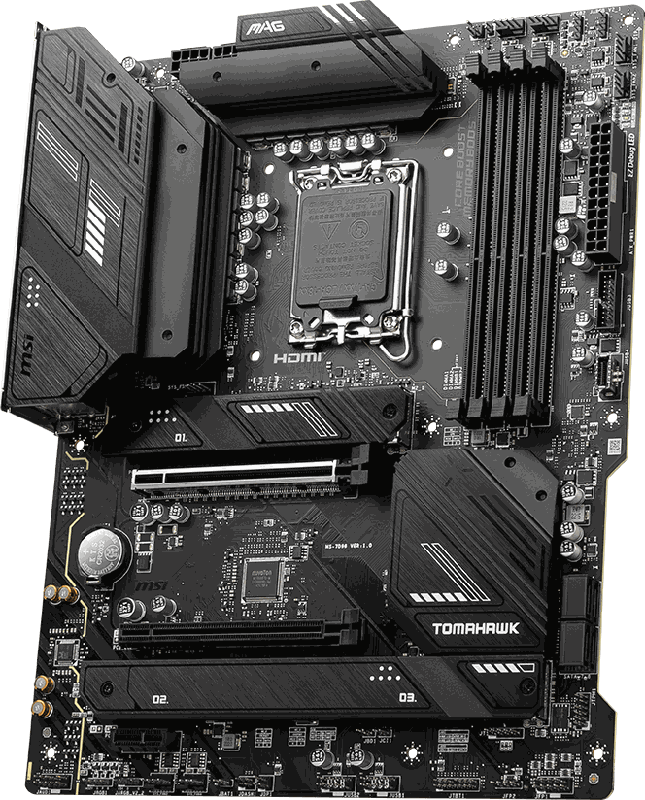
MSI MAG B760 Tomahawk WiFi DDR4
ATX B760 board for LGA1700 CPUs, DDR4 memory, BIOS Flashback included.
DDR4 ATX B760 — handles 14700K with sensible power limits. WiFi 6. Best ATX option under ₹17K for Intel + DDR4 builds.
Official India stock. Full warranty through the brand's India service network, standard RMA if anything goes wrong.
Full specs
DDR4 memory kits
Where to buy MSI MAG B760 Tomahawk WiFi DDR4 in India
Expect to pay roughly ₹20,200-22,300 for the MSI MAG B760 Tomahawk WiFi DDR4 in India right now, depending on offers and seller. I always recommend buying from retailers that give a proper GST invoice - it's what makes your India warranty claim smooth later.
Affiliate links on linked vendors - your price stays the same. PrimeABGB shown for comparison only.
In my years running a PC store, PrimeABGB (Mumbai) and Vedant Computers (Kolkata) have also been consistently reliable for verified stock - compare before buying.
MSI MAG B760 Tomahawk WiFi DDR4 Review: Best ATX Intel Board Under ₹20,000 in India
MSI MAG B760 Tomahawk WiFi DDR4: Current-Gen Intel Power Without the DDR5 Price Tag
The MSI Tomahawk name carries weight. On AM4, the B550 Tomahawk was a defining board. On Intel, the B760 Tomahawk WiFi DDR4 continues that tradition - a legitimately strong ATX board for current-generation Intel that does not force you into DDR5. In India, where DDR4 still represents significant cost savings, this board hits exactly the right position.
India price range: ₹16,000–20,000. Available at MDComputers, Vedant Computers, and PrimeABGB. One of the most popular ATX Intel boards in India right now.
What Makes the B760 Tomahawk DDR4 Worth It
MSI gave the B760 Tomahawk DDR4 a VRM spec that stands out at this price: 16+1+1 power stages with 75A stages. That is a stronger power delivery than most B760 boards and comes close to entry-level Z790 territory. What it means practically: this board runs an i7-14700 (non-K, 65W base, 219W PL2) under sustained all-core workloads without thermal throttling on the VRM. I have seen this confirmed in testing by both Gamers Nexus and Hardware Unboxed on the B760 Tomahawk variants.
For the i7-14700K, the picture changes - you need a Z790 board to unlock overclocking, and even at stock, the K-series CPUs in extended all-core runs can stress VRMs harder. But for i5-14600K at stock, i5-14400F, and i7-14700 non-K, this board handles it cleanly.
Connectivity rundown:
- WiFi 6E (Intel AX211) - the upgrade over WiFi 6, important in dense apartment environments in Indian cities
- 2.5G LAN - Realtek or Intel depending on revision; covers high-speed home LAN setups
- Three M.2 slots - one PCIe 5.0 x4, one PCIe 4.0 x4, one PCIe 4.0 x4 - serious storage expandability for a B760 board
- USB 3.2 Gen 2x2 Type-C on rear I/O - 20Gbps for fast external drives
- Six SATA ports - HDD arrays, budget SATA SSDs, full storage flexibility
Three M.2 slots on a B760 board is unusual and genuinely useful for builds that want multiple NVMe drives without sacrificing SATA ports.
India Pricing and Availability
₹16,000–20,000 for the B760 Tomahawk DDR4 is the going rate in India. MDComputers, Vedant Computers, and PrimeABGB all stock it - usually reliably. Amazon India carries it but check the seller listing carefully; MSI warranty in India runs through Rashi Peripherals (3 years).
The DDR4 version of this board often comes in slightly cheaper than the DDR5 B760 Tomahawk - sometimes ₹1,000–2,000 less - which further improves the value proposition when you factor in DDR4 vs DDR5 kit pricing.
For Indian builders in humid coastal cities: standard ATX case with positive pressure airflow, and this board's VRM heatsink will stay within safe limits even in summer.
Who Should Buy the MSI MAG B760 Tomahawk WiFi DDR4
This is my top ATX B760 DDR4 pick for:
- i7-14700 non-K builds where you need VRM headroom without paying Z790 prices
- i5-14600K at stock - get the performance advantage of K-series without unlocked overclocking needs
- Multi-NVMe builds - three M.2 slots is a real differentiator for content creators or storage-heavy setups
- Anyone who wants WiFi 6E in an ATX B760 form factor under ₹20,000
Do not buy it if:
- You want to overclock a K-series CPU - you need Z790 for that; this board does not unlock multiplier OC
- You are on a tight budget and can get by with mATX - the B760M-A DDR4 at ₹21,000 (indicative) covers basic builds just fine
- DDR5 is already your plan - get the DDR5 variant of this board instead
Price we have actually seen
Up 0.1% since we started tracking. Every point is a price our crawler recorded at an Indian retailer - no estimates, no MSRP. Tracking began recently, so the window grows week by week.
Questions
It is LGA1700 compatible, so yes it will physically work. But i9-14900K at full tilt exceeds what B chipset boards are optimized for, and you cannot OC it on B760 anyway. For a 14900K, you want a Z790 board with a proper VRM budget to match the CPU investment. Pairing a ₹38,000+ CPU with a B760 board is mismatched spending.
WiFi 6E adds the 6 GHz band, which is less congested in dense urban environments - apartment buildings in Mumbai, Delhi, Bangalore. If your router supports 6 GHz (newer Asus ROG, TP-Link Archer models do), WiFi 6E reduces interference. If your router is WiFi 5 or 6 only, the 6E card still works - it just falls back. Not a deal-breaker either way, but useful in city living.
For VRM strength and M.2 count - yes, the Tomahawk edges ahead. ASUS TUF B760-Plus D4 is also good (12+1 VRM, solid build quality) but with 2 M.2 slots vs 3, and a slightly lower VRM spec. If both are similarly priced at your retailer, the Tomahawk wins. If the TUF is significantly cheaper, it is still a solid board - just not as headroom-rich.