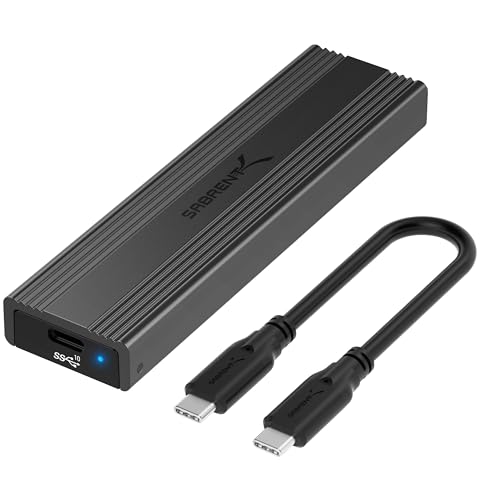
Sabrent EC-SNVE
Sabrent EC-SNVE
The Sabrent EC-SNVE is a toolless USB 3.2 Gen 2 (10Gbps) NVMe enclosure available in India at ₹1,799–1,999 through grey market sellers on Amazon India and Flipkart. It caps out around 950 MB/s - fast enough for most tasks, not nearly as fast as your NVMe drive running inside a PC
Official India stock. Full warranty through the brand's India service network, standard RMA if anything goes wrong.
Full specs
Where to buy Sabrent EC-SNVE in India
Expect to pay roughly ₹1,900-2,100 for the Sabrent EC-SNVE in India right now, depending on offers and seller. I always recommend buying from retailers that give a proper GST invoice - it's what makes your India warranty claim smooth later.
Affiliate links on linked vendors - your price stays the same. PrimeABGB shown for comparison only.
In my years running a PC store, PrimeABGB (Mumbai) and Vedant Computers (Kolkata) have also been consistently reliable for verified stock - compare before buying.
Sabrent EC-SNVE India Review: Toolless NVMe Enclosure Under ₹2,000 - Worth It?
Good Enough for Most People, Honest About What It Is
The Sabrent EC-SNVE is a toolless USB 3.2 Gen 2 (10Gbps) NVMe enclosure available in India at ₹1,799–1,999 through grey market sellers on Amazon India and Flipkart. It caps out around 950 MB/s - fast enough for most tasks, not nearly as fast as your NVMe drive running inside a PC. The plastic build does warm up in Indian summers but handles typical use fine. No official India warranty, no Sabrent service presence here. The right choice if you want to repurpose an old drive cheaply and do not need sustained high-speed transfers in hot conditions.
When you upgrade from a 250GB NVMe to a 1TB drive - something a large number of Indian builders do within the first two years of a build - you are left with a usable drive that happens to be homeless. The drawer it goes into is not where it belongs. An enclosure like the Sabrent EC-SNVE is the practical, low-cost solution: slip the drive in, connect via USB-C, and you have portable storage that demolishes any external HDD in speed.
At ₹1,799–1,999, the EC-SNVE is the entry point for decent NVMe enclosures in India. It is not flashy, the build is plastic, and Sabrent has almost no official India presence. But it works reliably for the most common use case: moving files between machines, carrying project folders between home and office, or keeping a backup of your active work that is fast enough to actually use rather than just archive.
The question worth answering before you buy is whether 10Gbps is enough for what you actually do, and whether the plastic construction will cause you grief in an Indian summer.
Transfer Speed and Thermal Performance
The EC-SNVE uses a JMicron JMS583 bridge chip, which is a well-proven controller at the 10Gbps tier. Sequential read speeds in testing land around 900–950 MB/s and writes around 850–900 MB/s on drives like the WD SN550, Kingston NV2, or Samsung 970 Evo. These numbers are consistent and the chip is stable - you are not going to see random drops or disconnects, which is a real problem with some cheap enclosures using off-brand controllers.
To put 950 MB/s in context: copying a 10GB video file takes about 11 seconds. A 50GB project folder takes under a minute. For most Indian creators and general users, this is fast enough to not feel like a bottleneck in daily use. Where it becomes limiting is if you are doing sustained large transfers - moving 200GB of video footage between drives over an extended session. In that scenario, the 10Gbps ceiling is noticeable compared to NVMe-to-NVMe transfers inside a PC.
The thermal story is the honest downside. The EC-SNVE is plastic, and plastic does not conduct heat away from the drive. In an air-conditioned room at 22–24 degrees, the drive inside stays cool enough that throttling is not a concern during typical transfers. In a 36-degree room in June or July - which describes a lot of Indian work environments that do not have full air conditioning - sustained transfers above 20–30GB can cause the drive to start throttling. When that happens, you will see sequential speeds drop to 400–500 MB/s or lower, which is still usable but significantly below what the enclosure can theoretically do.
If your work environment in summer is reliably hot, this is the main argument to spend more and get an aluminium-shell enclosure. For air-conditioned offices and home setups, the plastic build is fine.
The compatibility score is the EC-SNVE's strongest card. It works with any USB-C port that supports USB 3.2 Gen 2 - which is most modern ports on laptops and the front panel USB-C on builds using a B550 or B650 board. There is no need to hunt for a specific port the way you do with the Gen 2x2 ORICO. If there is a USB-C port on your machine from the last four years, this enclosure will work at full rated speed.
India Pricing and Availability
Sabrent has no official India distribution channel. The EC-SNVE reaches Indian buyers entirely through grey market importers on Amazon India and occasionally Flipkart. The price range of ₹1,799–1,999 has been fairly stable, though you may find it listed higher (₹2,200+) from some sellers - there is no reason to pay above ₹2,000 for this model.
MDComputers and PrimeABGB do not stock Sabrent products. If you want a toolless NVMe enclosure from an Indian PC parts retailer with better accountability, the UGREEN CM400 is stocked more reliably and has official UGREEN India support. The EC-SNVE's advantage is purely on price: it is typically ₹400–600 cheaper than the CM400 at equivalent listing times.
There is no Indian warranty for the EC-SNVE. Amazon India's return window is your only safety net. For a ₹1,800–1,900 purchase, most buyers find this acceptable. The JMicron controller and the enclosure construction are reliable enough that dead-on-arrival units are not common, but it does happen with grey market imports.
Who Should Buy / Who Should Skip
Buy this if:
You have an old NVMe drive - from a PC upgrade, a laptop swap, or a storage consolidation - and you want the simplest possible way to make it useful again without spending much money. You work in a reasonably temperature-controlled environment so the plastic build's thermal weakness does not matter in practice. Your use case is intermittent transfers: moving project files, carrying course material between home and college, keeping a fast backup of your working documents. You are on a tight budget and the ₹500–700 saving over an aluminium enclosure is genuinely meaningful to you.
Skip this if:
You work in a hot environment without air conditioning and will be doing sustained large transfers - the plastic shell will cause throttling under those conditions and you will be frustrated. You are specifically a video editor moving 100GB+ of footage at a stretch; for that workload, spend more on the UGREEN CM400 or ORICO M2PVC3-G20. You want something that will last through daily heavy use for years - the plastic build and grey market sourcing both create durability and support risk that an aluminium-shell enclosure from UGREEN does not.
Price we have actually seen
Down 1.6% since we started tracking. Every point is a price our crawler recorded at an Indian retailer - no estimates, no MSRP. Tracking began recently, so the window grows week by week.