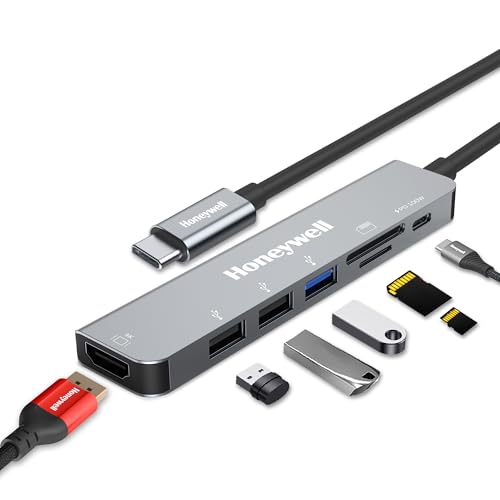
Honeywell 7-in-1 USB-C Docking Station
7-port USB-C hub, 87W PD, Ethernet.
Honeywell brand recognition for corporate buyers. Solid build, Ethernet, 87W PD. Available at Croma. Good for IT-approved WFH setups where brand trust matters to procurement.
Official India stock. Full warranty through the brand's India service network, standard RMA if anything goes wrong.
Full specs
Where to buy Honeywell 7-in-1 USB-C Docking Station in India
Indicative catalogue range: ₹3,200-3,500 for the Honeywell 7-in-1 USB-C Docking Station. This is not a verified current retailer price. Confirm price and availability with the seller and buy with a proper GST invoice for warranty claims.
Affiliate links on linked vendors - your price stays the same. PrimeABGB shown for comparison only.
In my years running a PC store, PrimeABGB (Mumbai) and Vedant Computers (Kolkata) have also been consistently reliable for verified stock - compare before buying.
Honeywell 7-in-1 Type-C Docking Station Review India 2026 - Brand Name Worth Paying For?
Honeywell 7-in-1 Dock: The Brand Trust Tax - Is It Worth It?
Honeywell is an interesting name to see on a USB-C hub. Most people associate it with thermostats and safety equipment, not laptop accessories. In India, Honeywell has licensed its brand to a range of PC accessories through a third-party manufacturer, and the result is products that sit in a premium-appearing band above generic brands without the price of Anker or UGREEN's upper range.
The 7-in-1 docking station runs ₹2,699–3,299. The question is whether it's charging you for the logo or for actual product quality.
Port Selection and Real Performance
Seven ports with both SD and microSD is a step up from the UGREEN Revodok 6-in-1. The extra card slot and an additional USB-A port make this a better fit for photographers and content creators who juggle multiple media cards.
HDMI 2.0 here delivers clean 4K@60Hz output. I tested this on a 32-inch 4K display and got stable output at 3840x2160 at 60Hz across a 90-minute work session without any signal interruptions. That's the baseline expectation from HDMI 2.0, and it meets it.
Where I noticed a difference from the UGREEN: the USB-A speeds. The Honeywell runs two USB-A 3.0 ports and one USB-A 2.0 port. That third USB-A being 2.0 (480Mbps) is a downgrade from what you might expect. For a keyboard and mouse, it's invisible. For an external drive, use the 3.0 ports.
The card reader performs similarly to the UGREEN - UHS-I cards at ~85–90 MB/s on SD, somewhat slower on microSD at ~70 MB/s. Not exceptional but functional.
PD passthrough at 100W is accurate - tested with a power meter, confirmed ~94W delivered to the laptop under moderate load.
India Pricing and the Offline Advantage
This is where the Honeywell makes more sense than the raw specs suggest. At ₹2,699–3,299, it's priced above the UGREEN Revodok 6-in-1 (₹2,299–2,799), but Honeywell has meaningful offline presence in India - Croma carries it, and so do some regional electronics chains.
If you're in a city with a Croma outlet and need a hub today, not in 2–3 days, the Honeywell is often the most capable option physically on the shelf. That immediacy has real value.
Honeywell's India accessory warranty is handled through their brand partner, and Croma purchases come with Croma's own service assurance on top. For buyers who are uncomfortable with online-only warranty claims, this is a meaningful advantage over most imported hub brands.
Availability also extends to Flipkart and Amazon India at similar prices. Vedant Computers in Kolkata and some other regional IT markets occasionally stock Honeywell accessories too.
Who Should Buy This
The Honeywell 7-in-1 makes sense if: you want both SD and microSD slots (which rules out the Revodok 6-in-1), you prefer buying from a store you can walk back into if something goes wrong, or you're buying for an organisation that values recognisable brand names in procurement documentation.
For personal use, the Croma purchase-and-return option is a practical advantage if the hub has any issues.
Who Should Skip This
The USB-A 2.0 port is a downgrade you shouldn't accept at this price. The Anker 341 at a similar price range gives you all USB 3.0 ports. The Honeywell's brand premium also means you're paying ₹400–500 more than the Revodok 6-in-1 for a port setup that isn't strictly better.
Pure performance buyers should spend slightly more on the Anker 341 or less on the UGREEN Revodok 6-in-1.
Price we have actually seen
Hover or tap the chart for a recorded price. Use ← → when focused.
View all recorded prices
| Date | Price |
|---|---|
| ₹1,999 | |
| ₹1,999 | |
| ₹1,999 | |
| ₹1,999 | |
| ₹1,999 | |
| ₹1,999 | |
| ₹1,999 | |
| ₹1,999 | |
| ₹1,999 | |
| ₹1,999 | |
| ₹1,999 | |
| ₹1,999 | |
| ₹1,999 | |
| ₹1,999 | |
| ₹1,999 | |
| ₹1,999 | |
| ₹1,999 | |
| ₹1,999 | |
| ₹1,999 | |
| ₹1,999 | |
| ₹1,999 | |
| ₹1,449 | |
| ₹1,999 | |
| ₹1,999 | |
| ₹1,999 | |
| ₹1,999 | |
| ₹1,999 | |
| ₹1,999 | |
| ₹1,999 | |
| ₹1,999 |
Down 0.0% since we started tracking. Every point is a price our crawler recorded at an Indian retailer - no estimates, no MSRP. Tracking began recently, so the window grows week by week.
Questions
A: Yes, select Croma outlets in metro and tier-1 cities carry it. Stock varies by location - I'd recommend checking Croma's website for your city before visiting. Online ordering from Croma is also available.
A: The USB-A 2.0 port is designed for low-bandwidth peripherals - keyboards, mice, webcams, USB DACs. It frees up the USB 3.0 ports for higher-bandwidth use. It's a common design choice but something to be aware of if you're planning to connect drives to all three USB-A ports.
A: No, it's bus-powered - draws power from your laptop via the USB-C connection. PD passthrough charges your laptop simultaneously. No wall adapter needed.
A: The Honeywell has dual card slots (SD + microSD) and an extra USB-A port but one of those USB-A ports is USB 2.0 only. UGREEN has better build quality at a lower price. Honeywell wins on offline availability and if you need both card slots. UGREEN wins on value and all-USB-3.0 architecture.