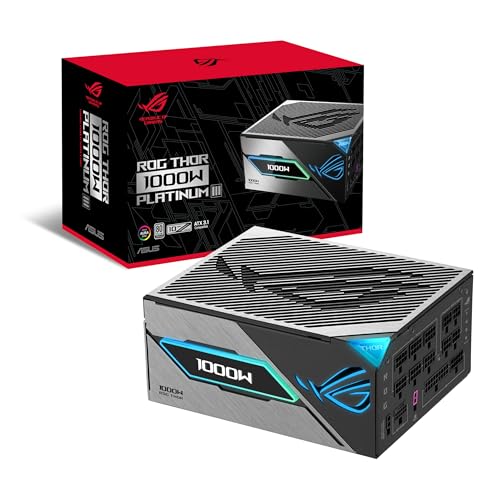
ASUS ROG Thor 1000W Platinum III
1000W 80+ Platinum, full-modular, no native 12VHPWR - adapter required for RTX 40-series.
Official India stock. Full warranty through the brand's India service network, standard RMA if anything goes wrong.
Full specs
GPUs this PSU can power
Where to buy ASUS ROG Thor 1000W Platinum III in India
Indicative catalogue range: ₹34,600-38,200 for the ASUS ROG Thor 1000W Platinum III. This is not a verified current retailer price. Confirm price and availability with the seller and buy with a proper GST invoice for warranty claims.
Affiliate links on linked vendors - your price stays the same. PrimeABGB shown for comparison only.
In my years running a PC store, PrimeABGB (Mumbai) and Vedant Computers (Kolkata) have also been consistently reliable for verified stock - compare before buying.
ASUS ROG Thor 1000W Platinum III Price in India, Review & Who It's For
ASUS ROG Thor 1000W Platinum III: The PSU That Wants to Be Seen
Most power supplies are the part of your build you never think about again once it's installed. The ASUS ROG Thor 1000W Platinum III is not that PSU. It has a small OLED-style wattage readout built into Thor's hammer on the side panel, glowing through your case window and telling anyone who looks that your system is pulling, say, 412W right now. It's a PSU that wants to be looked at, and ASUS backs that showmanship with genuine 80+ Platinum efficiency, full ATX 3.1 compliance, and the kind of component quality that justifies the halo pricing.
This is also the first ASUS power supply we're covering on GetPC, so worth a quick intro to the lineup. ASUS makes PSUs across a few tiers under the ROG and TUF Gaming banners, and the Thor series sits at the top as the showpiece unit, the one built to be a centerpiece rather than a hidden component. At ₹36,000 to ₹39,500 depending on retailer, with ₹36,750 confirmed at MDComputers, the ROG Thor 1000W Platinum III is priced like a flagship. Whether that price makes sense depends entirely on what you're building and whether you care about the display.
The ROG Thor 1000W Platinum III is a 1000W, 80+ Platinum, fully modular ATX 3.1 PSU with a native 12V-2x6 connector for modern GPUs, and a real-time OLED wattage display built into the side panel. Priced at ₹36,000-39,500 in India (₹36,750 confirmed at MDComputers), it costs roughly double what a Corsair HX1000i or ASUS's own TUF Gaming 1200W Gold runs. You're paying for the display, the Japanese capacitors, the 0dB fan mode, and a 10-year warranty. If you have a windowed case and a high-end RTX 5080-class build, it's a genuinely great PSU. If you just need clean, reliable power for a mainstream rig, this is not where your budget should go.
What's Actually Inside
Strip away the RGB and the wattage meter and you have a solid, modern high-wattage PSU. Here's the spec rundown:
Key specs:
- Wattage: 1000W continuous
- Efficiency: 80+ Platinum
- ATX version: ATX 3.1 compliant
- Native GPU connector: 1x 12V-2x6 (PCIe 5.1), rated up to 600W, no adapter needed
- Modularity: Fully modular
- Signature feature: Thor's Power Meter, real-time OLED wattage display
- Fan: Axial-tech design, 0dB silent mode at low/idle load
- Capacitors: Japanese-made, high-durability grade
- Lighting: Aura Sync addressable RGB
- Warranty: 10 years (India)
The native 12V-2x6 connector is worth calling out on its own. ATX 3.1 units with a proper single-cable 600W-rated connector mean you're not hunting for a separate adapter or worrying about a janky 4-to-1 cable bundle when you slot in an RTX 5080 or 5090. That connector alone is one of the bigger practical upgrades over older-generation PSUs still floating around the Indian market.
Efficiency Across the Load Curve
80+ Platinum isn't a marketing sticker, it's a tested certification with real thresholds at 20%, 50%, and 100% load. At 230V (the standard for Indian mains), Platinum requires roughly 90% efficiency at light load, 94% at half load, and 91% at full load. That's meaningfully better than an 80+ Gold unit, which sits closer to 87-90-87 across the same three points.
The practical point: your build will spend most of its life somewhere between 20% and 50% load, not pegged at 100%. That's exactly where Platinum-tier units like this one hit their peak efficiency, which means less power drawn from the wall, less heat dumped into your case, and less wear on the unit over years of daily use.
Thor's Power Meter, and Whether It's a Gimmick
I'll be upfront: a wattage readout on your PSU does not make your frames higher or your build more stable. But it's also not pure gimmick. Watching real-time system draw during a stress test or a long render session is genuinely useful for spotting anomalies, like a GPU pulling way more than expected or a CPU boosting harder than your cooler can handle. For most buyers though, the honest answer is that the display exists because it looks fantastic in a windowed case with RGB fans and a tempered glass side panel, and ASUS knows exactly who's buying this PSU. Paired with Aura Sync, it ties into the rest of an ROG-themed build without needing third-party RGB software juggling.
The axial-tech fan design keeps things quiet, with a proper 0dB mode that keeps the fan fully stopped under light desktop loads. Combined with Japanese-made capacitors rated for long-term durability, this isn't a PSU where ASUS spent the whole budget on the display and skimped on the internals. That balance is what separates a legitimate flagship unit from a PSU that's all show.
India Pricing and Where to Buy
Real-world pricing across Indian retailers: ₹36,000 to ₹39,500, with MDComputers listing it at a confirmed ₹36,750. PrimeABGB and Vedant Computers typically track close to that number, and Amazon India pricing swings a bit more depending on stock and seller. Flipkart and Croma carry select ASUS ROG components occasionally but aren't your most reliable source for this specific unit, so check MDComputers or PrimeABGB first if you want price stability.
That premium is real, and it's the whole story of this PSU. Corsair's HX1000i gets you the same wattage and the same Platinum efficiency for close to half the price, but no OLED wattage display and no Thor's hammer branding. You're paying ASUS for the spectacle and the finish quality, not for meaningfully more power delivery.
Connectors: What's in the Box
The native 12V-2x6 cable rated for 600W means an RTX 5090 draws its full rated power through one cable, no adapter, no daisy-chained pigtails hanging off the side of your GPU. That's a real quality-of-life upgrade if you've ever dealt with the bulky 4-to-1 adapters that shipped with early ATX 3.0 units.
Why PSU Quality Matters More in India
This is the part of the article I write for basically every PSU review, and it matters just as much here. Indian grid conditions are not the same as a clean, stable European or North American supply. Voltage fluctuations, brownouts, and sudden power cuts are common enough in most cities, and worse in tier-2 and tier-3 towns. A cheap PSU with poor voltage regulation and weak surge protection is a genuine risk to every other component in your build, not just an inconvenience.
80+ Platinum certification isn't only about efficiency numbers on a spec sheet. Getting to that certification tier requires better internal components: tighter voltage regulation, better ripple suppression, and higher-grade protection circuitry (OVP, UVP, OCP, SCP, OTP) that actually holds up under real-world grid noise. The Japanese capacitors in the ROG Thor aren't marketing filler either, capacitor quality is one of the biggest factors in how a PSU survives years of voltage swings without degrading. If you've ever had a budget PSU die and take a motherboard or GPU with it, you know why this matters. A 10-year warranty backing the unit in India gives you real recourse if something does go wrong, which matters more here than in markets with less voltage instability.
What GPU Tier Actually Needs 1000W
Be honest with yourself about this before buying. A 1000W PSU is not a requirement for most gaming builds:
- Mainstream builds (RTX 5060/5070, mid-range Ryzen or Intel CPU): 650-750W covers this with room to spare. You do not need this PSU.
- High-end builds (RTX 5070 Ti or RTX 5080, flagship Ryzen 7/9 or Intel Core Ultra 9): This is the sweet spot for 1000W. You get real headroom without overspending on capacity you'll never use.
- Single RTX 5090 configurations: 1000W handles this, though it's closer to the edge under sustained full-load stress testing. If you're planning aggressive overclocking on both GPU and CPU, 1200W (like ASUS's own TUF Gaming 1200W Gold) gives more breathing room.
For most people reading this and eyeing the ROG Thor, the honest driver is the display and the RGB, not raw wattage necessity. That's fine, as long as you know that's what you're paying for.
Who Should Buy This
Anyone building a high-end RTX 5080-class or single RTX 5090 rig in a windowed case who wants the build to look as good as it performs. If you're already committed to an ROG-themed build with Aura Sync peripherals and RGB fans, the Thor slots in as the centerpiece rather than an odd one out. Enthusiasts who genuinely use real-time wattage monitoring during stress testing or overclocking sessions will get practical value out of the display, not just visual flair. And if you want a 10-year warranty and genuine Platinum-tier components from a brand with strong India service presence, this checks that box too.
Who Should Skip This
If your case doesn't have a side window, you're paying a premium for a feature you'll never see, skip straight to the ASUS TUF Gaming 1200W Gold or a Corsair HX1000i for similar wattage and reliability at nearly half the price. If your build peaks under 700W, this is dramatically oversized capacity you don't need at any price point. And if RGB and displays genuinely don't interest you, there is no functional reason to pay double for this over a quieter, cheaper Platinum unit.
Price we have actually seen
Hover or tap the chart for a recorded price. Use ← → when focused.
View all recorded prices
| Date | Price |
|---|---|
| ₹36,745 | |
| ₹36,745 | |
| ₹33,999 | |
| ₹36,745 | |
| ₹36,745 | |
| ₹36,745 | |
| ₹33,999 | |
| ₹36,745 | |
| ₹36,745 | |
| ₹33,999 | |
| ₹33,999 | |
| ₹33,999 | |
| ₹33,999 | |
| ₹33,999 | |
| ₹33,999 | |
| ₹33,999 | |
| ₹33,999 | |
| ₹33,999 | |
| ₹33,999 | |
| ₹33,999 | |
| ₹33,999 | |
| ₹33,999 | |
| ₹33,999 | |
| ₹33,999 | |
| ₹33,999 | |
| ₹33,999 | |
| ₹33,999 | |
| ₹33,999 | |
| ₹33,999 | |
| ₹33,999 |
Down 7.5% since we started tracking. Every point is a price our crawler recorded at an Indian retailer - no estimates, no MSRP. Tracking began recently, so the window grows week by week.
Questions
Functionally, they're close: both are 1000W, both are 80+ Platinum, both are fully modular. The Thor costs nearly double mainly because of the wattage display, the Aura Sync RGB, and ASUS's build finish. If you have a windowed case and want the visual centerpiece, it's worth it. If you just want reliable Platinum-tier power, the HX1000i is the better value.
Yes. It ships with a native 12V-2x6 connector rated for 600W, which covers the RTX 5090's full rated draw directly, no adapter cable needed.
For a single RTX 5070 Ti with a mainstream CPU, 850W is usually sufficient. 1000W isn't wasteful here though, it gives you comfortable headroom for a future GPU upgrade or added storage and fans, and keeps the PSU running in its most efficient load range more of the time.
It's an OLED-style panel embedded in the Thor's hammer logo on the side of the unit, showing real-time total system wattage draw. It's visible through a case window and doesn't require separate software to function, though brightness and some display behavior can be tuned through ASUS's software.
ASUS backs the ROG Thor 1000W Platinum III with a 10-year warranty in India, among the longer warranty terms available on a consumer PSU here. Buy from an authorized retailer like MDComputers, PrimeABGB, or Amazon India to make sure the warranty registers correctly.