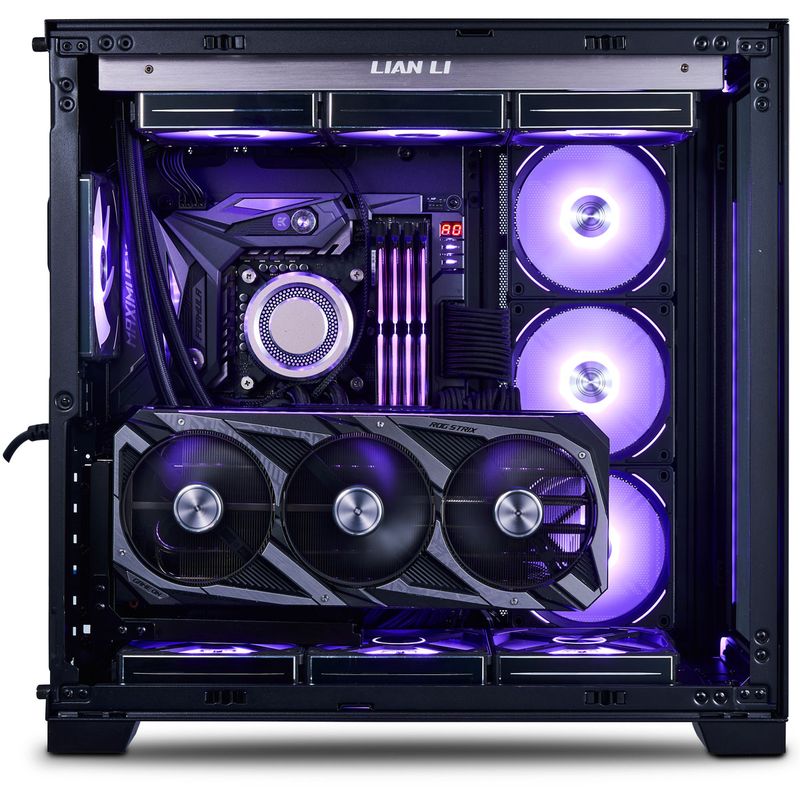
Lian Li O11 Dynamic EVO
Mid-tower case supporting up to 422mm GPUs and 167mm coolers. 0 fans included.
Showcase case. Dual-chamber design, glass on two sides. No fans included — budget ₹4-5K for fans on top. Beautiful when finished.
Official India stock. Full warranty through the brand's India service network, standard RMA if anything goes wrong.
Full specs
GPUs that fit (≤422mm)
Air coolers that fit
Where to buy Lian Li O11 Dynamic EVO in India
Expect to pay roughly ₹24,000-26,500 for the Lian Li O11 Dynamic EVO in India right now, depending on offers and seller. I always recommend buying from retailers that give a proper GST invoice - it's what makes your India warranty claim smooth later.
Affiliate links on linked vendors - your price stays the same. PrimeABGB shown for comparison only.
In my years running a PC store, PrimeABGB (Mumbai) and Vedant Computers (Kolkata) have also been consistently reliable for verified stock - compare before buying.
Lian Li O11 Dynamic EVO India Review 2025 - Best Case for Watercooling Builds
Lian Li O11 Dynamic EVO India Review 2025 - The Watercooling Builder's Case
The original O11 Dynamic built a cult following, and for good reason. The EVO revision takes what worked and adds the features people wanted: better riser support for vertical GPU mounting, improved cable routing flexibility, and more radiator positions. I've built in the original O11D and the EVO, and the EVO is a meaningfully better case - not just a spec bump.
What the EVO Revision Actually Changes
The O11 Dynamic EVO keeps the dual-chamber layout that made the original famous - main chamber for GPU, CPU, and cooling; secondary chamber behind the motherboard for PSU, cables, and storage. What changes:
PCIe 4.0 riser support - The EVO includes a PCIe 4.0 riser cable slot natively, which matters if you want to vertically mount your GPU for display. The original needed an aftermarket bracket.
More fan and radiator mounting positions - The EVO adds bottom-mount radiator support (up to 360mm), so you can run triple 360mm radiators simultaneously. Front and top also support 360mm. This is excessive for most builds, but if you're doing a full custom loop with separate CPU and GPU loops, the EVO handles it.
Better cable routing - Additional cutouts and cable pass-throughs in the EVO make cable management less frustrating. The original O11D's routing could get messy with modern high-wattage GPUs drawing multiple 12V cables.
Tempered glass dual panel - Left side and bottom panels are both tempered glass on the EVO. Bottom glass requires caution - place the case on a stand or the included feet are sufficient - but it adds to the showcase quality.
India Pricing and Where to Buy
The O11 Dynamic EVO sits at ₹12,000–16,000 in India as of May 2025, depending on color variant (black, white) and stock location.
- MDComputers - most reliable source for Lian Li in India
- PrimeABGB - often has competitive pricing on the EVO
- Amazon India - available but pricing fluctuates; verify authenticity via seller ratings
- Vedant Computers - worth checking if you're in Mumbai/Pune region
Lian Li availability in India is more limited than Corsair or NZXT, so expect occasional stock gaps. MDComputers is the most consistent for both stock and customer service on Lian Li products.
Who Should Buy This
The O11 Dynamic EVO is the right call for:
- Custom watercooling loop builds - the dual-chamber layout was designed for this
- High-end AIO builds (240mm + 360mm dual AIO configurations)
- Builders who prioritize showcase aesthetics - dual tempered glass looks exceptional
- RTX 4090 / i9-14900K / Ryzen 9 7950X builds that need maximum cooling headroom
In Indian conditions with high humidity during monsoon season (June–September), a fully sealed custom loop is actually beneficial - less open-air exposure for components compared to air cooling. The EVO supports this configuration well.
Who Should Skip It
Don't buy the O11 Dynamic EVO if:
- You're running standard air cooling - the case isn't optimized for airflow-only setups the way mesh-front cases are
- You're on a tight budget - at ₹12,000–16,000, this is a statement purchase
- Your build is mid-range (RTX 4070 or below, i5 or Ryzen 5 tier) - the case will outclass your components
Price we have actually seen
No change while tracked. Every point is a price our crawler recorded at an Indian retailer - no estimates, no MSRP. Tracking began recently, so the window grows week by week.
Questions
If you're buying new, always get the EVO. The PCIe 4.0 riser support alone is worth it for future GPU vertical mounting, and the improved cable routing is noticeable during the build. The original is only worth buying used if the price gap is significant.
Yes, the EVO supports up to E-ATX (272mm x 280mm). If you're using a larger E-ATX board, measure carefully - some very wide E-ATX boards may restrict cable management space.
The case is primarily designed around aesthetics and cooling performance, not dust management. It has fewer dust filters than mesh-front cases like the 4000D. Consider adding magnetic dust filters to the bottom intake if you're in a dusty environment.