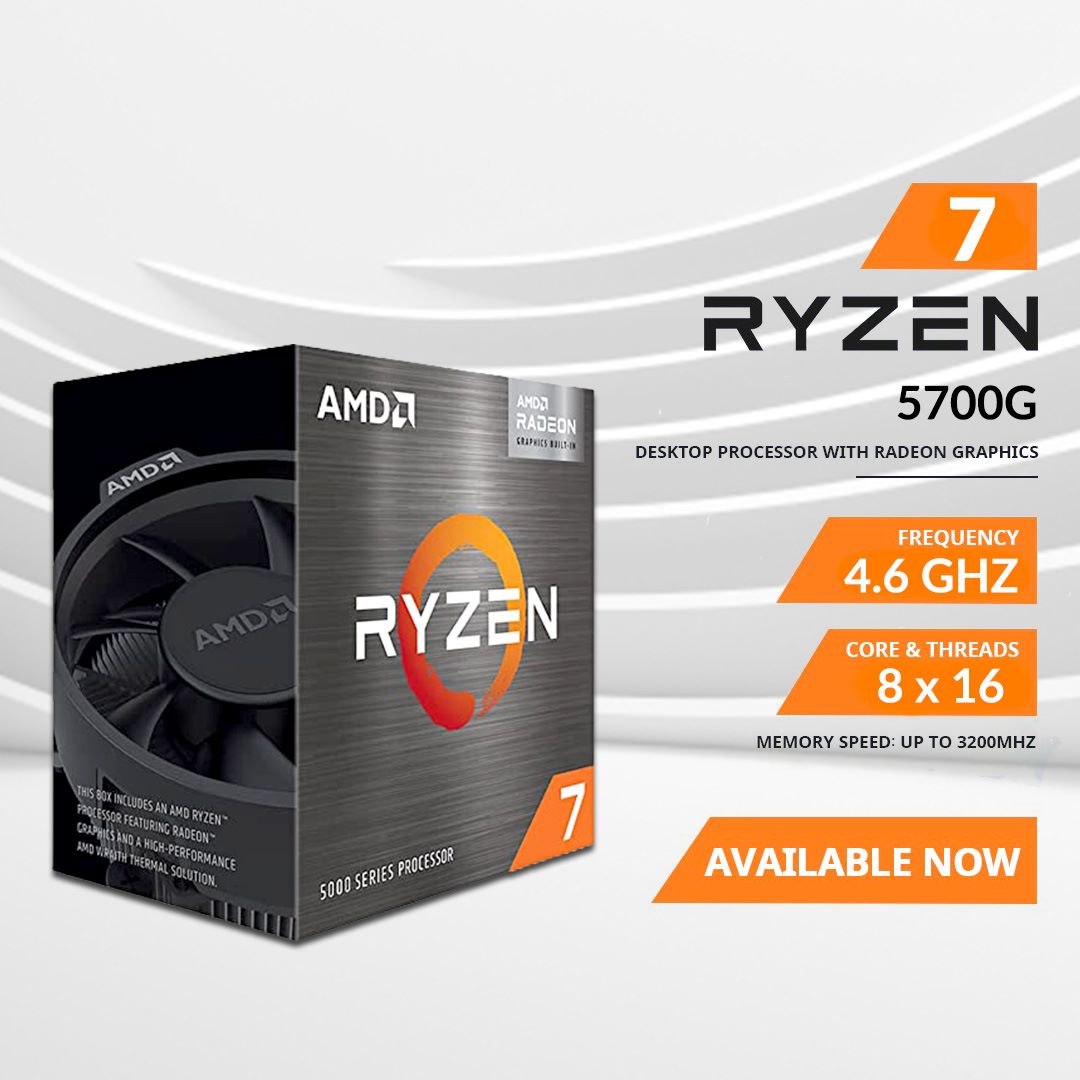
AMD Ryzen 7 5700G
8-core Zen 3 efficient chip on the AM4 platform, with usable integrated graphics.
8-core with decent iGPU. Good for productivity builds that might add a GPU later. DDR4 keeps cost down.
Official India stock. Full warranty through the brand's India service network, standard RMA if anything goes wrong.
Full specs
Motherboards for AMD Ryzen 7 5700G
Coolers for 65W+
Where to buy AMD Ryzen 7 5700G in India
Expect to pay roughly ₹15,400-17,000 for the AMD Ryzen 7 5700G in India right now, depending on offers and seller. I always recommend buying from retailers that give a proper GST invoice - it's what makes your India warranty claim smooth later.
Affiliate links on linked vendors - your price stays the same. PrimeABGB shown for comparison only.
In my years running a PC store, PrimeABGB (Mumbai) and Vedant Computers (Kolkata) have also been consistently reliable for verified stock - compare before buying.
AMD Ryzen 7 5700G India Review: AM4 APU at ₹16,000–21,000 in 2025
The Ryzen 7 5700G occupies a specific and shrinking niche in 2025. When it launched, an 8-core Zen 3 APU with capable integrated graphics was genuinely exciting. Now, AMD's AM5-based APUs with RDNA 3 integrated graphics have raised the bar considerably. But for AM4 builders who already have DDR4, or users who need a capable iGPU without a discrete GPU spend, the 5700G still does a legitimate job.
Let me explain exactly where it stands and who it's actually right for.
The CPU Side: 8 Cores of Zen 3
The 5700G's CPU cores are full Zen 3 - identical architecture to the Ryzen 7 5700X, running at slightly lower clocks (3.8 GHz base / 4.6 GHz boost vs the 5700X's 3.4/4.6). For CPU-side tasks: gaming with a discrete GPU, productivity, content creation - the 5700G punches at Zen 3 mid-range levels. That's competitive.
In gaming with a discrete GPU attached, the 5700G performs identically to a Ryzen 7 5700X in almost every scenario. The iGPU is disabled when a discrete GPU is connected; all processing happens on the dedicated card.
The iGPU Side: Vega 8 in 2025
The integrated Radeon Vega 8 has 512 shader processors. At Zen 3 clockspeeds, it's faster than the Vega 8 in the Ryzen 3 3200G - better IPC per shader, higher clocks. But it still uses the older RDNA-precursor Vega architecture, compared to RDNA 2 in the Ryzen 5 5600G and RDNA 3 in the Ryzen 5 8600G.
The performance gap to the Ryzen 5 8600G (Radeon 760M, RDNA 3) is significant - roughly 25–30% in gaming. If gaming without a discrete GPU is your primary reason to buy an APU, the 8600G on AM5 is the better chip. The 5700G's advantage is platform cost - AM4 with DDR4 is cheaper to build on today.
The Dual-Channel RAM Requirement
This is non-negotiable for anyone buying the 5700G for its iGPU: the integrated graphics share system RAM. Single-channel RAM (one stick) cuts iGPU gaming performance by 25–35%. You need two matched sticks running in dual-channel mode.
For iGPU performance, faster RAM also helps. DDR4-3200 is the sweet spot; DDR4-3600 provides marginal gains. In India, a decent 16GB (2x8GB) DDR4-3200 kit runs ₹3,500–5,000. Factor this into your build cost from the start.
India Pricing
The Ryzen 7 5700G retails at ₹16,000–21,000 in India. Pricing has come down as the chip ages and AM5 takes over as the current platform.
- MDComputers: Competitive pricing, reliable stock
- Amazon India: Frequently goes on sale during big shopping events
- PrimeABGB: Good for combo deals with B550 boards
- Vedant Computers: Check their AM4 clearance bundles
Includes AMD's Wraith Stealth cooler - adequate for the chip's 65W TDP.
Who Should Buy the Ryzen 7 5700G
Buy it if:
- You're upgrading an existing AM4 + DDR4 build and want more cores + temporary iGPU use
- You need an 8-core CPU with iGPU capability and AM5 platform cost is out of budget
- You're building a capable office or HTPC machine that might also do light gaming
- You already have fast dual-channel DDR4 to pair with it
Skip it if:
- Gaming without a GPU is your primary use - the Ryzen 5 8600G (AM5, RDNA 3) is significantly better for iGPU gaming
- You're building fresh without an AM4 platform investment - AM5 is more forward-looking
- You'll be adding a discrete GPU soon anyway - the Ryzen 7 5700X has the same CPU performance and costs less
- You have only a single RAM stick - single-channel mode will frustrate you with iGPU gaming
Price we have actually seen
Down 10.1% since we started tracking. Every point is a price our crawler recorded at an Indian retailer - no estimates, no MSRP. Tracking began recently, so the window grows week by week.
Questions
Yes - the 5700G is fully compatible with B550 boards (with BIOS update) and X570 boards. A520 boards also support it but limit platform features. B550 is the recommended pairing for most builds.
Light-to-moderate titles at 720p–1080p Low settings - yes. Valorant, CS2, older titles, and less demanding indie games run acceptably. AAA titles at 1080p are a struggle. The iGPU is best treated as a gap-filler until a discrete GPU is added to the build.
CPU performance is near-identical - both are 8-core Zen 3 chips. The 5700G adds the iGPU; the 5700X runs at slightly higher clocks and is often cheaper. If you don't need the iGPU, the 5700X is the better buy.