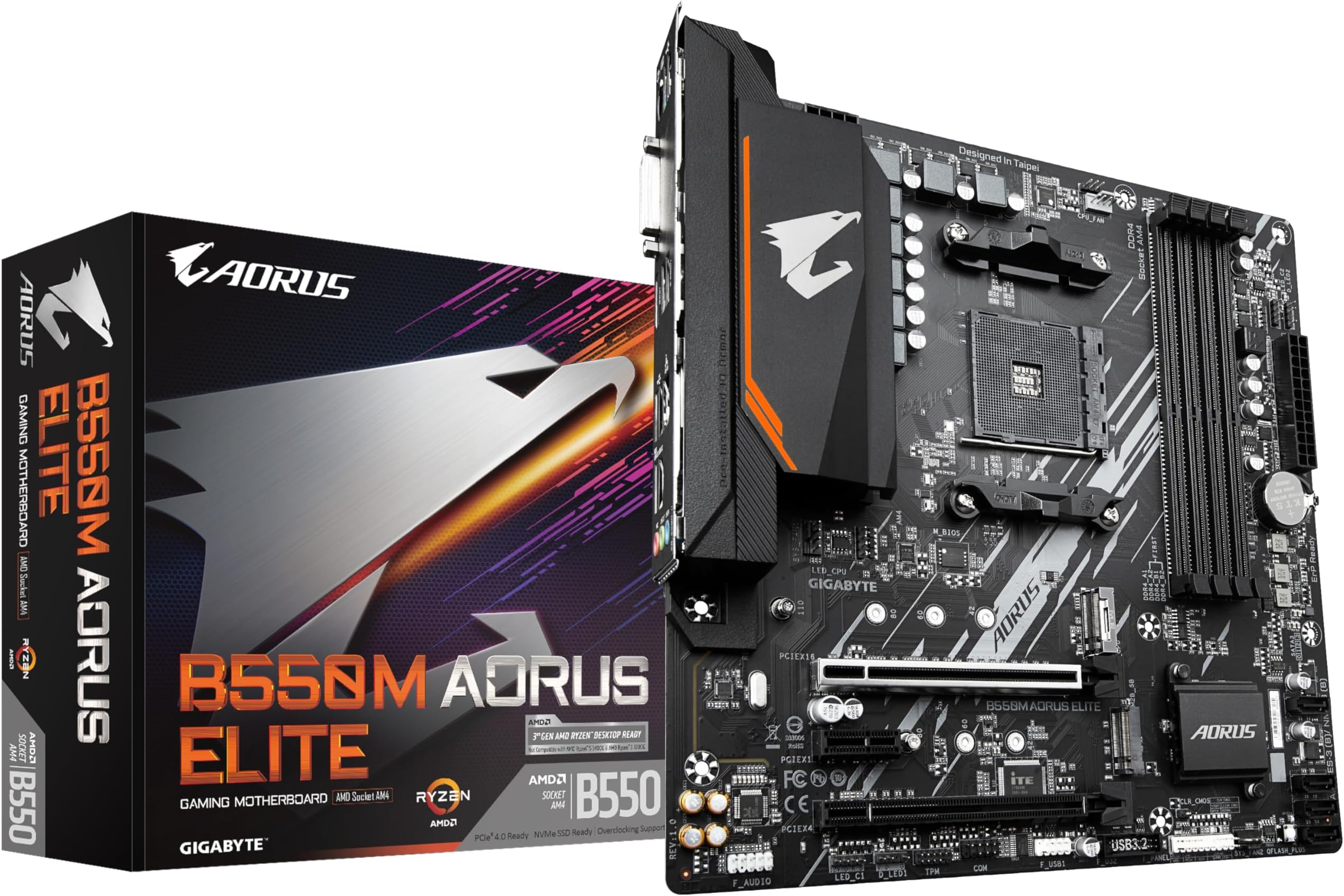
Gigabyte B550 Aorus Elite V2
ATX B550 board for AM4 CPUs, DDR4 memory, BIOS Flashback included.
Mid-range ATX AM4. Good VRMs for Ryzen 7/9. No WiFi - add a card or use ethernet.
Official India stock. Full warranty through the brand's India service network, standard RMA if anything goes wrong.
Full specs
Compatible CPUs
DDR4 memory kits
Where to buy Gigabyte B550 Aorus Elite V2 in India
Expect to pay roughly ₹11,500-12,700 for the Gigabyte B550 Aorus Elite V2 in India right now, depending on offers and seller. I always recommend buying from retailers that give a proper GST invoice - it's what makes your India warranty claim smooth later.
Affiliate links on linked vendors - your price stays the same. PrimeABGB shown for comparison only.
In my years running a PC store, PrimeABGB (Mumbai) and Vedant Computers (Kolkata) have also been consistently reliable for verified stock - compare before buying.
Gigabyte B550 Aorus Elite V2 - The Solid Mid-Range AM4 Board for Serious Ryzen Builds
The Gigabyte B550 Aorus Elite V2 sits in a competitive spot on the AM4 board market - priced above budget mATX options but below premium X570 territory. It's designed for builders pairing high-end Ryzen chips where VRM capability matters, and it delivers on that front without overcharging for features you might not use.
I've tracked this board in India since its launch and its positioning has remained consistent - it's the AM4 board I'd recommend when someone is pairing a Ryzen 7 5800X3D or Ryzen 9 5900X and wants a stable platform without paying X570 prices.
VRM and Feature Set: What V2 Improved
The V2 revision over the original Aorus Elite brought improved power delivery components and better thermal performance from the VRM heatsink. The 12+2 phase design uses Intersil ISL99390 90A power stages - a meaningful step up from budget boards running 50–60A stages. In practical terms, this means sustained multi-core workloads on Ryzen 9 5900X and Ryzen 7 5800X3D run without thermal throttling.
Two M.2 slots is the feature that separates this board from most mATX alternatives. Both slots support PCIe 4.0 - the first directly from the CPU (faster, ideal for primary NVMe), the second from the chipset (still PCIe 4.0 on B550, unlike some boards that drop M.2 slot 2 to PCIe 3.0). That means two full-speed NVMe drives without compromising either.
PCIe 4.0 x16 for the GPU slot is CPU-direct - same as other B550 boards. No degraded GPU bandwidth.
The onboard RGB is subtle - edge lighting and some accent elements. Gigabyte's RGB Fusion software lets you disable it completely if you prefer a clean look. This is a practical note: several buyers in India run their systems in well-lit rooms where RGB adds no visual value, and the ability to turn it off without leaving glowing lights you didn't ask for is appreciated.
India Pricing and Build Compatibility
The Gigabyte B550 Aorus Elite V2 runs ₹14,000–18,000 in India. MDComputers and PrimeABGB stock it. Vedant Computers carries it as well. Amazon India and Flipkart prices can be slightly higher.
Gigabyte distribution in India runs through both Rashi Peripherals and Acro Engineering, giving it reasonable availability outside major metros. Tier-2 city Gigabyte boards are more available than some ASUS premium alternatives.
No WiFi on the base model is the board's main practical gap - if wireless is essential, budget an additional ₹1,500–2,500 for an Intel AX200 PCIe WiFi card, or look at the ASUS TUF B550-Plus WiFi variant as an alternative that bundles WiFi.
The board's 4-slot DDR4 design handles up to 128GB RAM - practical for workstation builds pairing with Ryzen 9 5900X. For gaming builds, 32GB DDR4-3600 CL16 (₹5,000–7,000) is the right configuration.
Who Should Buy the Gigabyte B550 Aorus Elite V2
This board is for mid-to-high AM4 builds - specifically targeting Ryzen 7 5800X3D, Ryzen 9 5900X, or Ryzen 7 5700X builds where VRM headroom and dual PCIe 4.0 M.2 storage matter. The build quality and component spec justify the modest premium over budget B550 options. If you're spending on a 5800X3D or 5900X, this board is appropriately matched.
Who should skip this: Budget builders pairing with Ryzen 5 5600 - the MSI B550M Pro-VDH WiFi or ASUS TUF B550-Plus is sufficient and cheaper. Anyone who needs WiFi without adding a card - look at boards with integrated WiFi. New platform builders - AM5 on a B650 board is the better long-term choice for fresh builds in 2025.
Price we have actually seen
Down 0.0% since we started tracking. Every point is a price our crawler recorded at an Indian retailer - no estimates, no MSRP. Tracking began recently, so the window grows week by week.
Questions
No. B550 chipset does not support ECC memory. For ECC, you'd need a workstation platform - AMD's EPYC or Threadripper, neither of which is practical for consumer builds.
The 12+2 VRM handles 5950X at stock settings, but aggressive PBO on a 16-core chip is at the board's thermal edge. If you're running a 5950X, consider stepping up to an X570 board with more VRM headroom - the Aorus Pro or Elite X570 variants.
Both work well. The Aorus Elite V2's dual PCIe 4.0 M.2 is a meaningful advantage if you plan dual NVMe. The TUF B550-Plus has a slight edge in VRM component quality in some reviews. At similar pricing, I'd take the Aorus for the dual 4.0 M.2 - it's the more future-flexible storage configuration.