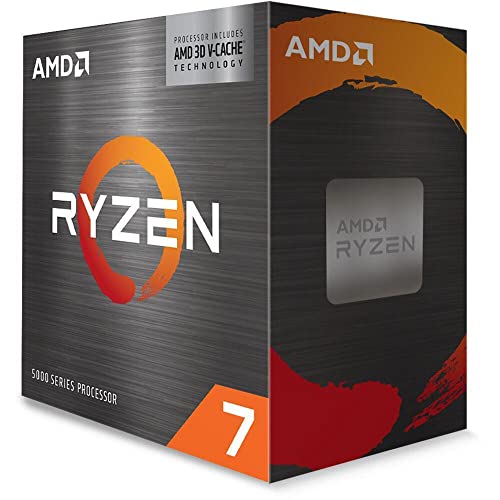
AMD Ryzen 7 5800X3D
8-core Zen 3 performance chip on the AM4 platform, for builds with a discrete GPU.
The original gaming X3D. Holds up surprisingly well at 1440p. Buy only if you already have an AM4 board — not worth a new platform.
Official India stock. Full warranty through the brand's India service network, standard RMA if anything goes wrong.
Full specs
Motherboards for AMD Ryzen 7 5800X3D
Coolers for 105W+
Where to buy AMD Ryzen 7 5800X3D in India
Expect to pay roughly ₹21,600-23,900 for the AMD Ryzen 7 5800X3D in India right now, depending on offers and seller. I always recommend buying from retailers that give a proper GST invoice - it's what makes your India warranty claim smooth later.
Affiliate links on linked vendors - your price stays the same. PrimeABGB shown for comparison only.
In my years running a PC store, PrimeABGB (Mumbai) and Vedant Computers (Kolkata) have also been consistently reliable for verified stock - compare before buying.
AMD Ryzen 7 5800X3D in India - The Endgame AM4 Gaming CPU
The Endgame AM4 Upgrade - And It Still Games Like a Champion
If you own a B450, B550, or X570 motherboard, the Ryzen 7 5800X3D is the single best CPU you can put in it. No contest. Eight Zen 3 cores, sixteen threads, and 96MB of 3D V-Cache stacked on top - the same technology that made the 7800X3D and 9800X3D the undisputed gaming kings. Except this one runs on AM4, uses your existing DDR4 RAM, and costs a fraction of what a full platform upgrade would set you back.
I have recommended this chip to dozens of builders in my community who were sitting on aging Ryzen 3600 or 2600 systems. The upgrade path is dead simple: update BIOS, swap the CPU, game. No new motherboard, no new RAM, no new cooler. Just a massive jump in gaming performance for ₹18,000-24,000 depending on whether you buy new or used.
At ₹22,000-26,000 new and ₹18,000-20,000 on the used market, this is the most cost-effective gaming upgrade available to anyone already on AM4. The 5800X3D does not care that it is running on a three-year-old B550 board with DDR4-3200. That enormous 96MB L3 cache compensates for everything, keeping frame rates shockingly close to chips that cost twice as much on newer platforms.
Gaming Performance - V-Cache Is the Great Equalizer
Here is what makes the 5800X3D special: that 96MB of 3D V-Cache feeds the CPU so much data so quickly that it papers over the architectural gap between Zen 3 and Zen 4/Zen 5. In gaming, where cache hits directly translate to frame rate, the 5800X3D consistently trades blows with the much newer 7800X3D. The gap is smaller than you would expect from a generational jump.
The numbers tell the story clearly. The 5800X3D lands within 8-12% of the 7800X3D in most titles, and in some games it matches or even beats it. Meanwhile, it absolutely destroys the Ryzen 5 5600 by 20-27% - that is what 3D V-Cache does for gaming workloads. For anyone upgrading from a non-V-Cache AM4 chip, the jump is enormous and immediately noticeable.
The catch? Productivity. In multi-threaded workloads like Blender, video rendering, or heavy compilation, the 5800X3D falls behind modern Zen 4 and Zen 5 chips by 15-25%. It has a single CCD, lower IPC than Zen 4, and you cannot overclock it - the V-Cache is voltage-sensitive, and AMD locked the multiplier. If you need a workstation CPU, this is not it. But for gaming, the V-Cache advantage dominates.
India Pricing and the Used Market Goldmine
The 5800X3D pricing in India has settled into a very attractive range as of May 2026:
New stock (limited availability): ₹22,000-26,000 from MDComputers, PrimeABGB, and Vedant Computers. Stock is spotty since AMD has wound down AM4 production. Amazon India occasionally lists it at ₹24,000-27,000 from third-party sellers - verify the seller is AMD-authorized before buying. Flipkart pricing is unreliable, often inflated by resellers.
Used market (where the real value is): ₹18,000-20,000 on OLX, Facebook Marketplace, and TechEnclave forums. This is where I point most AM4 upgraders. The 5800X3D has no overclocking headroom, which means used chips are running at the same clocks and voltages as new ones. A used 5800X3D is functionally identical to a new one. Check for bent pins, verify the chip with CPU-Z, and you are golden.
The math is brutal in the 5800X3D's favor. If you already own an AM4 system, a used 5800X3D gets you within striking distance of the 7800X3D for ₹19,000. Moving to AM5 with a 7800X3D costs ₹63,000 after motherboard and RAM. That extra ₹44,000 buys you roughly 10% more gaming performance. For most builders on a budget, that money is dramatically better spent on jumping from an RTX 4060 to an RTX 4070 Super - a move that delivers 50-60% more gaming performance at 1440p.
Who Should Buy the 5800X3D
Existing AM4 owners looking for a final upgrade. This is the primary audience. If you have a B450, B550, or X570 board with a Ryzen 3600, 3700X, 2600, or even a 5600, the 5800X3D is the best possible upgrade. In my builds, I have seen people go from 5600 to 5800X3D and gain 15-25% in CPU-limited titles instantly. From a 3600, the jump is even bigger - 30-40% in gaming.
Budget-conscious gamers building new AM4 systems. If your total build budget is ₹60,000-80,000, building around a used 5800X3D with a B550 board and DDR4 gets you elite-tier gaming performance without the AM5 tax. Pair it with an RTX 4060 or RX 7600 and you have a 1080p monster that punches well above its price class.
Anyone who games first and works second. The 5800X3D is a gaming specialist. It handles everyday tasks, light creative work, and coding without any issues. But if heavy multi-threaded productivity is part of your daily workflow, look elsewhere.
Who Should NOT Buy the 5800X3D
Builders with no existing AM4 hardware. If you are starting from scratch, buying into a dead-end platform makes less sense. The Ryzen 5 7600 on AM5 gives you a future upgrade path to 7800X3D or 9800X3D chips. The upfront cost is higher, but the platform has a future.
Content creators and productivity users. Single CCD, no overclocking, and older IPC make the 5800X3D weak in Blender, DaVinci Resolve, and heavy compilation. The Ryzen 5 7600 with its newer architecture and DDR5 bandwidth is actually faster in many productivity tasks despite having fewer marketing bullet points.
People who upgrade frequently. AM4 is done. There will never be another CPU for this socket. If you upgrade every 2-3 years, invest in AM5 now and enjoy the upgrade path.
The Ryzen 7 5800X3D is the greatest AM4 CPU ever made. If you own an AM4 motherboard and want the best gaming performance without rebuilding your entire system, this is the chip - no question. A used 5800X3D at ₹18,000-20,000 is one of the best value propositions in Indian PC gaming right now. It is a dead-end platform, but it is a glorious dead end.
Price we have actually seen
Up 1.8% since we started tracking. Every point is a price our crawler recorded at an Indian retailer - no estimates, no MSRP. Tracking began recently, so the window grows week by week.
Questions
For AM4 upgraders, absolutely. If you already own a B550 or X570 board, the 5800X3D is the most impactful single-component upgrade you can make. The gaming performance remains competitive with modern V-Cache chips, and the upgrade cost is a fraction of moving to a new platform. If you are building entirely from scratch, AM5 with a Ryzen 5 7600 is the smarter long-term play.
No. AMD locked the multiplier on the 5800X3D because the 3D V-Cache is sensitive to voltage. You cannot increase core clocks beyond the stock boost. You can enable PBO (Precision Boost Overdrive) with Curve Optimizer for a modest 2-4% improvement, but traditional overclocking is off the table. This is also why used chips are safe buys - nobody has been pushing dangerous voltages through them.
The 105W TDP is modest by modern standards. In Indian summer conditions (35-40C ambient), a Deepcool AK620 keeps it at 70-78C under sustained gaming load. Even the stock Wraith Stealth is technically functional, though I recommend against it in Indian ambient temperatures. A basic ₹2,000-3,000 tower cooler like the Deepcool AK400 or Thermalright Assassin X 120 is perfectly adequate. No AIO needed.
The 5800X3D dominates by 20-30% in most gaming benchmarks thanks to V-Cache. The i5-12400F is a solid budget chip, but it cannot compete with 96MB of L3 cache in gaming workloads. If gaming is your priority and you have an AM4 board, the 5800X3D is in a completely different league.