AMD Ryzen 7 5700X3D
8-core Zen 3 performance chip on the AM4 platform, for builds with a discrete GPU.
A practical final CPU upgrade for an existing AM4 gaming PC near ₹20,000-₹22,000. GetPC used only a few units, including builds on MSI B550 Tomahawk and Gigabyte X570 AORUS PRO WiFi boards. For a completely new PC, choose AM5 instead of buying a new AM4 platform.
Official India stock. Full warranty through the brand's India service network, standard RMA if anything goes wrong.
Full specs
Motherboards for AMD Ryzen 7 5700X3D
Coolers for 105W+
Where to buy AMD Ryzen 7 5700X3D in India
We consider roughly ₹20,000-₹22,000 a sensible Ryzen 7 5700X3D price for an existing AM4 upgrade. If you also need a new motherboard and memory, compare the complete cost of an AM5 platform before paying. Use the live table below for today's retailer prices.
Affiliate links on linked vendors - your price stays the same. PrimeABGB shown for comparison only.
In my years running a PC store, PrimeABGB (Mumbai) and Vedant Computers (Kolkata) have also been consistently reliable for verified stock - compare before buying.
Ryzen 7 5700X3D review: an AM4 upgrade, not a new-build CPU
A practical Ryzen 7 5700X3D review for India covering its ₹20,000 to ₹22,000 buying range, AM4 motherboard support, cooler requirements and why new PCs should move to AM5.
A strong final upgrade for AM4, but not where we would start a new PC
The Ryzen 7 5700X3D exists for a very specific buyer: someone who already owns a good AM4 motherboard, DDR4 memory and a gaming PC that needs more CPU performance. In that situation, it can extend the useful life of the entire system without forcing a motherboard and memory replacement.
We have used only a few of these processors. By the time the 5700X3D became relevant, most customers buying a completely new performance PC preferred AM5. Our recommendation reflects that difference instead of treating every buyer as if they have the same starting point.
Consider the Ryzen 7 5700X3D at roughly ₹20,000 to ₹22,000 when upgrading an existing AM4 gaming PC. If you are buying the motherboard and RAM as well, move to AM5. The processor is good; building a completely new system around its older platform is the weak decision.
Our practical buying range, not a live-stock promise
Reuse a capable board and DDR4 memory
A better foundation when starting from zero
The price only makes sense when AM4 parts are already owned
Search results make the Ryzen 7 5700X3D look like a normal CPU purchase. The real decision is the cost of the surrounding platform.
If you already have a suitable B550 or X570 motherboard and working DDR4 memory, the processor can be the only major component required. That is its strongest case. You keep the board, RAM, storage, cabinet and power supply while giving the gaming system a meaningful CPU upgrade.
If you are starting from nothing, the same ₹20,000 to ₹22,000 processor price must be added to a motherboard and memory purchase. At that point, spending on new AM4 parts locks a fresh build to an older platform. We would put that complete budget toward AM5 instead.
| Buying situation | Our recommendation |
|---|---|
| Existing strong AM4 board and DDR4 | Consider the 5700X3D at ₹20,000 to ₹22,000 |
| Existing entry-level AM4 board | Verify CPU support and board suitability before buying |
| Completely new gaming PC | Choose AM5 |
| New 5700X3D priced well above ₹22,000 | Compare the total cost of an AM5 platform |
| Used 5700X3D with no compelling platform saving | Skip it and move to AM5 |
Do not compare only the processor prices. Add the exact motherboard, memory and cooler required on both sides. Reusing AM4 parts is what creates the 5700X3D's value.
The live retailer table on this page shows current observed listings. Our ₹20,000 to ₹22,000 range is the price at which the processor made practical sense to us, not a statement that stock will always be available there.
The motherboards we used
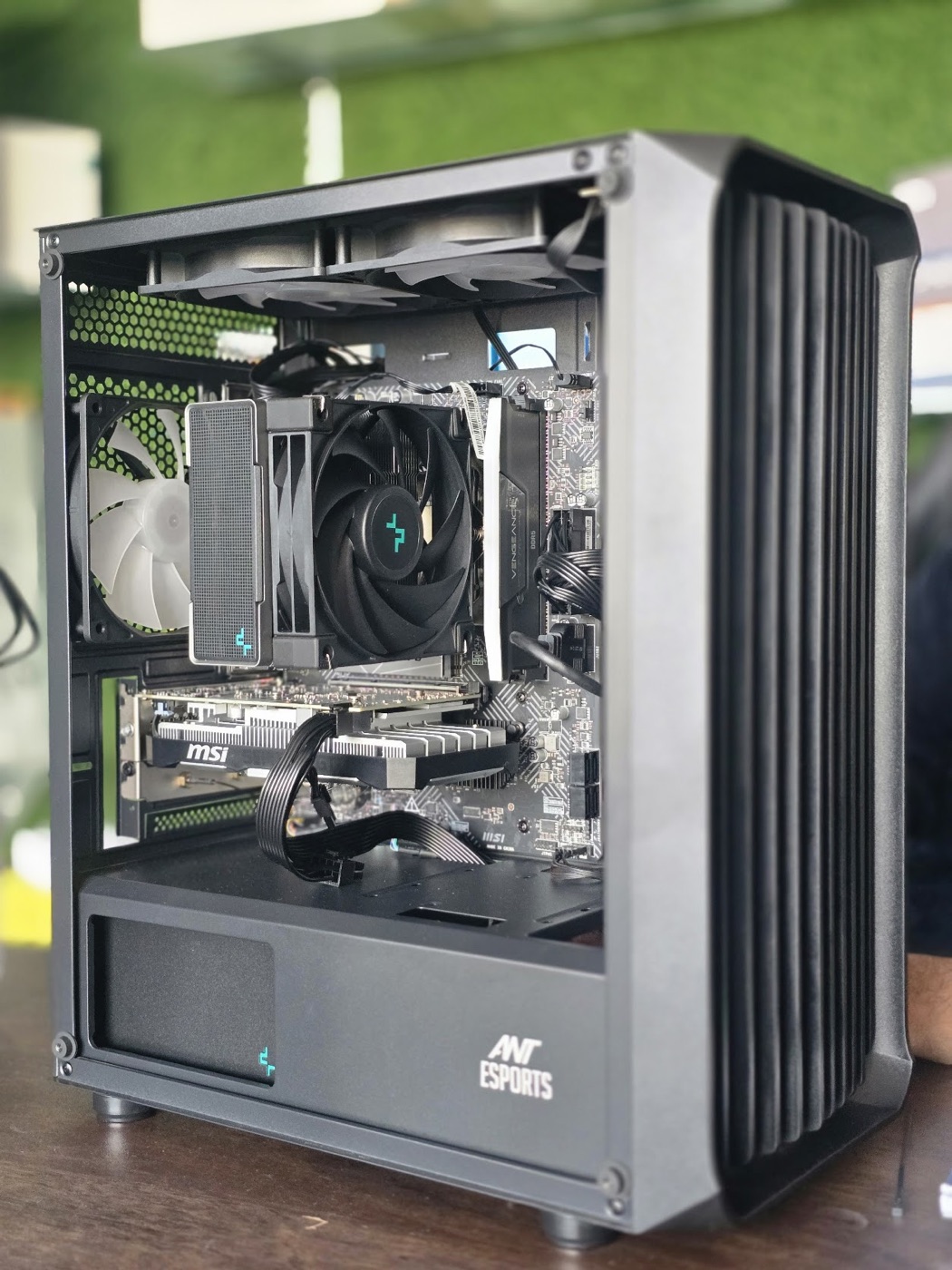
Our 5700X3D systems used higher-quality AM4 boards such as the MSI MAG B550 Tomahawk and Gigabyte X570 AORUS PRO WiFi. We did not encounter a recurring compatibility problem in those builds.
That does not mean every AM4 motherboard should be treated equally. The processor uses the AM4 socket, but the exact board model and BIOS version still matter. A board can physically accept the CPU while requiring a newer BIOS before it can boot.
Before buying the processor for an existing system:
- Note the complete motherboard model and revision.
- Open the manufacturer's CPU-support page.
- Find the Ryzen 7 5700X3D and its minimum BIOS version.
- Check the BIOS currently installed on the PC.
- Update the BIOS before removing the old CPU when that is the safer sequence.
The two boards we used are examples from our builds, not a requirement to buy those exact models. The point is to verify the board already owned instead of assuming that every B450, B550 or X570 unit behaves identically.
Cooling: AG400 is adequate, AK400 is the better everyday choice
AMD specifies the Ryzen 7 5700X3D at 105W default TDP, and the boxed processor does not include a cooler. The previous version of this article incorrectly described it as a 65W CPU. That has been corrected.
Our practical cooler guidance is workload-based:
| Workload | Cooling direction |
|---|---|
| Primarily gaming | DeepCool AG400 is adequate |
| Gaming plus regular mixed workloads | DeepCool AK400 is a stronger choice |
| Long editing or sustained processor-heavy work | Consider a suitable 240mm AIO |
The DeepCool AG400 can handle the processor for a gaming-focused build with reasonable cabinet airflow. We prefer the AK400 when the budget permits because it gives the system a better cooling foundation. For long editing sessions, a good 240mm liquid cooler can provide more sustained cooling headroom.
This is not a temperature benchmark. We did not record these customer systems under one controlled room temperature, cabinet, fan curve and workload, so publishing exact temperature claims would create false precision.
Where it sits between the Ryzen 5 5600 and Ryzen 7 5800X3D
From our practical perspective, the 5700X3D sits between the Ryzen 5 5600 and Ryzen 7 5800X3D. It is the more serious gaming upgrade than the 5600, while the 5800X3D remains the higher model within this AM4 X3D family.
That position does not mean every game gains the same amount or that one fixed percentage can describe the processor. Game engine, graphics card, resolution and settings all change how much CPU performance is visible. We have removed the old site's unsupported relative-performance graphic for that reason.
The buying logic is more useful than an invented universal percentage:
- Keep the Ryzen 5 5600 when its performance is already sufficient for the graphics card and games being used.
- Choose the 5700X3D when an existing AM4 gaming system genuinely needs a final CPU upgrade.
- Consider the 5800X3D only when its real purchase price is close enough to justify it.
- Choose AM5 when building a new system or replacing the motherboard and RAM anyway.
Is the Ryzen 7 5700X3D good for editing?
It has 8 cores and 16 threads, so it can run editing and productivity workloads. However, gaming is the clearer reason to buy it. The additional cache is central to the X3D proposition, while a new editing-focused system should be compared against newer processors and platforms as a complete package.
If the PC will spend long periods rendering or exporting, budget for cooling accordingly. We would use an AK400-class tower cooler or consider a suitable 240mm AIO rather than treating a basic cooler as an afterthought.
For a customer purchasing every component today, we would still choose AM5. A processor can be usable for editing without being the best foundation for a brand-new editing workstation.
Should you buy a used 5700X3D?
We would not chase a used 5700X3D simply because it is cheaper than a new one. If the total platform decision is still open, putting that money toward a new AM5 build is the better direction.
A used unit can only become interesting when all three conditions are true:
- You already own a compatible AM4 motherboard and DDR4 memory.
- The processor is tested, physically clean and meaningfully cheaper than new stock.
- The saving is large enough that an AM5 platform replacement does not make more sense.
AM4 processors have exposed pins. Inspect them under good light for bends, missing pins or thermal paste contamination. Verify that the system recognises all cores and memory, then test stability under sustained load. Do not assign value to remaining warranty without a valid invoice and matching product details.
Official specifications that matter
AMD lists the Ryzen 7 5700X3D as an 8-core, 16-thread Zen 3 desktop processor with a 3.0GHz base clock, boost up to 4.1GHz, 96MB L3 cache and 105W default TDP. It uses socket AM4, supports DDR4 memory and requires a discrete graphics card.
The processor has no integrated graphics. A motherboard video output will not provide a display unless another graphics device is present. It also does not include a boxed cooler, so cooling cost belongs in the purchase calculation.
You can confirm the specifications on AMD's official Ryzen 7 5700X3D page.
Our final recommendation
The Ryzen 7 5700X3D is not a bad processor. It is a specialised final upgrade for a platform many buyers already own.
Buy it when you have a capable AM4 motherboard, DDR4 memory and a gaming workload that can justify the upgrade. Aim for roughly ₹20,000 to ₹22,000, verify the motherboard BIOS first and include a proper cooler in the budget.
Do not choose it for a completely new PC merely because AM4 parts appear cheaper individually. Price the whole platform. If the motherboard and RAM must also be purchased, our recommendation is AM5.
Price we have actually seen
Down 0.0% since we started tracking. Every point is a price our crawler recorded at an Indian retailer - no estimates, no MSRP. Tracking began recently, so the window grows week by week.
Questions
Our practical buying range is approximately ₹20,000 to ₹22,000. This makes the most sense when you already own a suitable AM4 motherboard and DDR4 memory. Check the live retailer table on this page for current listings.
It is an AM4 processor and uses DDR4 memory. It does not work in an AM5 motherboard.
No. AMD specifies that a discrete graphics card is required.
No. Budget for a separate CPU cooler. We consider the DeepCool AG400 adequate for gaming, prefer the AK400 as a stronger everyday choice, and consider a suitable 240mm AIO for long editing workloads.
Many boards support it with the correct BIOS, but support must be checked for the exact motherboard model and revision. Do not assume socket compatibility guarantees that the installed BIOS can boot the processor.
The 5700X3D sits below the 5800X3D in the AM4 X3D range. Compare their actual prices rather than paying a large premium for the higher model. For a new platform, compare both against an AM5 build.
No, that is not our recommendation in 2026. It is most attractive as an upgrade that reuses an existing AM4 motherboard and DDR4. For a complete new build, AM5 is the better direction.
Usually not if you are free to build on AM5. A used unit only becomes compelling for an existing AM4 owner when it is tested and meaningfully cheaper than new stock.