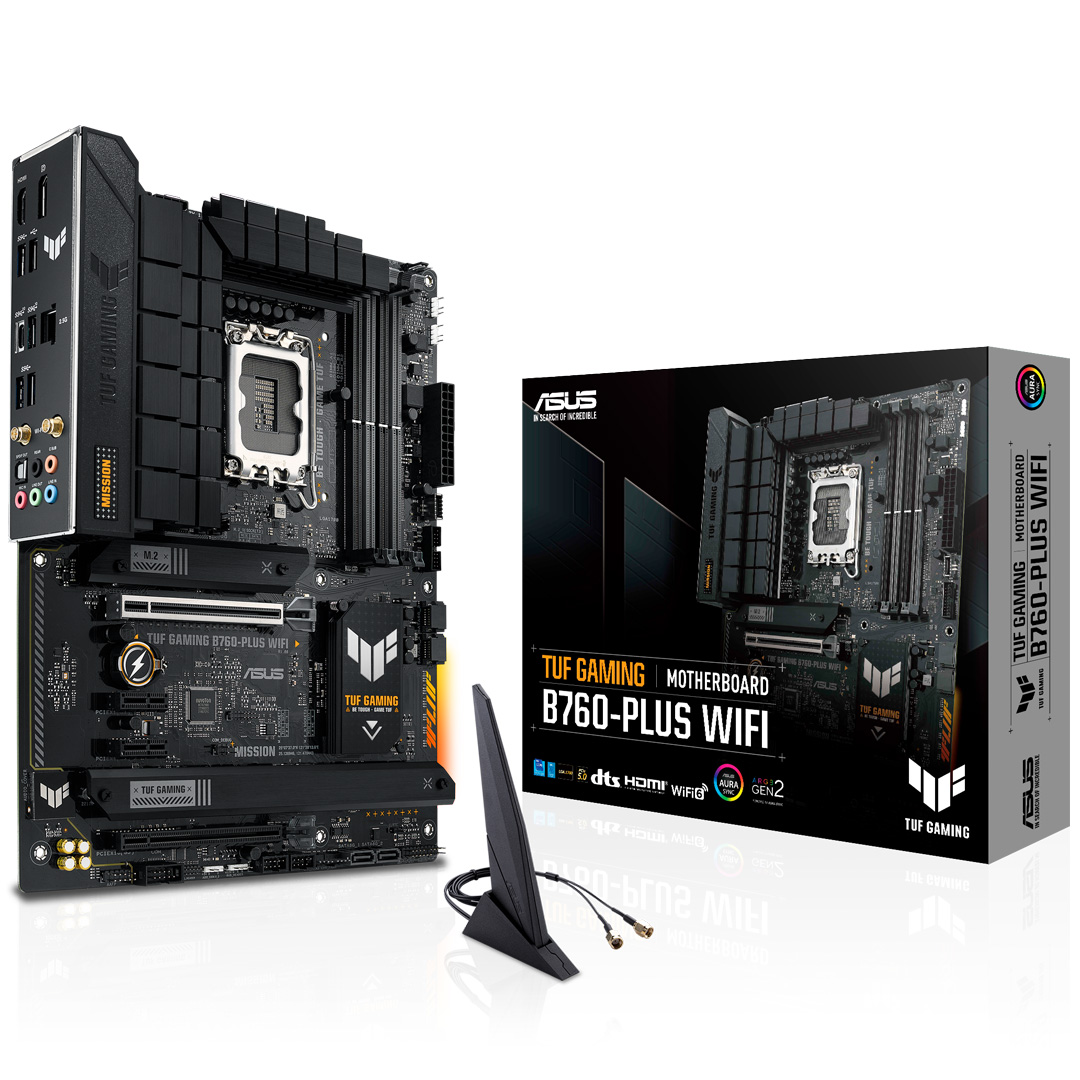
ASUS TUF Gaming B760-Plus WiFi
ATX B760 board for LGA1700 CPUs, DDR5 memory, BIOS Flashback included.
Solid Intel DDR5 mid-range. Good VRMs for i5/i7. WiFi 6 included. 3 M.2 slots.
Official India stock. Full warranty through the brand's India service network, standard RMA if anything goes wrong.
Full specs
DDR5 memory kits
Where to buy ASUS TUF Gaming B760-Plus WiFi in India
Expect to pay roughly ₹18,200-20,100 for the ASUS TUF Gaming B760-Plus WiFi in India right now, depending on offers and seller. I always recommend buying from retailers that give a proper GST invoice - it's what makes your India warranty claim smooth later.
Affiliate links on linked vendors - your price stays the same. PrimeABGB shown for comparison only.
In my years running a PC store, PrimeABGB (Mumbai) and Vedant Computers (Kolkata) have also been consistently reliable for verified stock - compare before buying.
ASUS TUF Gaming B760-Plus WiFi India - Intel's Mid-Range AM5 Foundation at {{price}}
ASUS TUF Gaming B760-Plus WiFi: Solid LGA1700 DDR5 Platform at ₹19,000
The ASUS TUF Gaming B760-Plus WiFi is an ATX LGA1700 motherboard supporting DDR5, WiFi 6, and Intel 12th/13th gen CPUs. At ₹19,000 in India, it offers a complete Intel platform with modern connectivity - PCIe 5.0 x16 for future GPUs, WiFi 6 built-in, 2.5G LAN, and ASUS's TUF durability standards.
Best paired with: i5-13600KF, i5-13400F, i7-13700KF for a complete DDR5 Intel gaming or workstation build. Note: LGA1700 is a closed platform - no future Intel CPUs will use this socket.
DDR5 note: This board requires DDR5. DDR5 prices have normalized significantly - 16GB DDR5-5600 kits are now available around ₹9,000-10,000, comparable to DDR4.
What you get: 2x M.2 slots (one PCIe 4.0, one PCIe 3.0), USB 3.2 Gen 2x2 front header, WiFi 6, 2.5G Realtek LAN, comprehensive rear I/O. Not a budget board - a solid mid-range foundation.
VRM and CPU Compatibility
Great match: i5-13400F, i5-13600KF, i5-12400F - 65-125W CPUs the B760 VRM handles comfortably.
Works but not ideal: i7-13700KF, i7-13700K - 16-core CPUs push VRM limits under sustained all-core load. Use a quality cooler and enable Intel Baseline Profile for stable operation.
Avoid: i9-13900K/KS - these 24-core CPUs need Z790 boards with stronger VRM for stable operation.
Price we have actually seen
No change while tracked. Every point is a price our crawler recorded at an Indian retailer - no estimates, no MSRP. Tracking began recently, so the window grows week by week.
Questions
Only if you plan to overclock your CPU (B760 locks the multiplier). For stock operation, B760 is fully capable and costs ₹8,000-12,000 less than Z790. The performance difference at stock speeds is zero.
Yes. LGA1700 is compatible across 12th (Alder Lake) and 13th (Raptor Lake) gen Intel CPUs. Check ASUS's QVL list for specific CPU compatibility and BIOS requirements.
For most home setups, the real-world difference is minimal unless you have a WiFi 6 router. WiFi 6 offers better performance in congested environments with many devices. If your router is WiFi 5, the benefit is theoretical rather than practical.