
AMD Ryzen 7 7700
8-core Zen 4 efficient chip on the AM5 platform, with usable integrated graphics.
Efficient 8-core AM5 option. Best near ₹28K; compare the Ryzen 7 7800X3D for a gaming-first build above ₹33K.
Official India stock. Full warranty through the brand's India service network, standard RMA if anything goes wrong.
Full specs
Motherboards for AMD Ryzen 7 7700
Coolers for 65W+
Where to buy AMD Ryzen 7 7700 in India
Expect to pay roughly ₹26,900-29,700 for the AMD Ryzen 7 7700 in India right now, depending on offers and seller. I always recommend buying from retailers that give a proper GST invoice - it's what makes your India warranty claim smooth later.
Affiliate links on linked vendors - your price stays the same. PrimeABGB shown for comparison only.
In my years running a PC store, PrimeABGB (Mumbai) and Vedant Computers (Kolkata) have also been consistently reliable for verified stock - compare before buying.
Ryzen 7 7700 Price in India (2026): Buy It or Move Up?
Ryzen 7 7700 India price and buying advice from GetPC builds. See the ₹28K target, ₹33K limit, cooler choice, B650 fit and 7800X3D comparison.
Buy the Ryzen 7 7700 for efficiency, not as the default high-end gaming CPU
The Ryzen 7 7700 is an efficient 8-core AM5 processor that makes sense near ₹28,000. GetPC's stop-and-compare point is above ₹33,000. For a gaming-focused build, move to the Ryzen 7 7800X3D if the complete budget allows. Choose the 7700 when you specifically value lower power, easier cooling and eight general-purpose cores. The 7700X is not a large enough upgrade to justify an automatic switch.
The Ryzen 7 7700 is a calm, capable AM5 option rather than the fastest gaming choice. Pair it with a good B650 board and an AG400, AK400 or suitable 240mm AIO. Check the 7800X3D before paying premium money for the 7700.
This is where the efficiency and included cooler create a useful package.
Check the 7800X3D, 7700X and newer alternatives.
Strong general use without choosing a high-power part.
GetPC has built fewer Ryzen 7 7700 systems than mainstream Ryzen 5 machines. The pattern we did see was clear: customers used a B650M Gaming WiFi-class motherboard and paired the CPU with GPUs such as the RTX 5060, RTX 5060 Ti or RTX 5070. These were primarily gaming systems, even though eight cores also provide useful headroom outside games.
The recommendation is intentionally narrower than the old page. The previous article positioned the 7700 as the obvious mixed-workload sweet spot and published precise performance figures that GetPC had not measured in a controlled retained test. This version separates verified specifications, shop experience and buying judgement.
Around ₹28,000 is sensible; above ₹33,000 needs another comparison
India pricing can look inconsistent because stock moves between specialists and marketplaces. One listing may be a genuine boxed processor with the Wraith Prism cooler and a GST invoice. Another may be sold out, an old search result, a tray unit or a marketplace offer priced far above normal specialist-store stock.
GetPC's practical target is approximately ₹28,000. That aligns with the useful part of recent tracked specialist-retailer history. It does not promise that every retailer will have stock at that figure today. Use the live table on this page, open the actual listing, and confirm the final checkout total.
Above ₹33,000, the 7700 loses much of its quiet-value argument. The buyer should compare the Ryzen 7 7700X, the Ryzen 7 7800X3D and any current-generation alternatives available at the same time. Compare complete platform cost, including cooler where necessary, rather than looking at the CPU line alone.
GetPC's Ryzen 7 7700 buying rule
Check PrimeABGB, Vedant, MDComputers and other tracked sellers through the live retailer table. Verify stock, boxed versus tray status, cooler inclusion, invoice and Indian warranty before paying.
Retailer-specific searches can be useful, but they are not a substitute for availability. A ₹28,000 sold-out page is not a purchasable deal. A higher in-stock listing should still be compared with every nearby CPU before checkout.
B650M Gaming WiFi with RTX 5060 to RTX 5070 graphics
The Ryzen 7 7700 appeared in gaming-first systems with a B650M Gaming WiFi-class board. “Class” matters because several manufacturers use similar names. Check the exact model for VRM design, M.2 layout, rear I/O, wireless module, BIOS flashback and memory support instead of buying from two words in the product title.
GPU pairings ranged from RTX 5060 through RTX 5060 Ti to RTX 5070. The right card depends on monitor resolution, refresh rate, games and graphics settings. A faster CPU does not compensate for an underpowered GPU, and an expensive GPU does not make every game immune to CPU limits.
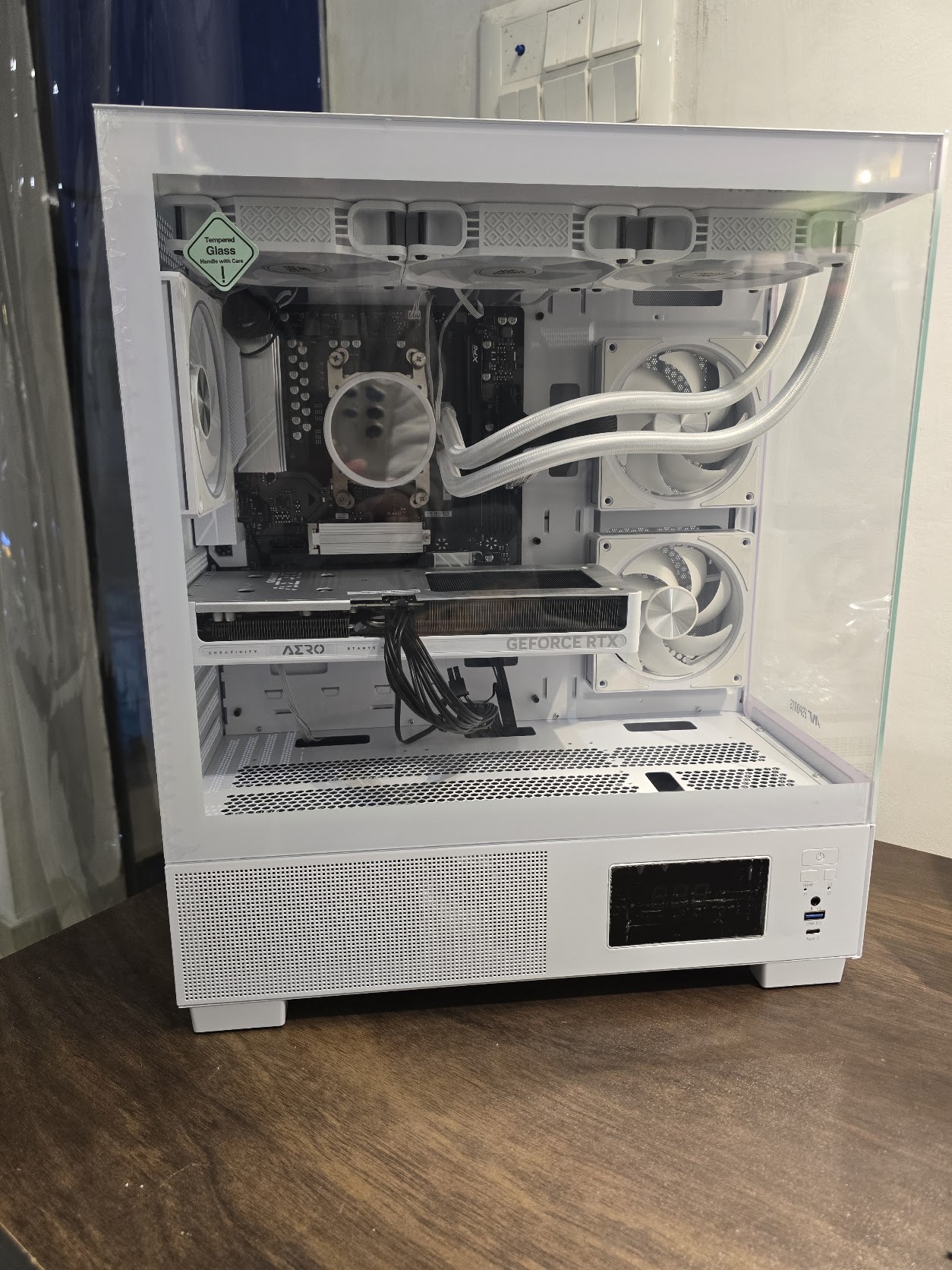
The attached build also shows why a part page should not pretend there is one mandatory aesthetic. A white case, vertically prominent graphics card and liquid cooler can be a valid customer choice, but the processor works equally well in a restrained air-cooled system. Appearance should not override airflow, radiator placement, GPU clearance or serviceability.
Eight Zen 4 cores, 65W default TDP and integrated Radeon graphics
AMD specifies the Ryzen 7 7700 as an 8-core, 16-thread Zen 4 desktop processor with a 3.8GHz base clock and boost up to 5.3GHz. It has 32MB of L3 cache, a 65W default TDP, AM5 socket support and a maximum operating temperature of 95°C.
The processor supports DDR5 memory across two channels. AMD's official specification lists DDR5-5200 for common two-DIMM configurations, with lower official speeds for four-DIMM layouts. Memory overclocking profiles can operate beyond the official rate, but success depends on the CPU memory controller, board, BIOS, module kit and capacity. Do not promise one speed for every four-stick installation.
AMD lists PCIe 5.0 capability and 24 usable native CPU lanes. That does not mean every B650 motherboard exposes every slot at Gen5. Board design determines which graphics and M.2 slots run at which generation and how lanes are shared. Read the exact motherboard manual before buying a Gen5 SSD or add-in card.
Unlike the Ryzen 5 5500, the Ryzen 7 7700 includes basic integrated Radeon graphics. It is useful for display output and troubleshooting. It is not a replacement for the RTX 5060-class gaming GPU in the builds discussed here.
The included Wraith Prism works, but a modest aftermarket cooler is the cleaner build
AMD includes the Wraith Prism with boxed Ryzen 7 7700 processors. That means a genuine retail box can boot and operate without an immediate cooler purchase. It is a useful fallback and part of the total value comparison against CPUs sold without a cooler.
GetPC would still normally choose an AG400 or AK400-class tower cooler for this CPU. The goal is not to solve an imaginary 65W emergency. A larger heatsink can reduce fan speed and noise during sustained use, while providing more margin in a warm room or compact cabinet.
A 240mm AIO is also acceptable when the build design, radiator placement or customer preference justifies it. It is not compulsory for stock operation. Check pump and fan warranty, mounting support, tube routing and radiator clearance. Spending heavily on cooling while compromising the GPU or power supply is the wrong trade.
AG400 or AK400-class air cooler
Enough for a sensible Ryzen 7 7700 build with straightforward maintenance and good noise control.
240mm AIO
Use it when the case and aesthetic call for liquid cooling, not because the processor requires it to function.
The X model is not a major upgrade
Both processors use eight Zen 4 cores and the AM5 platform. The 7700X runs higher clocks and has a higher default power target, while the 7700 focuses on efficiency and includes a boxed cooler. Real performance difference depends on workload, cooling and configured power limits, so a small model-name change should not command a large premium.
Choose the 7700 when you want lower stock power, simpler cooling and the included Wraith Prism as a backup or initial solution. Choose the 7700X only when its live price is equal or better after accounting for the cooler, or when its modest extra performance specifically matters to the workload.
Ryzen 7 7700
- Default TDP
- 65W
- Box cooler
- Wraith Prism
- Best reason
- Lower-power 8-core build
- GetPC view
- Preferred when value is close
Ryzen 7 7700X
- Default TDP
- 105W
- Box cooler
- Not included
- Best reason
- Small extra CPU performance
- GetPC view
- Buy only at the right price
Gaming buyers should check the 7800X3D before checkout
The Ryzen 7 7800X3D is the gaming-focused alternative. Its 3D V-Cache design targets workloads that benefit from a much larger last-level cache. If the PC is mainly for gaming and the higher complete-build cost fits, GetPC would move up to the 7800X3D.
The Ryzen 7 7700 remains relevant when power, cooling, price or broader all-round behaviour matters more than buying the gaming-specialist chip. It also includes a cooler and has basic integrated graphics for troubleshooting. Those benefits do not make it faster for gaming; they make it a different package.
Do not fund the CPU upgrade by damaging the rest of the build. A 7800X3D paired with a much weaker GPU can be the worse gaming system at the intended resolution. Compare CPU, cooler and GPU together.
Ryzen 7 7700
- Best fit
- Cooler, lower-power 8-core PC
- Graphics
- Basic iGPU included
- Cooler
- Wraith Prism included
- Price target
- About ₹28,000
Ryzen 7 7800X3D
- Best fit
- Higher-end gaming
- Key feature
- 3D V-Cache
- Budget test
- Keep the intended GPU
- Decision
- Move up if affordable
RTX 5060, RTX 5060 Ti and RTX 5070 all fit different display targets
An RTX 5060 pairing can create a capable mainstream gaming build, but the eight-core CPU may leave more processor headroom than the GPU needs in many games. That is not harmful; it simply means a cheaper CPU could also be considered if it releases enough money for a better graphics card.
The RTX 5060 Ti is the middle pairing GetPC used, including the attached 16GB Aero build. Check the exact 8GB or 16GB model, card dimensions, power connector and price. The suffix matters more than the shared “5060 Ti” name.
The RTX 5070 is the stronger graphics pairing and makes the CPU choice easier to justify in a higher-budget gaming system. Resolution and refresh target still decide the value. Do not purchase a high-end card for a display and game library that cannot use it.
RTX 5060 Ti or RTX 5070
Useful pairings when the monitor and game settings can use the stronger GPU.
RTX 5060
A valid pairing, but compare a less expensive CPU if that change can fund a meaningful GPU upgrade.
Update carefully, then verify the system at stock settings
GetPC did not encounter a recurring Ryzen 7 7700 defect pattern. BIOS preparation remains normal AM5 build hygiene. Check the board's CPU support list and revision before assembly. A later BIOS can improve memory compatibility or platform behaviour, but an update should be done from stable power with the exact file and manufacturer procedure.
After the first successful boot, load appropriate defaults and confirm the processor, total memory and storage are detected. Then enable the intended EXPO profile if the memory kit, board and CPU support it. Test stability before changing curve optimizer, power limits or other tuning controls.
Four DDR5 modules are harder on the memory controller than two. AMD's official supported speed drops in four-DIMM configurations. If high capacity is required, a two-module kit at the required total capacity is often the cleaner plan. Do not combine unrelated kits and assume the advertised one-kit speed will remain stable.
If there is no display, use the processor's integrated graphics as a diagnostic path when the board provides an output. Reseat memory, check CPU and motherboard power, clear CMOS when appropriate, and verify that the display is connected to the output currently being tested.
Buy the Ryzen 7 7700 new
GetPC's preference is a new boxed Ryzen 7 7700. The processor is valuable enough that the invoice, defined warranty path and included cooler are worth preserving. A small used discount does not compensate for unknown handling, missing accessories or an unclear seller.
If a used offer is unusually strong, inspect the AM5 contact pads for contamination or damage, check the motherboard socket separately for bent pins, verify all cores and memory channels, and run sustained stability tests. AM5 places the delicate pins in the motherboard socket, so inspect both parts rather than looking only at the CPU.
Do not value a used bundle from the CPU name alone. Test the board's RAM slots, M.2 slots, Wi-Fi, Ethernet, USB and audio. Confirm BIOS access and serial details. A return window and original invoice are more valuable than a seller's claim that the system was “hardly used.”
You want an efficient eight-core AM5 system
- The CPU costs around ₹28,000
- Lower power and easier cooling are priorities
- Your gaming build uses an RTX 5060 to RTX 5070-class GPU
- A verified B650 board provides the features you need
- The 7800X3D upgrade would damage the rest of the budget
The asking price enters a better tier
- The price exceeds roughly ₹33,000
- You are mainly gaming and can afford the 7800X3D
- A cheaper CPU would fund a meaningfully stronger GPU
- The seller cannot confirm boxed status, invoice or warranty
- You are buying a used unit without testing or recourse
At about ₹28,000, the Ryzen 7 7700 is an efficient and easy-to-cool eight-core AM5 processor. Above ₹33,000, compare aggressively. Gaming buyers should move to the 7800X3D when the complete build allows; everyone else should buy the 7700 for its lower-power package, not because the name sits between two other Ryzen 7 models.
Compare: Ryzen 7 7700X | Ryzen 7 7800X3D | RTX 5060 Ti 16GB | RTX 5070 12GB. Guides: PSU Quality in India | Where to Buy PC Parts.
Price we have actually seen
Down 0.0% since we started tracking. Every point is a price our crawler recorded at an Indian retailer - no estimates, no MSRP. Tracking began recently, so the window grows week by week.
Questions
GetPC considers approximately ₹28,000 a good target. Above ₹33,000, compare the Ryzen 7 7700X, Ryzen 7 7800X3D and newer alternatives. Use the live retailer table for today's observed prices and stock.
Yes. GetPC paired it with RTX 5060, RTX 5060 Ti and RTX 5070-class GPUs. For a mainly gaming build, check whether the 7800X3D fits without forcing a weaker graphics card.
A suitable B650 motherboard is the practical starting point. GetPC used B650M Gaming WiFi-class boards. Verify the exact model's CPU support, BIOS flashback, memory support, M.2 layout, rear I/O and wireless hardware.
AMD lists the Wraith Prism with boxed Ryzen 7 7700 processors. GetPC still prefers an AG400 or AK400-class tower cooler for lower noise and better sustained margin. A 240mm AIO is optional, not mandatory.
The 7700X is not a huge upgrade. Compare CPU price plus cooler cost. Choose the 7700 for lower stock power and the included cooler; choose the 7700X only when its total price or specific workload performance makes sense.
For a higher-budget gaming-first system, GetPC prefers the 7800X3D if the complete build can afford it. Choose the 7700 when lower power, easier cooling or preserving the GPU budget matters more.
Yes. AMD lists two integrated Radeon graphics cores. They are useful for display output and troubleshooting, but they do not replace a dedicated gaming GPU.
AMD officially lists DDR5-5200 for common two-DIMM configurations and lower supported rates with four DIMMs. Faster EXPO settings are overclocking and depend on the CPU, board, BIOS, kit and capacity.
It depends on the exact motherboard and installed firmware. Check the CPU support list and board revision. Update with stable power and the manufacturer's procedure, then test at stock settings before enabling memory profiles or tuning.
GetPC prefers a new boxed unit for the invoice, warranty path and included cooler. Consider used only when the discount is substantial and the CPU, motherboard socket, memory channels and full system pass inspection and stress testing.