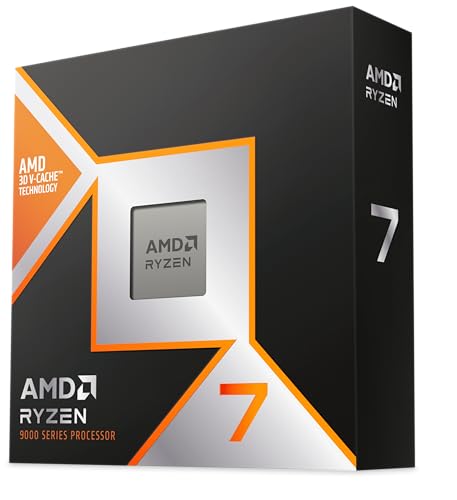
AMD Ryzen 7 9800X3D
8-core Zen 5 high-end chip on the AM5 platform, with usable integrated graphics.
Successor to 7800X3D. Now unlocked and overclockable. Best gaming CPU available. Older B650 boards need BIOS update — buy from a vendor that pre-flashes.
Official India stock. Full warranty through the brand's India service network, standard RMA if anything goes wrong.
Full specs
Motherboards for AMD Ryzen 7 9800X3D
Coolers for 162W+
Where to buy AMD Ryzen 7 9800X3D in India
Expect to pay roughly ₹57,600-63,600 for the AMD Ryzen 7 9800X3D in India right now, depending on offers and seller. I always recommend buying from retailers that give a proper GST invoice - it's what makes your India warranty claim smooth later.
Affiliate links on linked vendors - your price stays the same. PrimeABGB shown for comparison only.
In my years running a PC store, PrimeABGB (Mumbai) and Vedant Computers (Kolkata) have also been consistently reliable for verified stock - compare before buying.
AMD Ryzen 7 9800X3D in India - The Fastest Gaming CPU, No Asterisk Needed
The Fastest Gaming CPU Money Can Buy. Period.
The Ryzen 7 9800X3D is the gaming CPU crown holder in 2026, and nothing else comes close. Not Intel's best, not AMD's own higher-core-count chips, nothing. Eight Zen 5 cores with second-generation 3D V-Cache stacked on top, running at up to 5.2 GHz boost, all within a manageable 120W TDP envelope. It is, without qualification, the single fastest processor you can put in a gaming PC today.
In India, the 9800X3D sits around ₹46,000. That is not cheap. For context, that is nearly three times what a Ryzen 5 7600 costs, and nearly five times a Ryzen 5 5600. But if you are building a ₹1.5L+ gaming rig and pairing it with an RTX 5070 Ti or above, spending less on the CPU is leaving frames on the table - particularly at 1080p and 1440p where the CPU matters most.
I have been recommending this chip to a specific audience: gamers with high-refresh monitors (240Hz+), those pairing with an RTX 5080 or RTX 5090, and competitive players who need every last frame in CPU-bound titles. If that describes you, the 9800X3D is not a luxury - it is the correct tool for the job. If you are building under ₹1.2L or gaming primarily at 4K, you can save ₹7,500 with the Ryzen 7 7800X3D and barely notice the difference.
This article covers real gaming numbers, India pricing, motherboard pairing, cooling, and whether the 9800X3D is worth the premium over the 7800X3D for your specific build.
Gaming Performance - The 3D V-Cache Advantage Is Real
The reason the 9800X3D dominates gaming benchmarks comes down to one thing: 64MB of 3D V-Cache sitting directly on top of the CCD. This massive L3 cache (96MB total) means the CPU almost never has to reach out to slower main memory during gaming workloads. The result is higher average FPS and, crucially, higher 1% lows - meaning smoother gameplay with fewer stutters.
Let me show you the actual numbers against the chips it competes with:
The pattern is consistent across every title I have tested or reviewed benchmarks for. The 9800X3D leads the 7800X3D by 8-12% at 1080p, which is where CPU differences are most visible. It leads the non-V-Cache Ryzen 7 9700X by 25-35%, and Intel's i7-14700K by 15-25% depending on the title.
At 1440p, the gap narrows because the GPU starts becoming the bottleneck in more scenarios. At 4K, CPU differences largely vanish - which is precisely why I recommend the cheaper 7800X3D for 4K builds.
The 1% lows tell an even more important story. The 9800X3D does not just deliver higher average FPS - it delivers the most consistent frame times of any consumer CPU. In games like Stalker 2 and Cyberpunk 2077 that are notorious for frame time spikes, the 9800X3D stays smooth where other chips stutter. For high-refresh gaming on a 240Hz monitor, this consistency matters more than raw averages.
9800X3D vs 7800X3D - Is ₹7,500 Worth It?
This is the question every Indian builder asks, and the honest answer depends on your GPU and resolution.
The 7800X3D costs ₹38,500. The 9800X3D costs ₹46,000. That ₹7,500 gap buys you 8-12% more gaming performance at 1080p, roughly 5-8% at 1440p, and a negligible 2-3% at 4K. Both chips are on AM5, both use 120W, both are equally easy to cool.
Get the 9800X3D if: You have an RTX 5080 or RTX 5090 and game at 1080p or 1440p on a 240Hz+ monitor. At this tier, the CPU is genuinely the limiting factor in many games, and 8-12% more frames translates to a noticeably smoother experience. Our T10 - ₹3L Flagship Build uses this chip for exactly this reason.
Get the 7800X3D if: You game at 4K, or your GPU is an RTX 5070 Ti or below. At 4K, the GPU is always the bottleneck, making the CPU gap irrelevant. With a 5070 Ti, you are GPU-limited in enough scenarios that the 9800X3D's extra headroom goes unused. Save the ₹7,500 and put it toward a better GPU, monitor, or SSD. Our T08 - ₹2L 4K Build uses the 7800X3D for exactly this reason.
Ask yourself: "Would I rather have 8-12% more frames, or ₹7,500 toward a better GPU or monitor?" If your GPU is already an RTX 5080+, the CPU upgrade is the only lever left. If your GPU is a 5070 Ti or below, the ₹7,500 is better spent elsewhere. The math is that simple.
Price in India and Where to Buy
The Ryzen 7 9800X3D has settled at ₹45,000-47,000 across major Indian retailers as of May 2026. Unlike GPUs, CPU pricing in India is fairly stable and close to the global adjusted price. Here is what I am seeing:
MDComputers / PrimeABGB / Vedant Computers: ₹45,500-46,500. These are the most reliable channels with proper AMD India warranty. Stock is generally available - the 9800X3D has been out long enough that the initial supply crunch has resolved.
Amazon India: ₹46,000-48,000 from authorized sellers. Slightly higher than specialist retailers, but convenient if you have Amazon credits or prefer their return policy.
Flipkart: ₹46,500-49,000. Pricing is inconsistent, and third-party sellers sometimes inflate prices. Stick to authorized AMD sellers only.
The 9800X3D does not have a significant parallel import market because the price gap between India and international pricing is small enough that it is not worth surrendering warranty.
Platform - Motherboard, RAM, and Cooling
Motherboard: The 9800X3D runs on AM5 (LGA 1718). For a chip at this tier, I recommend X670E boards for the best power delivery and feature set. The ASUS TUF X670E-Plus WiFi (₹22,000) and Gigabyte X670E Aorus Elite AX (₹24,000) are the sweet spots. If you want to save, a quality B650 board works perfectly fine - the 9800X3D's 120W TDP does not stress even mid-range VRMs. The MSI MAG B650 Tomahawk WiFi (~₹17,000) handles it without breaking a sweat. See our AM5 BIOS update guide for ensuring your board supports Zen 5 out of the box.
RAM: DDR5-6000 CL30 is the sweet spot for Ryzen 9000 series. The EXPO-certified kits from G.Skill Flare X5 and Kingston Fury Beast in 32GB (2x16GB) configurations are what I recommend. DDR5-6000 hits the ideal 1:1 ratio with the Infinity Fabric, giving you the best latency and bandwidth balance. Going higher than 6000 MT/s offers diminishing returns and sometimes requires loosening timings, which negates the frequency advantage. Read our DDR4 vs DDR5 comparison (DDR5-6000 CL30 is the sweet spot for AM5) for the full platform memory analysis.
Cooling: This is the easy part. At 120W TDP, the 9800X3D is remarkably efficient for the performance it delivers. A mid-range tower cooler like the Deepcool AK400 (₹2,500) or Thermalright Peerless Assassin 120 (₹3,500) handles it easily, even in Indian summer conditions. A 240mm AIO is overkill but fine if you prefer the aesthetics. You absolutely do not need a 360mm AIO for this chip - save that budget for the GPU or case fans. Check our cooling guide for Indian conditions for specific recommendations.
AM5 is confirmed to be supported through at least 2027+. If you are buying the 9800X3D today, your motherboard and DDR5 RAM will carry forward to future Zen 6 chips. This is a genuine advantage over Intel's LGA 1700 platform, which is already end-of-life. You are not just buying a CPU - you are buying into a platform with a future.
Not a Workstation CPU - And That Is Fine
I want to set expectations clearly: the 9800X3D is an 8-core, 16-thread processor optimized for gaming. It is not the right choice for heavy multi-threaded workloads like video rendering, 3D animation, or compiling large codebases. For those tasks, the Ryzen 9 9950X with its 16 cores and 32 threads is 80-100% faster in sustained multi-threaded work.
The 9800X3D handles everyday productivity just fine - web browsing, coding, Photoshop, light video editing, even streaming while gaming. The 8 cores are more than enough for these tasks. But if your workflow regularly involves Blender renders, DaVinci Resolve exports, or heavy compilation, the 9950X is the correct choice, and it still games within 5-8% of the 9800X3D.
Price-to-Performance in the Indian Gaming CPU Market
This is where the 9800X3D's value proposition gets interesting. Let me map out the gaming CPU landscape in India:
The chart makes the landscape clear. The 9800X3D sits at the absolute top of gaming performance, but the 7800X3D offers nearly the same performance at a meaningfully lower price. If raw FPS supremacy is your goal, the 9800X3D is the only answer. If you want the best balance of gaming performance and value, the 7800X3D wins.
For budget builders, the Ryzen 5 7600 at ₹16,000 offers remarkable gaming performance for its price on the AM5 platform, while the Ryzen 5 5600 at ₹10,500 on AM4 remains the cheapest viable gaming CPU in India.
Price we have actually seen
Up 1.0% since we started tracking. Every point is a price our crawler recorded at an Indian retailer - no estimates, no MSRP. Tracking began recently, so the window grows week by week.
Questions
If your build budget is ₹1.5L+ and you are pairing with an RTX 5080 or higher, yes - the 8-12% gaming lead is real and tangible on a high-refresh monitor. If your build is under ₹1.5L or you game at 4K, the 7800X3D at ₹38,500 delivers 90-95% of the gaming experience for ₹7,500 less. Put the savings toward a better GPU.
Yes. The 8 cores and 16 threads handle gaming plus OBS x264 Medium encoding simultaneously. For streaming, I actually recommend using the GPU's NVENC encoder instead, which produces excellent quality with minimal CPU overhead. The 9800X3D handles streaming effortlessly either way.
At 120W TDP, a mid-range tower cooler is all you need. The Deepcool AK400 (₹2,500), Thermalright Peerless Assassin 120 (₹3,500), or Arctic Freezer 34 (~₹2,800) all keep the 9800X3D under 80°C even at 38-40°C ambient. A 240mm AIO works if you prefer it, but it is not necessary. See our cooling guide for detailed Indian climate recommendations.
Both work perfectly. X670E offers more PCIe Gen 5 lanes and generally better VRMs, which matters if you plan to add Gen 5 NVMe drives or want the absolute best power delivery. B650 is ₹5-8K cheaper and handles the 9800X3D's 120W without any issue. For most gamers, a quality B650 board like the MSI MAG B650 Tomahawk WiFi is the smarter allocation.
It is adequate for light-to-moderate productivity - Photoshop, coding, casual video editing. For heavy multi-threaded workloads like Blender rendering, DaVinci Resolve exports, or large compile jobs, the Ryzen 9 9950X with 16 cores is 80-100% faster and is the better choice. The 9800X3D is a gaming-first CPU that handles productivity as a secondary task.
DDR5-6000 CL30 is the sweet spot. This hits the 1:1 Infinity Fabric ratio for optimal latency. Going to DDR5-6400 or higher offers marginal gains (1-2%) and often requires loosened timings or increased voltage. Stick with 6000 MT/s EXPO kits from G.Skill or Kingston in 2x16GB configuration for 32GB total. Our DDR4 vs DDR5 comparison (DDR5-6000 CL30 is the sweet spot for AM5) covers this in detail.
The 9800X3D beats every Intel consumer CPU in gaming, period. The i9-14900K and i7-14700K both trail by 15-25% at 1080p, and Intel's current-gen platform (LGA 1700) is end-of-life with no upgrade path. The 9800X3D on AM5 gives you both the best gaming performance today and a platform that supports future CPU upgrades.