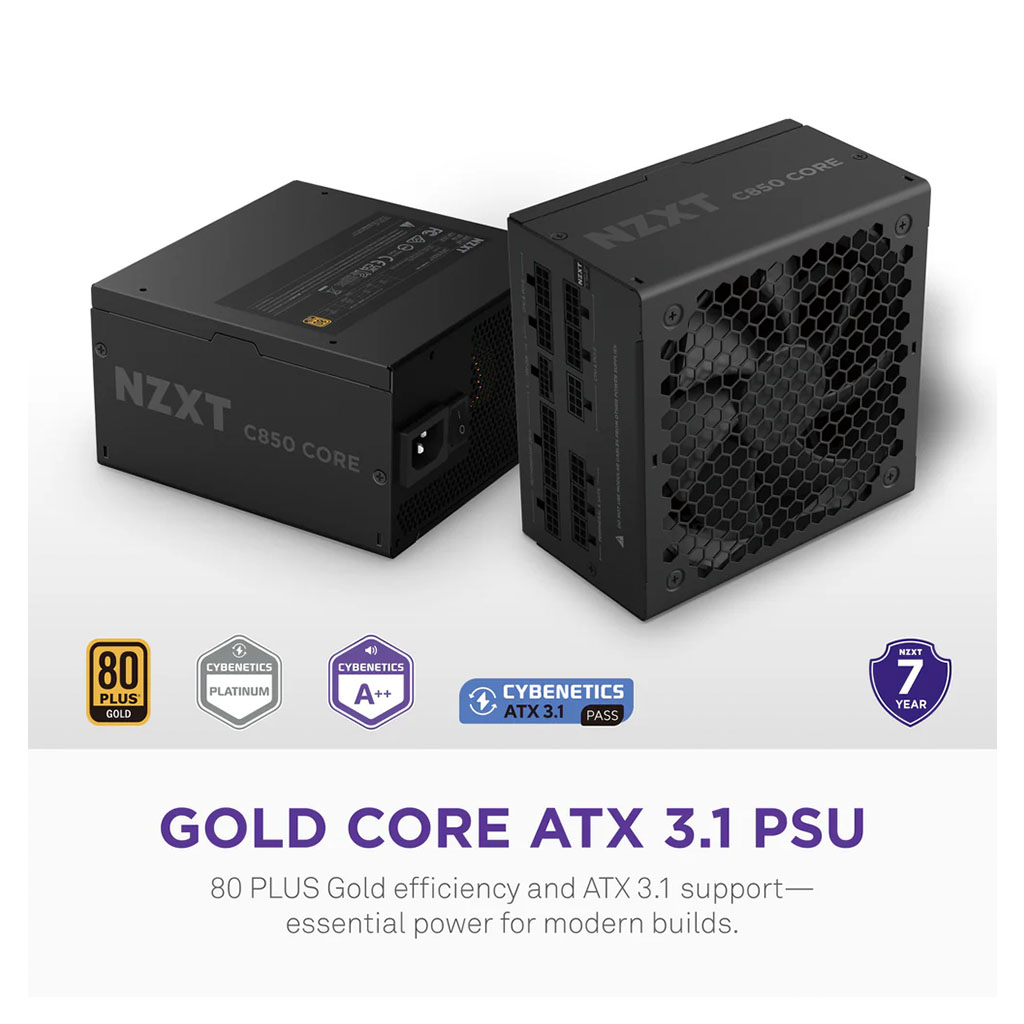
NZXT C850 80+ Gold 850W
850W 80+ Gold, full-modular, no native 12VHPWR - adapter required for RTX 40-series.
850W Seasonic platform. Premium but reliable. Verify India warranty before buying.
Both official and parallel-import stock circulate. Official costs more but has full India warranty support. Confirm with seller which variant.
Full specs
GPUs this PSU can power
Where to buy NZXT C850 80+ Gold 850W in India
Expect to pay roughly ₹9,600-10,600 for the NZXT C850 80+ Gold 850W in India right now, depending on offers and seller. I always recommend buying from retailers that give a proper GST invoice - it's what makes your India warranty claim smooth later.
Affiliate links on linked vendors - your price stays the same. PrimeABGB shown for comparison only.
In my years running a PC store, PrimeABGB (Mumbai) and Vedant Computers (Kolkata) have also been consistently reliable for verified stock - compare before buying.
NZXT C850 Gold Review: 850W ATX 3.0 PSU for Premium Indian Gaming Builds
NZXT C850 Gold: ATX 3.0, PCIe 5.0 Native, and the PSU NZXT Builders Actually Want
NZXT makes cases that people love. Naturally, NZXT builders want a PSU that matches - clean white or black aesthetic, the NZXT logo, no mismatched branding. The C850 Gold delivers that, plus legitimate electrical credentials: ATX 3.0 compliance, native PCIe 5.0 connector (no adapter), 80+ Gold, and a 10-year warranty. It is not just aesthetic matching - it is a technically strong 850W unit.
India price range: ₹10,000–13,000. Available at MDComputers, Vedant Computers, and Amazon India. Less ubiquitous than Corsair but consistently stocked at major online retailers.
ATX 3.0 and PCIe 5.0 - Why It Matters for High-End Builds
ATX 3.0 is the updated power supply standard designed around modern GPU power delivery behavior. High-end GPUs like the RTX 4080 and RTX 4090 can draw significant power spikes in short bursts (called transients) that exceed their rated TDP momentarily. ATX 3.0 PSUs are designed to handle these transients - up to 200% of rated load for brief durations - without triggering overcurrent protection and shutting down.
For RTX 4080 and RTX 4090 builds, an ATX 3.0 PSU like the C850 eliminates the risk of unexpected shutdowns under heavy gaming or benchmark loads. Older ATX 2.x PSUs may struggle with transients from these cards.
The native PCIe 5.0 connector (12VHPWR, 16-pin) means no adapter. RTX 4080 and 4090 cards use 16-pin connectors. Older PSUs include two or three PCIe 8-pin connectors and ship with an adapter to convert to 16-pin. The NZXT C850 has the 16-pin cable natively - cleaner, and eliminates adapter failure as a risk point.
The C850's internals are built on a quality platform (Seasonic-derived per available teardown analysis) - clean voltage regulation and low ripple. 80+ Gold at 850W: roughly 90% efficiency at 50% load (425W on input for ~383W delivered at 50% draw). The 135mm FDB fan is quiet at medium loads and becomes audible under sustained heavy draw.
Fully modular, as expected at this price. NZXT's included cables are well-made and available in white colorway - important if you are building in an NZXT H510 Flow, H7, or H9 case where white cables are part of the aesthetic.
India Pricing, Availability, and the NZXT Ecosystem Angle
₹10,000–13,000 puts the C850 in direct competition with the Corsair RM850e. Electrically, they are very close - both ATX 3.0, both native 16-pin, both 10-year warranty, both Gold. The differentiator is ecosystem and aesthetic.
If you are building in an NZXT case - H510 Flow, H7 Elite, H9 Flow - the NZXT C850 makes the build cohesive. White cables in a white NZXT case is a specific aesthetic that the C850 enables natively. If you are building in a Lian Li, Fractal Design, or Corsair case, there is no aesthetic reason to pick C850 over RM850e.
Availability in India is workable but not Corsair-level. MDComputers and Vedant Computers carry it regularly. Amazon India has it. PrimeABGB sometimes stocks it. If C850 is out of stock and your build cannot wait - Corsair RM850e is the equivalent swap.
NZXT warranty in India: 10 years, handled through their India service network. NZXT's India presence has grown but is not yet as extensive as Corsair/Rashi. Service experience from Indian users has been mostly positive but RMA timelines can be longer outside major metros.
Indian power note: ATX 3.0 PSUs handle transient loads better - relevant not just for GPU spikes but also for the load fluctuations common in Indian grid power. The C850's active PFC and ATX 3.0 compliance give it solid resilience for India's grid conditions.
Who Should Buy the NZXT C850 Gold
Buy the C850 if:
- You are building in an NZXT case and want the full NZXT aesthetic with matching PSU
- Your GPU is an RTX 4080 Super (320W) or RTX 4090 (450W) - ATX 3.0 and native 16-pin are the right specs
- You want 850W with 10-year warranty at a fair India price
- You value the native PCIe 5.0 cable - no adapter risk with high-TDP cards
Skip it if:
- You are not in the NZXT ecosystem and the RM850e is similarly priced - Corsair's India availability and service network (through Rashi) is stronger
- Your GPU does not need 850W - RTX 4070 Super and below is well-served by 650–750W units; the C850 is overkill
- Stock is not available and your build timeline is tight - get the RM850e instead without hesitation
Price we have actually seen
Up 0.8% since we started tracking. Every point is a price our crawler recorded at an Indian retailer - no estimates, no MSRP. Tracking began recently, so the window grows week by week.
Questions
For most RTX 4090 builds with a mid-to-high-end Intel or AMD CPU at stock settings - yes. The RTX 4090 draws up to 450W TDP, and a typical i7 or Ryzen 7 CPU adds 100–150W. Peak system draw is around 600–650W, leaving 200W+ of headroom on a C850. For extreme all-core OC on both CPU and GPU simultaneously, step to 1000W. For stock settings: 850W is fine.
Electrically near-identical. Both ATX 3.0, native 16-pin, 10-year warranty, 80+ Gold. The RM850e has stronger India availability and Rashi's well-established service network. The C850 wins on NZXT aesthetic matching. If you are in an NZXT case: C850. If you are not: RM850e.
Yes. The NZXT C850 includes a native 16-pin (12VHPWR) cable for PCIe 5.0 GPU compatibility. This supports RTX 4080, 4080 Super, and 4090 without the 3x8-pin to 16-pin adapter that older PSUs require. This is a meaningful practical advantage for high-end builds.