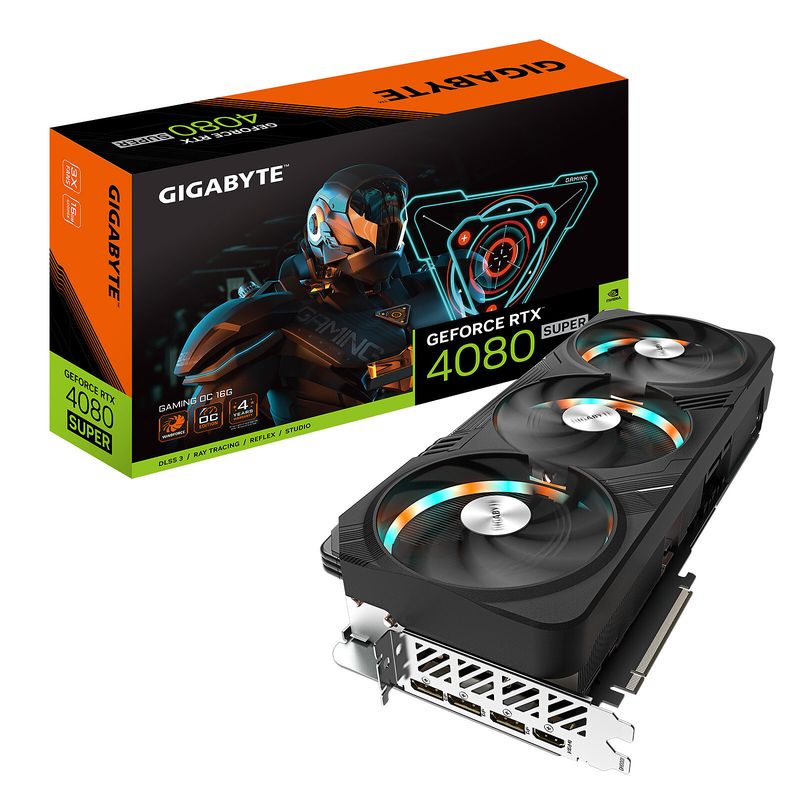
NVIDIA GeForce RTX 4080 Super 16GB
16GB high-end graphics card, 320W draw, 310mm long, DLSS 3.5.
Top-tier Ada GPU below the 4090. 4K-capable in everything. Parallel imports save ₹8-12K but lose India warranty.
Both official and parallel-import stock circulate. Official costs more but has full India warranty support. Confirm with seller which variant.
Full specs
PSUs rated 850W+
Cases that fit 310mm
Where to buy NVIDIA GeForce RTX 4080 Super 16GB in India
Expect to pay roughly ₹1,04,200-1,15,000 for the NVIDIA GeForce RTX 4080 Super 16GB in India right now, depending on offers and seller. I always recommend buying from retailers that give a proper GST invoice - it's what makes your India warranty claim smooth later.
Affiliate links on linked vendors - your price stays the same. PrimeABGB shown for comparison only.
In my years running a PC store, PrimeABGB (Mumbai) and Vedant Computers (Kolkata) have also been consistently reliable for verified stock - compare before buying.
RTX 4080 Super Review India: Is It Worth ₹1,00,000+ in 2025?
What the RTX 4080 Super Actually Is
Nvidia has a habit of releasing "Super" variants mid-generation that make the original launch look overpriced. The RTX 4080 Super is the cleanest example of this. Launched in January 2024, it takes the Ada Lovelace AD102 die - the same one in the RTX 4090 - and cuts it to 10,240 CUDA cores versus the 4090's 16,384. The original RTX 4080 used AD103. This die change matters: the 4080 Super shares memory bandwidth headroom with the 4090 architecture, which shows up in memory-heavy workloads.
Specs that matter for real use: 16GB GDDR6X on a 256-bit bus, 23.0 Gbps memory speed, 320W TDP. It's a chunky card - most AIB versions run 3-slot designs, so plan your case clearance before buying. In India, AIB models from MSI, Asus, Gigabyte, and Zotac are available. Founders Edition is not officially sold here, so whatever you're buying is an AIB card with its own cooler and fan curve.
Performance: 4K is Where This Belongs
I'll be direct about what the data shows. At 4K, the RTX 4080 Super trades blows with the RTX 4090 in many titles - the gap is typically 8–15%, not the 30–40% you'd expect from price difference alone. At 1440p, both cards are GPU-limited less often, and the gap shrinks further. This card is almost always at or above 60fps at 4K max settings in demanding titles, and regularly hits 90–120fps at 4K in well-optimized games.
The 16GB VRAM is non-negotiable at 4K in 2025. Games like Hogwarts Legacy, Alan Wake 2, and The Last of Us Part I regularly push 10–12GB at 4K max. Having 16GB means you're not hitting VRAM walls that hurt performance inconsistently.
The RTX 4080 Super sits comfortably above the RX 7900 XTX and the original 4080 in rasterization, and the gap to the 4090 is genuinely small for the money saved. Ray tracing is where Nvidia's advantage compounds - at 4K with ray tracing, the AMD alternative falls back further, while the 4080 Super holds close to 4090 territory.
DLSS 3.5 and Frame Generation in India
One thing that doesn't show up in raw benchmark numbers: DLSS 3 Frame Generation is exclusive to RTX 40-series. In supported titles - Cyberpunk 2077, Alan Wake 2, Hogwarts Legacy, Dying Light 2, and 50+ others - this can effectively double perceived frame rates at 4K. That's the difference between 55fps native and 110fps with Frame Generation enabled, with minimal visual downside at 4K resolution where generated frames are less obvious.
This matters in India because many builders here run TVs as monitors - 55-inch 4K TVs from Sony, Samsung, or LG connected via HDMI 2.1. The RTX 4080 Super's HDMI 2.1 output handles 4K 144Hz over HDMI without adapters. That's a real-world advantage if you haven't made the jump to a proper 4K gaming monitor yet.
India Pricing and Where to Buy
The RTX 4080 Super retails in India between ₹1,00,000–1,15,000 depending on AIB variant and seller. MSI Gaming X Slim and Asus TUF variants tend to land at the lower end of that range; Asus ROG Strix and MSI Suprim X push toward the top.
Reliable sources I've checked stock at: MDComputers, PrimeABGB, Vedant Computers, and Amazon India. Flipkart occasionally lists it but stock is inconsistent. Croma carries it in select metro stores - Chennai and Bangalore usually have floor stock.
A word on import duties: GPU pricing in India includes 20% basic customs duty plus GST. This is why the RTX 4080 Super costs nearly 30% more here than its US MSRP of $999. There's no way around this on new stock. Parallel imports exist but come without Indian warranty - not worth the risk on a ₹1,00,000 purchase.
Distribution in India runs through Rashi Peripherals and Acro Engineering for most AIB brands. Warranty claims go through these distributors, so buy from an authorized reseller who can issue a proper GST invoice. That invoice is your warranty document.
The price-to-performance argument for the RTX 4080 Super in India is strongest when compared to the RTX 4090. You're spending ~35% less for ~11% fewer frames. The comparison against the RX 7900 XTX is closer - roughly ₹10,000–15,000 more for better ray tracing, DLSS 3, and Nvidia's driver/software ecosystem. That's a real cost difference worth thinking through.
Who Should Buy the RTX 4080 Super
Buy this if: You're building or upgrading a dedicated 4K gaming rig and want it to last 4–5 years without thermal throttling or VRAM anxiety. This card also makes sense for content creators doing video editing in Premiere Pro or DaVinci Resolve - 16GB VRAM handles 4K timelines cleanly, and Nvidia's NVENC encoder is meaningfully better than AMD's for streaming and export quality. If you're in a profession where Nvidia's CUDA ecosystem matters (machine learning inference, CUDA-accelerated tools), there's no AMD equivalent that replaces this.
Skip this if: You're gaming at 1440p - the RTX 4070 Ti Super handles that resolution brilliantly for ₹30,000–40,000 less, and you'll never notice what you're missing at 1440p. Also skip it if you're building a value-first gaming PC - this is a ₹1,00,000 GPU in a GPU market where ₹40,000 gets you excellent 1440p performance. Don't buy this because it sounds impressive. Buy it because 4K gaming or professional workloads specifically need it.
One India-specific caution: the RTX 4080 Super is a 320W card. In areas with unstable power (frequent cuts, voltage fluctuations), pair it with a proper UPS or stabilizer. I've seen GPU VRAM damage from power spikes during load - that's a warranty grey area you don't want to navigate. A Seasonic or Corsair RMx PSU with good surge protection is non-negotiable here.
Temperatures and Noise in Indian Conditions
Most AIB coolers on the RTX 4080 Super maintain 75–80°C under sustained load in a 25°C ambient room. In Indian summer conditions - 35–40°C ambient in cities like Delhi, Chennai, or Nagpur - expect load temps of 82–88°C with standard case airflow. That's within safe limits but closer to the edge than a benchmarker in a 20°C lab would tell you.
The fix: two things. First, a case with decent airflow - the Lian Li Lancool 216, Fractal Design North, or DeepCool CC560 all move enough air. Second, check if your case layout puts the GPU exhaust near the PSU intake - some compact cases have this problem, and it compounds thermal issues. I recommend at least 2 intake fans and 1 exhaust for any build with this GPU.
Price we have actually seen
Up 1.7% since we started tracking. Every point is a price our crawler recorded at an Indian retailer - no estimates, no MSRP. Tracking began recently, so the window grows week by week.
Questions
The original RTX 4080 is nearly discontinued in India - most retailers have cleared stock. If you find one at ₹1,08,500 (indicative) it's decent value. But the 4080 Super at ₹1,00,000 is the better buy: more CUDA cores, higher memory bandwidth, and full availability from authorized sellers with warranty.
If you're gaming-only, the RX 7900 XTX is ₹10,000–15,000 cheaper with similar rasterization performance. Go AMD. If you care about ray tracing quality, DLSS 3 Frame Generation, content creation, or CUDA workloads, the RTX 4080 Super is worth the premium. The software and ecosystem gap is real and growing.
In most e-sports and mid-tier titles, yes - it reaches 100–144fps at 4K. In the most demanding AAA titles at max settings, you'll be at 60–90fps native. With DLSS Quality mode + Frame Generation, you can push most games above 100fps at 4K. For a 4K 144Hz panel, this card is the minimum I'd recommend.
MSI Gaming X Trio and Asus TUF OC are the most available models with strong cooling. The Asus ROG Strix OC is the premium pick if you want the most aggressive OC headroom and a quieter fan curve. The MSI Suprim X is similar performance to the ROG Strix at a slightly lower price. Avoid no-name parallel import cards without GST invoices.