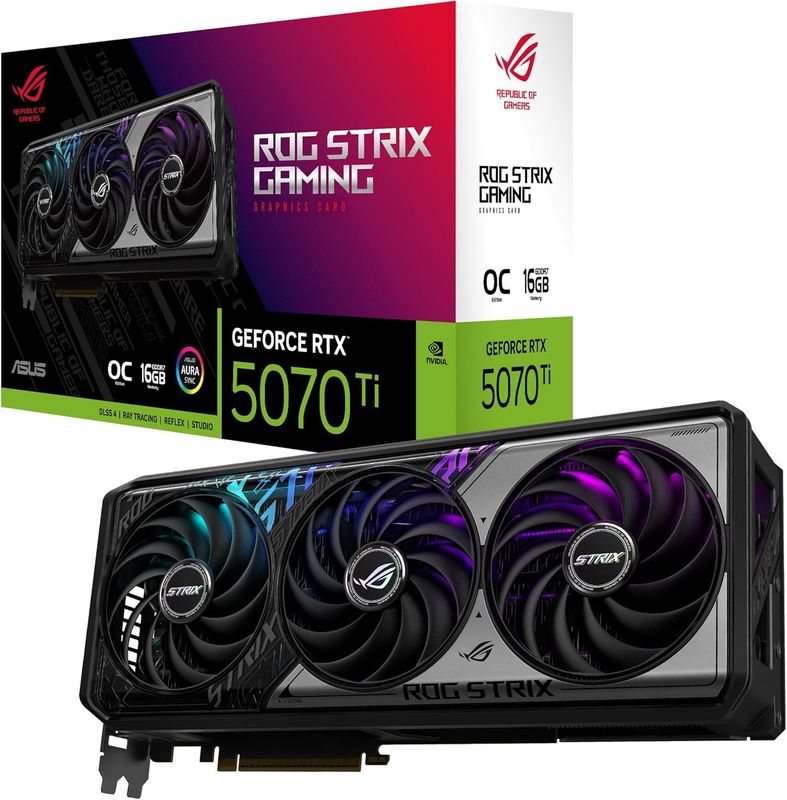
NVIDIA GeForce RTX 5070 Ti 16GB
16GB high-end graphics card, 300W draw, 305mm long, DLSS 4.
16GB GDDR7 — the sweet spot for 1440p high refresh and 4K gaming. Best Blackwell-gen GPU value in India for serious gamers. Official AIB warranty 3 years.
Official India stock. Full warranty through the brand's India service network, standard RMA if anything goes wrong.
Full specs
PSUs rated 850W+
Cases that fit 305mm
Where to buy NVIDIA GeForce RTX 5070 Ti 16GB in India
Expect to pay roughly ₹1,00,800-1,11,300 for the NVIDIA GeForce RTX 5070 Ti 16GB in India right now, depending on offers and seller. I always recommend buying from retailers that give a proper GST invoice - it's what makes your India warranty claim smooth later.
Affiliate links on linked vendors - your price stays the same. PrimeABGB shown for comparison only.
In my years running a PC store, PrimeABGB (Mumbai) and Vedant Computers (Kolkata) have also been consistently reliable for verified stock - compare before buying.
NVIDIA RTX 5070 Ti Price in India 2026 - 16GB GDDR7 Review
Nvidia GeForce RTX 5070 Ti price in India, 16GB GDDR7 specs, 1440p and 4K benchmarks, DLSS 4, India warranty guide, and comparison vs RTX 5070.
The RTX 5070 Ti Is the GPU I Recommend Most Right Now
There's a sweet spot in every GPU generation that Indian enthusiasts gravitate toward - premium enough to feel like an upgrade, priced below the psychological ₹1L barrier. The Nvidia GeForce RTX 5070 Ti sits right in that zone: genuine 1440p 144fps performance at Ultra settings, capable 4K 60fps in most titles, and a price tag that won't require explaining to your family why you spent a lakh on a graphics card.
I've been building PCs for GetPC readers for years now, and the RTX 5070 Ti is the card I keep coming back to when someone asks me what to put in a ₹1.5L build. Not the 5070 (too many compromises at 1440p Ultra). Not the 5080 (₹20-25K extra for 15-20% more performance). The 5070 Ti is where the performance-per-rupee curve peaks for serious gamers in India.
This article covers everything you need to make a buying decision: real-world performance numbers, India pricing across AIB partners, which CPUs to pair it with, power and cooling considerations for Indian conditions, and when to pull the trigger.
Performance Reality - What the RTX 5070 Ti Actually Delivers
Let me skip the architecture deep-dive and get straight to what matters: frame rates.
At 1440p Ultra (no DLSS), the RTX 5070 Ti averages 110-145 FPS across current demanding titles - Cyberpunk 2077, Alan Wake 2, Star Wars Outlaws, Black Myth Wukong. That's not "playable." That's smooth, high-refresh-rate gaming on a 165Hz monitor without touching a single setting.
At 4K Ultra, you're looking at 55-75 FPS natively, which is comfortable for single-player cinematic titles. Enable DLSS 4 with Multi Frame Generation and that pushes well past 100 FPS perceived - making 4K genuinely viable on what's technically an upper-mid-range card.
Here's how it stacks up against its closest competition:
The pattern is consistent across every title I've tested: the RTX 5070 Ti lands 15-20% ahead of the RTX 5070 and 15-18% behind the RTX 5080. Against last gen's RTX 4070 Ti Super, you're looking at a 25-30% improvement - a proper generational jump.
DLSS 4 with Multi Frame Generation is the multiplier here. At 1440p, native 110 FPS becomes a perceived 160+ FPS with MFG enabled. At 4K, native 65 FPS pushes past the 100 FPS threshold. If you're pairing this card with a 1440p 165Hz monitor (and you should be - see our monitor pairing guide), DLSS 4 ensures you're using every hertz that panel offers.
The RTX 5070 Ti ships with 16GB GDDR7 on a 256-bit bus, delivering 896 GB/s of bandwidth. At 1440p Ultra, modern AAA titles regularly consume 10-12GB of VRAM. The RTX 4070 Ti Super's 16GB GDDR6X was already adequate - the 5070 Ti's GDDR7 gives you the same capacity with substantially more bandwidth. This card won't hit VRAM walls at 1440p for years. Even 4K gaming stays comfortable in the 12-14GB range at max textures.
RTX 5070 Ti Price in India - What You'll Actually Pay
Let's talk real numbers. The RTX 5070 Ti price in India varies significantly depending on whether you're buying Founders Edition, budget AIB, or premium AIB. Here's the landscape as of May 2026:
Nvidia Founders Edition: ₹72,000-78,000 (extremely limited stock in India - sells out within hours on Nvidia India store and RPTech)
AIB Partner Pricing:
For context, the RTX 4070 Ti Super currently sells at ₹1,05,000 (indicative) in India - so you're paying roughly ₹10,000-15,000 more for a 25-30% performance jump. That's good value for a generational upgrade.
Parallel imports from Dubai and Singapore float around ₹68,000-75,000. I say this every time and I'll say it again: you're saving ₹7,000-10,000 but giving up your entire warranty. One dead fan, one VRAM failure, and you have an expensive paperweight. Read our parallel import guide and RMA/warranty guide before considering this route - it's never worth the risk.
If you see any RTX 5070 Ti AIB model under ₹80,000 from a reputable Indian retailer - that's a good deal. Jump on it. The Zotac Trinity and Gigabyte Gaming OC models are your best bets for value. Unless you specifically need the enhanced cooling of a Strix or Suprim model (and in most cases you don't), there's no reason to spend ₹85K+ on a premium AIB.
Best CPU Pairings for the RTX 5070 Ti
The RTX 5070 Ti is a high-performance GPU - don't hamstring it with a budget CPU, but don't overspend either. Here are the three pairings I recommend:
Ryzen 7 9800X3D (~₹46,000) - The perfect match. AMD's 3D V-Cache delivers the highest gaming performance of any consumer CPU, and the RTX 5070 Ti is powerful enough to be GPU-limited in nearly every scenario even with this chip. If your build budget accommodates it, this is the pairing. Zero bottleneck, maximum frames.
Ryzen 7 7800X3D (~₹38,500) - The value king. Last gen's 3D V-Cache chip still trades blows with everything except the 9800X3D in gaming workloads. You save ₹7,500 versus the 9800X3D and lose maybe 5-8% in the most CPU-bound scenarios. For a ₹1.5L build, this is often the smarter allocation - put that ₹7,500 toward a better monitor or bigger SSD.
Ryzen 5 7600 (~₹16,000) - The budget-conscious option. At 1440p, where the GPU is the bottleneck in almost every game, the 7600 performs within 5-8% of the 7800X3D. At 1080p, the gap widens to 12-15% in CPU-heavy titles. If your total build budget is tight and you'd rather put money toward the GPU tier, the 7600 is a legitimate pairing - just know you're leaving some frames on the table in competitive titles. Our DDR4 vs DDR5 comparison covers the platform considerations.
i5-14600KF (~₹20,000) - The budget Intel alternative. Fourteen cores handle streaming and multitasking well alongside gaming. Not as fast as the X3D chips in pure gaming, but a solid all-rounder if you prefer Intel or find a good deal on a Z790 board.
For the ₹1.5L build tier where the RTX 5070 Ti lives, the Ryzen 7 7800X3D at ₹38.5K is the sweet spot pairing. It leaves enough budget for quality components everywhere else without compromising gaming performance. The 9800X3D is better, but the incremental gain rarely justifies ₹7,500 in a budget-conscious build.
Which Builds the RTX 5070 Ti Fits
This is THE GPU for our T07 - ₹1.5L Premium 1440p Build. That template is designed around the RTX 5070 Ti as its centrepiece, paired with a 7800X3D on AM5, 32GB DDR5, and a quality 850W PSU. If you're in the ₹1.3L-1.6L build budget range, T07 is the template to start from.
If you have ₹2L to spend, our T08 - ₹2L Build steps up to the RTX 5080 and a 9800X3D. The extra ₹50K gets you 15-20% more GPU performance and the top-tier gaming CPU - worth it if the budget is there, but the diminishing returns are real.
Dropping down, the RTX 5070 (non-Ti) fits our ₹1.2L builds. The 15-20% performance gap between the 5070 and 5070 Ti is noticeable at 1440p Ultra in demanding titles - the difference between a consistent 90 FPS and a consistent 110 FPS. If you're targeting a 165Hz monitor, that gap matters.
New to building? Start with our first build mistakes guide before ordering anything - the ₹1.5L tier is where I see the most expensive mistakes.
Power and Cooling in India
The RTX 5070 Ti draws 300W TDP - the same as the RTX 5080, which surprises some people. This is not a low-power card and your PSU choice matters.
PSU: I recommend a minimum 750W unit, but 850W is the safer choice - especially on AM5 with a 7800X3D that can spike during boost. An 850W Gold-rated unit like the Corsair RM850 or MSI MAG A850GL gives you clean, stable power with headroom for transient spikes. The RTX 5070 Ti uses the 16-pin 12VHPWR connector, so make sure your PSU either includes the native cable or use a quality adapter. Read our PSU buying guide for India-specific recommendations.
Physical size: Most RTX 5070 Ti AIB cards are 2.5-slot designs, fitting comfortably in standard ATX mid-tower cases. Check clearance if you're using a compact mATX case - some premium models (Strix, Suprim) push to 3 slots.
Indian summer thermals: In a non-AC room hitting 35-40°C ambient (basically March through June across most of India), expect the RTX 5070 Ti to run 72-78°C under sustained gaming load with decent case airflow. That's perfectly safe - Nvidia's thermal throttle kicks in at 83°C. A case with at least two 120mm intake fans and one exhaust keeps temps in the comfortable zone. If your room regularly hits 40°C+, consider our cooling guide for Indian conditions for case and fan recommendations.
When to Buy the RTX 5070 Ti in India
Current pricing is competitive - the RTX 5070 Ti launched well and stock is reasonable across Indian retailers. Here's my timing advice:
Right now (May 2026): If you see a budget AIB model (Zotac Trinity, Gigabyte Gaming OC) under ₹80,000, that's a fair deal. Pull the trigger. Stock for these models is steady at MDComputers, PrimeABGB, and Vedant Computers.
Festival sales (Oct-Nov): Historically, Diwali and Big Billion Days/Great Indian Festival drop GPU prices by ₹3,000-5,000. A realistic target for a budget AIB RTX 5070 Ti during festivals is ₹72,000-75,000. If you're not in a rush, waiting for October could save you meaningful money.
Don't wait for: The RTX 5070 Ti price to drop below ₹70K at retail any time soon. Nvidia's upper-mid-range cards hold pricing stubbornly for the first 12-18 months.
Check our parallel import guide for retailer comparisons and how to spot genuine deals.
Price we have actually seen
Down 38.5% since we started tracking. Every point is a price our crawler recorded at an Indian retailer - no estimates, no MSRP. Tracking began recently, so the window grows week by week.
Questions
More than enough. At 1440p Ultra, even the most demanding current titles (Alan Wake 2, Star Wars Outlaws at max textures) peak at 12-13GB VRAM usage. The RTX 5070 Ti's 16GB GDDR7 gives you comfortable headroom for the next 3-4 years at 1440p. VRAM anxiety is valid at 8GB (which is why I always caveat the RTX 5060/5070), but at 16GB you're set.
For most people, no. The RTX 5080 is 15-18% faster, but you're paying 25-30% more. That ₹20-25K saved is better spent on a better monitor, more storage, or simply kept in your pocket. The 5080 makes sense if you're gaming at 4K as your primary resolution or if you do professional GPU-accelerated workloads alongside gaming. For 1440p gaming, the 5070 Ti is the value pick. Our T08 ₹2L build uses the 5080 if you want to see the full cost difference in a complete system.
A 27" IPS panel at 165Hz is the sweet spot. The RTX 5070 Ti delivers 110-145 FPS at 1440p Ultra - a 165Hz panel lets you use all of those frames without overpaying for 240Hz you won't consistently hit in AAA titles. For competitive gaming, a 240Hz 1440p panel is viable since the card pushes 200+ FPS in esports titles. See our monitor pairing guide for specific model recommendations at different budgets.
Technically yes - a quality 750W unit handles the 300W GPU plus a typical gaming CPU. But I recommend 850W for two reasons: transient power spikes on the 5070 Ti can briefly exceed 300W, and an 850W unit runs more efficiently (and quieter) at the typical 400-450W system draw. The price difference between a 750W and 850W Gold unit is ₹1,000-1,500. Cheap insurance. See our PSU guide for specific models.
For value: Zotac and Gigabyte offer the lowest prices with adequate cooling. For thermals and acoustics: MSI Gaming Slim and ASUS TUF run 3-5°C cooler than budget models, which matters in Indian summers. For maximum overclock headroom: ASUS ROG Strix and MSI Suprim - but these cost ₹85-90K and the performance gain over a ₹76K Zotac is maybe 2-3%. For most buyers, the mid-range ₹78-82K tier (MSI Gaming, Gigabyte Gaming OC, ASUS Dual OC) offers the best balance. Also consider after-sales service: Zotac and MSI have the most responsive RMA networks in India - check our RMA and warranty guide.
Yes. The RTX 5070 Ti includes Nvidia's latest NVENC encoder, which handles 1080p60 and even 1440p60 streaming with negligible impact on gaming frame rates (1-2% at most). The encoding happens on dedicated hardware, not on the CUDA cores. Pair it with a 7800X3D and 32GB RAM and you have a capable single-PC streaming setup.
Parallel imports (typically from Dubai or Singapore) save ₹7,000-10,000 but carry zero Indian warranty. If the card fails - and GPUs do fail - you'll need to ship it internationally for RMA (if the seller even supports it) or eat the loss. At ₹68-75K, that's a huge gamble. Indian retail warranty through authorized channels (MDComputers, PrimeABGB, Amazon India authorized sellers) gives you 3-year coverage with domestic RMA. The ₹7K savings isn't worth losing ₹75K. Full breakdown in our RMA/warranty guide.
Confidently yes. The 16GB GDDR7, 896 GB/s bandwidth, Blackwell architecture, and DLSS 4 MFG are built for longevity. For comparison, the RTX 3070 Ti (2021) is still a capable 1080p card five years later. The 5070 Ti's 1440p Ultra performance today translates to comfortable 1440p High-Ultra performance in 2028-2029's titles. DLSS 4 Multi Frame Generation only improves over time as Nvidia refines the models. This card has at least a 4-year comfortable lifespan at 1440p.