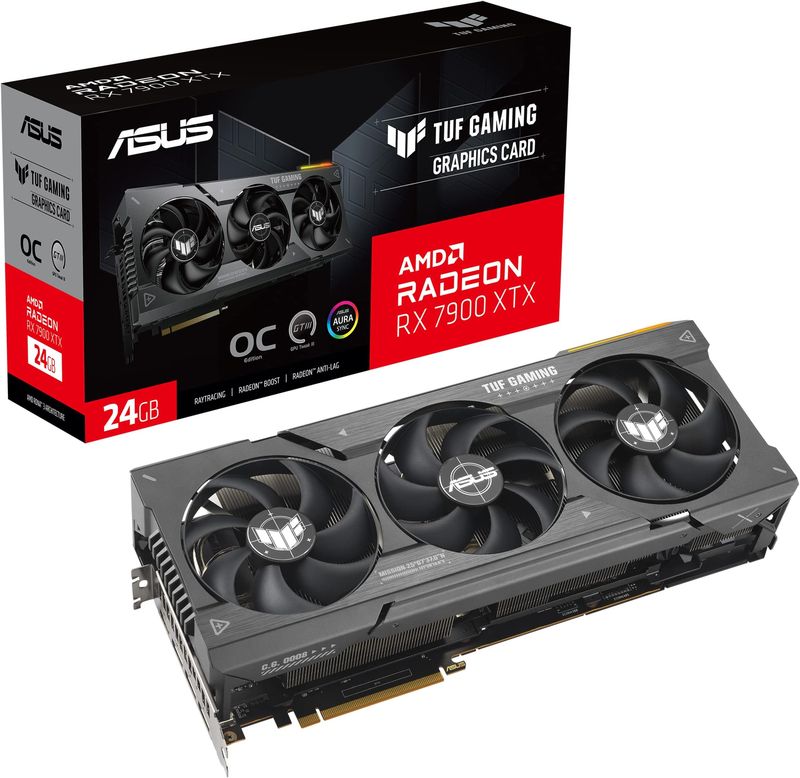
AMD Radeon RX 7900 XTX 24GB
24GB high-end graphics card, 355W draw, 287mm long, FSR 3.1.
AMD's previous flagship. 24GB VRAM, 4K raster king for AMD. RT and upscaling lag NVIDIA. For people who hate NVIDIA's stack.
Official India stock. Full warranty through the brand's India service network, standard RMA if anything goes wrong.
Full specs
PSUs rated 850W+
Cases that fit 287mm
Where to buy AMD Radeon RX 7900 XTX 24GB in India
Expect to pay roughly ₹90,200-99,600 for the AMD Radeon RX 7900 XTX 24GB in India right now, depending on offers and seller. I always recommend buying from retailers that give a proper GST invoice - it's what makes your India warranty claim smooth later.
Affiliate links on linked vendors - your price stays the same. PrimeABGB shown for comparison only.
In my years running a PC store, PrimeABGB (Mumbai) and Vedant Computers (Kolkata) have also been consistently reliable for verified stock - compare before buying.
RX 7900 XTX India Review: AMD's Flagship GPU at {{price}}
The RX 7900 XTX in India's High-End Market
AMD's flagship consumer GPU - the RX 7900 XTX - uses the Navi 31 die with 12,288 stream processors, 24GB GDDR6 on a 384-bit bus, and a 355W TDP. It launched in December 2022 alongside the RTX 4080 and has aged well: the 24GB VRAM still leads the field among sub-₹1,10,000 GPUs, and RDNA 3's rasterization efficiency is strong.
In India, it lands between ₹90,000–1,05,000 depending on AIB variant. Sapphire Pulse and XFX Speedster are the most common models in the market. Gigabyte and PowerColor also have stock at select retailers. This is a direct competitor to the RTX 4080 Super, which sits at ₹1,00,000–1,15,000 - meaning the 7900 XTX is often ₹10,000 cheaper while trading blows on performance.
That price gap defines who this card is for in India.
Rasterization Performance: Where AMD Shines
In pure rasterization - the way most games still render - the RX 7900 XTX and RTX 4080 Super are separated by noise. Hardware Unboxed's large game test suite puts them within 3–5% of each other across 50+ titles at 4K. In some titles the AMD card wins. In others, Nvidia pulls ahead. For the average gaming workload, they're effectively tied.
That chart tells you everything. In rasterization: AMD within 3%, Nvidia barely ahead. In ray tracing: AMD loses 36 points. This is AMD's persistent weakness with RDNA 3 - the ray tracing units just don't have the throughput that Ada Lovelace does. It's not subtle. In ray-traced Cyberpunk 2077 at 4K, the RTX 4080 Super is 40–50% faster than the RX 7900 XTX.
If you game primarily in titles that use ray tracing - and that list is growing every year - this matters. If you game in titles that don't - competitive shooters, older RPGs, most esports titles - the AMD card is a legitimate ₹10,000-cheaper alternative.
24GB VRAM: Actually Useful in 2025
The RX 7900 XTX's biggest spec advantage over the RTX 4080 Super is VRAM: 24GB vs 16GB. For gaming in 2025, 16GB is sufficient - almost no game needs more at 4K, and those that do (some modded titles, certain 8K texture packs) are edge cases.
Where 24GB matters more: AI inference workflows running locally (Stable Diffusion XL, LLM quantized models), 3D rendering in Blender (GPU rendering with large scenes), and video editing with heavy effects stacks. If you're doing any of these tasks on top of gaming, 24GB has real value. Stable Diffusion users in particular benefit from the headroom - larger models run unquantized, faster.
For pure gaming, don't let VRAM be the deciding factor. 16GB is fine for 4K gaming through 2026 at minimum.
India Pricing and Availability
The RX 7900 XTX in India runs ₹90,000–1,05,000 depending on model and retailer. Sapphire Pulse is the most widely stocked and best-valued variant - strong cooling, reasonable noise, solid warranty support. XFX Speedster MERC is the step up with better thermal performance.
MDComputers, PrimeABGB, and Vedant Computers carry authorized stock. Amazon India has it but pricing fluctuates and warranty terms need verification - always confirm you're getting an authorized Indian unit, not a grey import.
AMD's Indian distributor footprint runs through Rashi Peripherals. Unlike Nvidia AIBs which are broadly distributed, AMD GPU availability outside major cities can be patchier. Tier-2 cities may need to order online from the retailers above. Check their respective websites for current pricing - it moves.
GST is included in Indian retail pricing but ask for a GST-inclusive invoice. This matters for warranty (it's your proof of purchase) and for business buyers who can claim input tax credit.
FSR 3 vs DLSS 3: The Software Reality
AMD's FidelityFX Super Resolution 3 (FSR 3) includes Frame Generation - AMD's answer to DLSS 3. The advantage of FSR 3: it works across all GPUs, including Nvidia cards, so game developers who implement it reach a wider hardware base. AMD doesn't need a specific hardware unit for FSR.
The disadvantage in practice: DLSS 3's Frame Generation looks noticeably cleaner in most implementations, with less ghosting and more natural motion handling at fast pan speeds. FSR 3 Frame Generation has improved through driver updates but still trails in quality on fast-motion content. For slower-paced games - open world exploration, story RPGs - the gap is minimal. For fast action or competitive shooters, DLSS 3 has the edge.
This is a real software ecosystem consideration. Games that ship with DLSS but not FSR are more common than the reverse, though AMD has pushed RSR and FSR adoption actively through 2024.
Who Should Buy the RX 7900 XTX
Buy this if: You're gaming at 4K in titles that don't lean heavily on ray tracing, you want the best rasterization per rupee at the high end, or you need 24GB VRAM for AI/creative workloads. The price advantage over the RTX 4080 Super is real - ₹10,000–15,000 in India buys you an extra SSD or RAM kit. For a gaming-focused build where ray tracing is not a priority, the RX 7900 XTX is the better value.
Skip this if: You play games with heavy ray tracing - Cyberpunk 2077 with path tracing, Control, Metro Exodus Enhanced, Alan Wake 2 ray tracing modes. The performance gap against Nvidia in these titles is large enough to affect your actual experience. Also skip it if you use software that's CUDA-dependent: PyTorch model training, some video editing plugins, professional tools that require Nvidia. AMD's ROCm support is improving but not at parity with CUDA for professional workflows in India.
A practical India note: AMD GPU driver support has historically been patchier than Nvidia's in India, with some community reports of slower hotfix releases for region-specific issues. This has improved significantly through 2024 but is worth knowing if you're coming from an Nvidia background.
Temperatures and Power in Indian Conditions
355W TDP means this draws slightly more power than the RTX 4080 Super (320W). Plan your PSU accordingly - a 850W 80+ Gold unit is the right spec. Seasonic Focus GX-850 or Corsair RM850e are both solid picks.
In Indian summer conditions (35–40°C ambient), Sapphire Pulse models hold 78–84°C under sustained load. XFX Speedster MERC runs cooler at 72–78°C with its larger heatsink. Both are within AMD's thermal limits, but airflow matters. Cases with two front intakes and one rear exhaust handle this properly. Don't run this card in a small form factor case without verifying thermal clearance.
Price we have actually seen
Down 22.0% since we started tracking. Every point is a price our crawler recorded at an Indian retailer - no estimates, no MSRP. Tracking began recently, so the window grows week by week.
Questions
If ray tracing is not important to you: buy the RX 7900 XTX - same rasterization, ₹10,000–15,000 less, more VRAM. If you care about ray tracing quality or DLSS 3: buy the RTX 4080 Super, the performance gap in RT-heavy titles is significant.
For gaming alone in 2025, 16GB is sufficient at 4K. The 24GB matters if you're running AI image generation, local LLMs, or large 3D renders. Don't pay a premium just for VRAM if gaming is your only use case.
Sapphire Pulse is the most available model with solid build quality and good warranty support through Rashi Peripherals. If you can find the XFX Speedster MERC 319, it runs cooler. The Sapphire Nitro+ is the premium pick but availability is inconsistent in India.
No - DLSS is Nvidia-exclusive. The RX 7900 XTX supports FSR 3 (AMD's equivalent) and XeSS (Intel's, compatible with non-Intel GPUs). Game support for FSR 3 is broad and growing but trails DLSS 3 in both adoption and image quality in fast-motion scenarios.