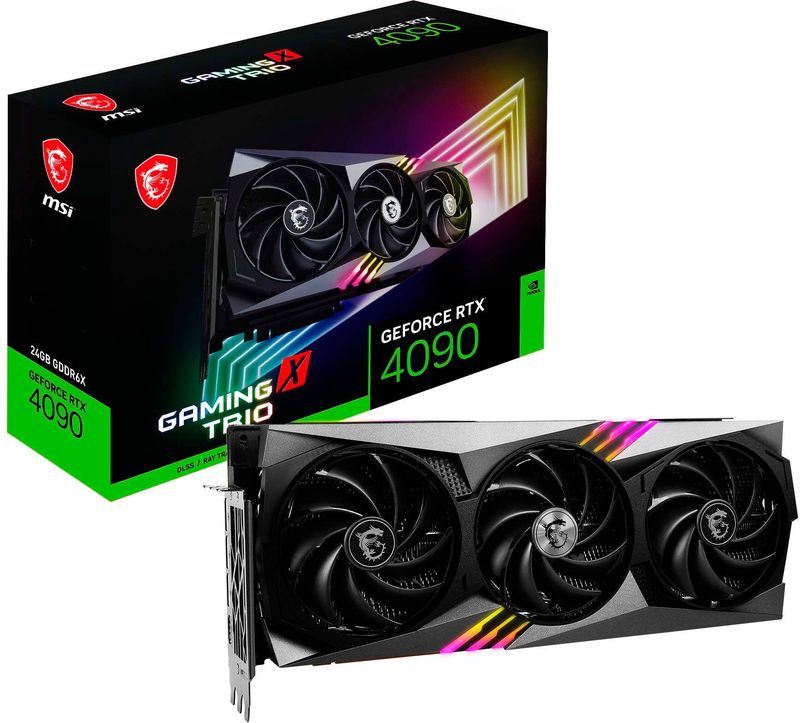
NVIDIA GeForce RTX 4090 24GB
24GB high-end graphics card, 450W draw, 335mm long, DLSS 3.5.
Out of production since RTX 50 series launch. Stock dwindling. 12VHPWR adapter melted on early units — use a native 12VHPWR PSU.
Both official and parallel-import stock circulate. Official costs more but has full India warranty support. Confirm with seller which variant.
Full specs
PSUs rated 1000W+
Cases that fit 335mm
Where to buy NVIDIA GeForce RTX 4090 24GB in India
Expect to pay roughly ₹1,70,400-1,88,200 for the NVIDIA GeForce RTX 4090 24GB in India right now, depending on offers and seller. I always recommend buying from retailers that give a proper GST invoice - it's what makes your India warranty claim smooth later.
Affiliate links on linked vendors - your price stays the same. PrimeABGB shown for comparison only.
In my years running a PC store, PrimeABGB (Mumbai) and Vedant Computers (Kolkata) have also been consistently reliable for verified stock - compare before buying.
Nvidia RTX 4090 in India - Still Worth ₹1.7L in 2026? (Honest Answer)
RTX 4090 in India - The ₹1.7L Question Nobody Asks Honestly
The RTX 4090 is the most interesting card on the Indian market in 2026 - not because it's the fastest (it isn't anymore), but because of what it represents at its current price.
At ₹1,70,999, you're buying last-gen's flagship GPU. The RTX 5090 beat it by 25–30% in gaming and costs ₹2.2L+. By pure gaming logic, the math doesn't work. By any other logic - AI/ML inference, 3D rendering, professional workloads, or value hunting - the RTX 4090 at ₹1,77,500 (indicative) is actually the most interesting GPU story in India right now.
This is the only consumer GPU with 24GB of fast VRAM on a 384-bit bus. That matters enormously for local LLM inference, stable diffusion, ComfyUI, and 3D scene rendering. No other card under ₹2L gives you this much VRAM. Not the RTX 5080 (16GB). Not the RX 7900 XTX (24GB, but slower compute). Only the 4090.
I'll give you the full picture - gaming, AI/ML, professional use, and the India used-market math.
Gaming Performance: Still Excellent, No Longer Untouchable
The RTX 4090's gaming legacy is straightforward: it was the only card that could run demanding titles at 4K Ultra 60+ FPS without DLSS for its entire lifecycle. In 2026, the RTX 5090 does that better, but the 4090 still doesn't struggle.
At 4K Ultra (no DLSS): 65–90 FPS in most demanding titles. Black Myth Wukong, Cyberpunk 2077, Alan Wake 2 - all playable at high framerates natively. Most games from 2022–2025 run at 80–100 FPS 4K Ultra without any upscaling. This is still exceptional.
At 1440p: it's simply CPU-limited. If you're putting an RTX 4090 in a system with anything below a Ryzen 7 9800X3D or i9-14900K, the CPU is the ceiling. At 1440p, the practical gaming difference between a 4090 and a 4070 Super is measured in CPU headroom, not GPU headroom.
The Real 4090 Story: 24GB VRAM for AI and Rendering
This is why I think the RTX 4090 deserves a fresh look in 2026.
Local AI inference has gone from hobbyist curiosity to genuine professional tool. If you're running LLMs locally - Llama 3.1 70B, Mistral, Qwen - 24GB VRAM is the threshold that unlocks the models that matter. The RTX 4090's 24GB GDDR6X lets you run a 70B parameter model at 4-bit quantization cleanly, with ~14–16 tokens/second. That's usable for production inference pipelines.
The RTX 5080 has 16GB. Better for gaming. Completely insufficient for 70B models in a single card. The RTX 4090 used as an AI workstation card at ₹1.70L new - or better yet, bought used - is the T09 AI workstation approach I recommend on this site.
India Pricing: New vs Used
New at ₹1,70,999: Available at MDComputers, PrimeABGB, and Vedant Computers. Stock is inconsistent - the 4090 was always limited volume, and with 50-series now shipping, retailers aren't restocking heavily. If you need one and see it in stock at this price, it's real.
Used market (₹1,20,000–1,40,000): The most interesting angle for Indian buyers. People who bought RTX 4090s for gaming are upgrading to RTX 5090s. Those used 4090s are showing up in Indian enthusiast communities, Facebook Marketplace in metro cities, and occasionally on OLX. A 4090 used from a gamer in good condition - same VRAM, same compute, same card - at ₹1.2L is a genuinely compelling AI workstation GPU.
The caution on used: warranty is gone (4090 OEM warranty doesn't transfer in most cases), and GPU mining abuse is rare but possible. Buy from a known person with purchase receipts if you can.
The honest recommendation
For pure gaming: don't buy a new RTX 4090 at ₹1.70L in 2026. The RTX 5080 is faster in rasterization with DLSS 4 and costs less. The RTX 4090's time as the gaming king is over.
For AI/ML local inference with 70B+ models, 3D rendering (Blender, Cinema 4D), or a dual-purpose gaming + AI workstation machine: the RTX 4090 is still the only sub-₹2L option that fits 70B models fully in VRAM. That's a real, defensible use case in 2026.
Who Should Buy It
Right GPU if:
- You're building the T09 AI workstation for local LLM inference - 24GB is non-negotiable for 70B models
- You're a 3D artist or VFX professional - the VRAM headroom for complex scenes is genuinely useful
- You find a used one under ₹1,30,000 in good condition - that's excellent value for an AI GPU
- Your workload is mixed: demanding 3D render + 4K gaming, and you don't want separate machines
Skip it if:
- You primarily game - the RTX 5080 at ₹1,15,000–1,20,000 is faster in gaming and costs less
- You only need up to 13B parameter models - the RTX 5070 Ti's 16GB handles those fine
- Budget matters at all - there are many better gaming GPUs for less money
- You want DLSS 4 and Multi Frame Generation benefits - those only work on Blackwell (50-series)
Price we have actually seen
Down 20.4% since we started tracking. Every point is a price our crawler recorded at an Indian retailer - no estimates, no MSRP. Tracking began recently, so the window grows week by week.
Questions
Gaming only: RTX 5080 wins. It's faster in rasterization with DLSS 4, has Multi Frame Generation support, and typically costs ₹1,15,000–1,20,000 vs the 4090 at ₹1.70L. The 4090 has 24GB vs 5080's 16GB - that matters for AI/ML but not for gaming in 2026. If it's a pure gaming machine, buy the 5080.
Yes - it's one of the best consumer options for image generation. At 24GB VRAM, you can run SDXL, Flux, and high-resolution Stable Diffusion 3.5 with full quality and large batch sizes. The CUDA cores and Tensor core throughput are still excellent for diffusion inference. For this use case, the 4090 is a better buy than a 16GB card even at higher price, because VRAM ceiling directly limits resolution and batch size.
Some parallel import sellers list RTX 4090s at slightly lower prices with international warranty. I'd be cautious: parallel import 4090s require overseas RMA if they fail, and repair turnaround for a ₹1.7L card is painful. Given the price gap is usually only ₹5,000–8,000 on parallel import, the warranty risk isn't worth it at this price tier.