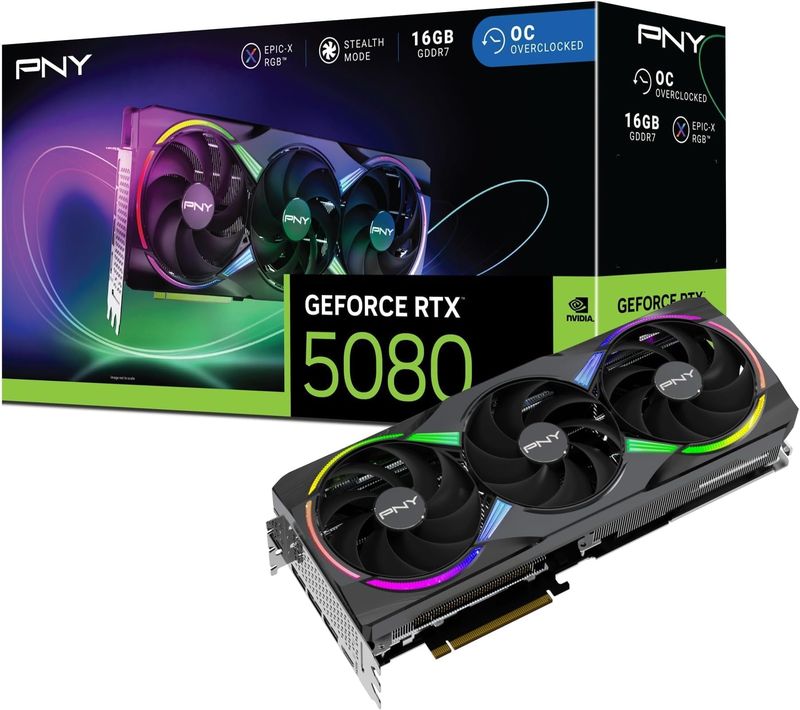
NVIDIA GeForce RTX 5080 16GB
16GB high-end graphics card, 360W draw, 335mm long, DLSS 4.
4K-capable. Big leap in DLSS 4 features over 4080 Super; raw raster gain is smaller. Native 12VHPWR PSU strongly recommended.
Official India stock. Full warranty through the brand's India service network, standard RMA if anything goes wrong.
Full specs
PSUs rated 1000W+
Cases that fit 335mm
Where to buy NVIDIA GeForce RTX 5080 16GB in India
Expect to pay roughly ₹1,44,000-1,59,000 for the NVIDIA GeForce RTX 5080 16GB in India right now, depending on offers and seller. I always recommend buying from retailers that give a proper GST invoice - it's what makes your India warranty claim smooth later.
Affiliate links on linked vendors - your price stays the same. PrimeABGB shown for comparison only.
In my years running a PC store, PrimeABGB (Mumbai) and Vedant Computers (Kolkata) have also been consistently reliable for verified stock - compare before buying.
Nvidia RTX 5080 in India - The Real Flagship for Serious Builders
The RTX 5080 Is the Real Flagship - Here's Why
Let me save you some money. The RTX 5090 costs between ₹3.5L and ₹7L depending on whether you can even find one in India, and it's designed for people who treat GPUs like status symbols. The Nvidia GeForce RTX 5080 delivers roughly 80-85% of the 5090's gaming performance at about a third of the price. For anyone building a serious 4K gaming rig or a creator workstation in India, this is the card that actually makes financial sense.
I've been tracking the RTX 5080 price in India since launch, and the market has started to stabilize. Founders Edition cards are ghostly rare (as always in India), but AIB options from MSI, ASUS, and Zotac are in stock across major retailers. The performance story is straightforward: 4K 60+ FPS at Ultra in every current title, 1440p 144+ FPS in most games, and DLSS 4 Multi Frame Generation that pushes perceived frame rates even higher.
This isn't a card for everyone - at ₹1L+, it better not be. But if you're building a ₹2L-2.5L machine and you want it to handle 4K gaming, video editing in DaVinci Resolve, or Stable Diffusion workloads without breaking a sweat, the Nvidia RTX 5080 is the GPU I'd put in that build. And I have - it's the GPU in both our ₹2L 4K build (T08) and ₹2.5L creator build (T09).
A quick note on the RTX 5080 laptop variants: mobile RTX 5080 cards exist but run at significantly lower TDP (80-150W vs 300W desktop) with correspondingly reduced performance. This article focuses on the desktop GeForce RTX 5080. If you're considering a laptop, the mobile 5080 performs closer to a desktop RTX 5070 Ti - keep that in mind before paying laptop-premium prices.
Performance Reality Check - Where the RTX 5080 Actually Sits
The RTX 5080 specs tell one story. Real-world gaming tells a more nuanced one. Here's how the card performs relative to the competition at 4K, which is its natural resolution:
The numbers paint a clear picture. At 4K Ultra, the RTX 5080 averages around 78 FPS across demanding AAA titles - comfortably above the 60 FPS threshold that makes 4K gaming genuinely enjoyable. That's roughly 30-35% faster than the RTX 4080 Super it replaces, and only about 15-20% behind the RTX 5090 that costs two to three times as much.
At 1440p, the RTX 5080 is frankly overkill for most titles. You're looking at 120-160 FPS at Ultra settings, which means it will drive a 1440p 165Hz monitor at near-full refresh rate in virtually everything. If you're pairing this with a 1440p monitor, honestly consider whether the RTX 5070 Ti at ₹30K less might be the smarter pick.
Where the RTX 5080 pulls ahead of everything below it is DLSS 4 Multi Frame Generation. At 4K, enabling DLSS 4 MFG pushes that 78 FPS average into 140-160+ perceived FPS territory. For a card that's already hitting 60+ natively, this is the difference between "playable 4K" and "genuinely smooth 4K" - something only the 5090 could claim before. Our monitor pairing guide (G05) covers which 4K displays actually make sense at this performance level.
Unlike the 5070 Ti's 12GB or the 5060's 8GB, the RTX 5080 ships with 16GB GDDR7 on a 256-bit bus. At 4K, this matters enormously - several 2025-2026 titles already push past 12GB VRAM usage at 4K Ultra textures. 16GB means you can max out texture settings without worrying about VRAM stutter for the foreseeable future. It also makes the 5080 a genuine workhorse for video editing timelines and AI/ML inference workloads.
India Pricing Landscape - What You'll Actually Pay for an RTX 5080
Let's talk money. The RTX 5080 price in India has settled into predictable bands after the initial launch chaos. Here's the real picture as of May 2026:
The sweet spot for most buyers is the Zotac Trinity or ASUS TUF in the ₹1.05-1.18L range. The MSI Gaming Trio is a premium product with the quietest cooler, but you're paying ₹10-15K extra mostly for acoustics and aesthetics. At this price tier, I'd argue that money is better spent on a better CPU or monitor.
For comparison, the RTX 4080 Super has settled to ₹85,000-95,000 at Indian retail - making it roughly ₹20K cheaper than the cheapest RTX 5080. That's a meaningful gap, and I'll address whether the 4080 Super still makes sense in the FAQ section below.
You'll find RTX 5080 cards on OLX and local dealers at ₹95K-1.05L - typically parallel imports from Dubai or Singapore. These carry zero manufacturer warranty in India. On a ₹1L GPU, that's an unacceptable risk. When an AIB card dies at month 11, you're left fighting for international RMA shipping that costs ₹8-10K each way - if the manufacturer even accepts it. Read our RMA and warranty guide (G10) for why this is a terrible gamble. The ₹10-15K you save isn't worth voiding 3 years of warranty coverage.
Best CPU Pairings for the RTX 5080 in India
At the ₹1L+ GPU price point, your CPU choice actually matters. A budget processor will bottleneck this card, especially at 1440p where the CPU has more influence on frame rates. Here are the three CPUs I recommend, ranked by use case:
Ryzen 7 9800X3D (~₹46,000) - The best gaming CPU on the planet, period. The 3D V-Cache design gives it a 10-15% lead over everything else in gaming workloads. If your ₹2L+ build is primarily for gaming, this is the CPU. It's the processor I paired with the RTX 5080 in our ₹2L 4K gaming build (T08).
Ryzen 7 7800X3D (~₹38,500) - Here's the dirty secret: at 4K resolution, the 7800X3D is only 2-3% behind the 9800X3D. The GPU becomes the bottleneck at 4K, not the CPU. If you're buying the RTX 5080 specifically for 4K gaming and want to save ₹7,500, the 7800X3D is the rational choice. That ₹7,500 buys you a better case or an additional NVMe drive.
Ryzen 9 9950X (~₹56,000) - Not for pure gaming. This is the pick if you're doing video editing in DaVinci Resolve, 3D rendering in Blender, or running AI inference workloads alongside gaming. The 16 cores handle multi-threaded production work that the X3D chips can't match. It's the CPU in our ₹2.5L creator build (T09).
Intel Core i7-14700K (~₹34,000) - The budget alternative. Twenty cores (8P + 12E) give you strong multi-threaded performance, and gaming is only 5-8% behind the 9800X3D at 4K. The catch: Intel's LGA 1700 platform is end-of-life, so there's no upgrade path. If you're on a tighter budget and don't plan to swap CPUs later, it works. But I'd stretch for the 7800X3D if you can.
Don't pair this GPU with anything below an 8-core chip. I've seen people put a Ryzen 5 5600 next to a ₹1L GPU and wonder why their frame times are inconsistent. Check our first build mistakes guide (G01) - CPU-GPU mismatches are one of the most expensive errors new builders make.
Which Builds the RTX 5080 Fits
The RTX 5080 is the centerpiece GPU in two of our build templates:
T08 - ₹2L 4K Gaming Build: Ryzen 7 9800X3D + RTX 5080 + 32GB DDR5 + 850W Gold PSU. This is the definitive 4K gaming machine in India. Every component is selected to let the RTX 5080 stretch its legs without a single bottleneck. If 4K 60+ FPS at Ultra settings with room for DLSS to push it further is your goal, T08 is the build.
T09 - ₹2.5L Creator Build: Ryzen 9 9950X + RTX 5080 + 64GB DDR5 + 1000W Gold PSU. Built for people who game and work - video editors, 3D artists, AI hobbyists. The 16-core CPU and 64GB RAM handle Resolve timelines and Blender renders while the RTX 5080's 16GB VRAM and CUDA cores accelerate GPU-compute tasks.
For reference, our ₹3L flagship build (T10) steps up to the RTX 5090 - but I genuinely think T10 is only justified if you're doing professional 8K editing or have deep pockets. For 95% of serious builders in India, T08 or T09 with the RTX 5080 is the right call.
Power and Cooling in Indian Conditions
The RTX 5080 has a 300W TDP - double the RTX 5060 and a meaningful step up from the 4080 Super's 320W. Here's what that means in practice for Indian builders:
PSU: 850W minimum, and I mean a quality 850W Gold unit - not a generic unrated box. A Ryzen 7 9800X3D (120W) plus RTX 5080 (300W) plus drives, fans, and the rest puts your system draw at 450-500W sustained. An 850W Gold PSU handles this with 40% headroom for transient power spikes, which Blackwell GPUs are known for. Our PSU guide (G04) has specific model recommendations at each wattage tier.
Thermals in Indian summers: This is where most international reviews become useless for Indian buyers. Reviewers test at 22°C lab conditions. Your room in May is 35-42°C. That 13-20°C delta translates directly to higher GPU temps. Expect 75-82°C under sustained gaming load in a non-AC room with a good-airflow case. That's safe - Nvidia's thermal throttle doesn't kick in until 87°C - but it means fan noise will be noticeable. If you game in a non-AC room regularly, prioritize the ASUS TUF or MSI Gaming Trio for their superior coolers, and pair with a high-airflow case like the Lian Li Lancool 216 or Fractal Torrent. Our cooling guide (G07) covers India-specific thermal management in detail.
Physical size: At 2.5 slots and 310-330mm length, the RTX 5080 fits comfortably in any standard mid-tower ATX case. It's noticeably smaller than the monstrous RTX 5090 (which pushes 3.5 slots in some AIB designs). You don't need to buy a full-tower unless your case is an unusually compact mATX design. The 16-pin 12VHPWR connector is the same one used since the RTX 4000 series - every RTX 5080 ships with an adapter for older 8-pin PSUs, but I'd recommend a PSU with native 12VHPWR if buying new.
When to Buy - Timing Your RTX 5080 Purchase
Don't buy at launch week. This advice applies to every GPU, but especially at the ₹1L+ tier where AIB markups can be aggressive in the first 2-3 weeks. The RTX 5080 has been out long enough now that prices have mostly normalized, but here's my timing guidance:
Right now (May 2026): Stock is stable, prices are within 5% of MSRP across most AIBs. If you're building a new rig, this is a fine time to buy. Don't wait for a mythical further price drop - at ₹1L+, these cards don't see steep discounts outside festival sales.
Festival sales (BBD/Great Indian Festival, October): Historically, ₹5,000-10,000 off AIB GPUs during Big Billion Days and Great Indian Festival. On a ₹1.1L card, that's 5-9% savings. Worth waiting for only if you're 4-5 months away from your build anyway. Don't delay a build you need now for a ₹7K saving.
If budget is tight: The RTX 4080 Super at ₹85-95K is still an outstanding 4K GPU. You lose DLSS 4 MFG and about 30-35% raw performance, but it's a card that handles 4K 60 FPS in most titles at High-to-Ultra settings. At ₹20K less, it frees budget for a better monitor or more RAM. Our where to buy guide (G03) covers which retailers offer the best deals on last-gen clearance stock.
Price we have actually seen
Up 127.6% since we started tracking. Every point is a price our crawler recorded at an Indian retailer - no estimates, no MSRP. Tracking began recently, so the window grows week by week.
Questions
Yes, and comfortably so for the next 3-4 years. At 4K Ultra, most current titles use 10-13GB VRAM. The 16GB buffer gives you meaningful headroom. The 256-bit GDDR7 bus also provides substantially more bandwidth than the 4080 Super's 256-bit GDDR6X, so the VRAM you have gets used more efficiently. Unlike the 12GB RTX 5070 Ti, the 5080's 16GB means you won't be texture-hunting in settings menus at 4K. For professional work - video editing timelines, Stable Diffusion - 16GB is adequate for most workflows, though truly large AI models will want the 5090's 32GB.
It depends on your resolution. At 1440p, the 5070 Ti delivers 85-90% of the 5080's performance for ₹20K less - that's a tough value proposition for the 5080. At 4K, the gap widens to 15-18%, the 16GB VRAM matters significantly more, and the 5080 is clearly the better buy. My rule: if you game at 1440p 165Hz, the 5070 Ti is the smarter pick. If you game at 4K or do GPU-compute work, the 5080's extra VRAM and shader count justify the premium.
For 4K gaming, a 27-32" 4K 144Hz IPS or OLED panel. The LG 27GR95QE (4K OLED, ₹55K-60K) is the dream pairing. More practically, the Gigabyte M28U or ASUS VG28UQL1A at ₹35-42K are excellent 4K 144Hz IPS options. At 1440p, the RTX 5080 is overkill unless you're targeting a 240Hz competitive panel. See our monitor pairing guide (G05) for the complete recommendation matrix by resolution and budget.
Technically possible, practically risky. The RTX 5080's 300W TDP plus transient spikes can briefly pull 400-450W from the GPU alone. Pair that with a 120W CPU and system overhead, and a 750W unit is operating at 85-90% sustained load - which reduces efficiency, increases heat, and shortens PSU lifespan. More critically, transient spikes can trip OCP (Over Current Protection) on lower-quality 750W units, causing shutdowns during gaming. I strongly recommend 850W minimum, and our PSU guide (G04) explains why skipping PSU wattage at this GPU tier is a false economy.
Zotac Trinity (₹1.05-1.12L): Best value. Adequate cooling, 3-year warranty in India through Zotac's Gurugram service center. Fan noise is higher than premium cards but perfectly acceptable. My default recommendation when budget matters.
Excellent. The 16GB GDDR7 VRAM handles 4K timeline scrubbing in DaVinci Resolve without proxies. NVENC encoding (Blackwell's updated encoder) exports faster than any previous generation. For Blender and 3D rendering, the 5080's CUDA core count puts it roughly 30% ahead of the 4080 Super. The one caveat: if you're doing serious AI/ML training (not just inference), the 5090's 32GB VRAM is a different league. For everything else in the creator workflow - video editing, motion graphics, Stable Diffusion image generation - the 5080 is more than sufficient.
The risk is simple: no warranty in India. Nvidia and AIB manufacturers (MSI, ASUS, Zotac, Gigabyte) all enforce regional warranty policies. A card purchased in Dubai carries a UAE warranty that is not honoured at Indian service centers. If your GPU develops a fault - and at 300W sustained power draw, components do fail - you'll need to ship it internationally for RMA at your own expense (₹8-10K round trip), with no guarantee of acceptance. On a ₹95K-1.05L purchase, saving ₹10-15K while voiding warranty protection is a bad risk calculation. Our RMA and warranty guide (G10) documents specific cases of failed international RMA attempts.
If you already own a 4080 Super: no. The 30-35% performance gain costs ₹1.1L+ minus whatever you sell the 4080 Super for (₹65-70K used). That's ₹40-45K net for a generational improvement that won't change your gaming experience at 4K - you're going from "good 4K" to "great 4K."