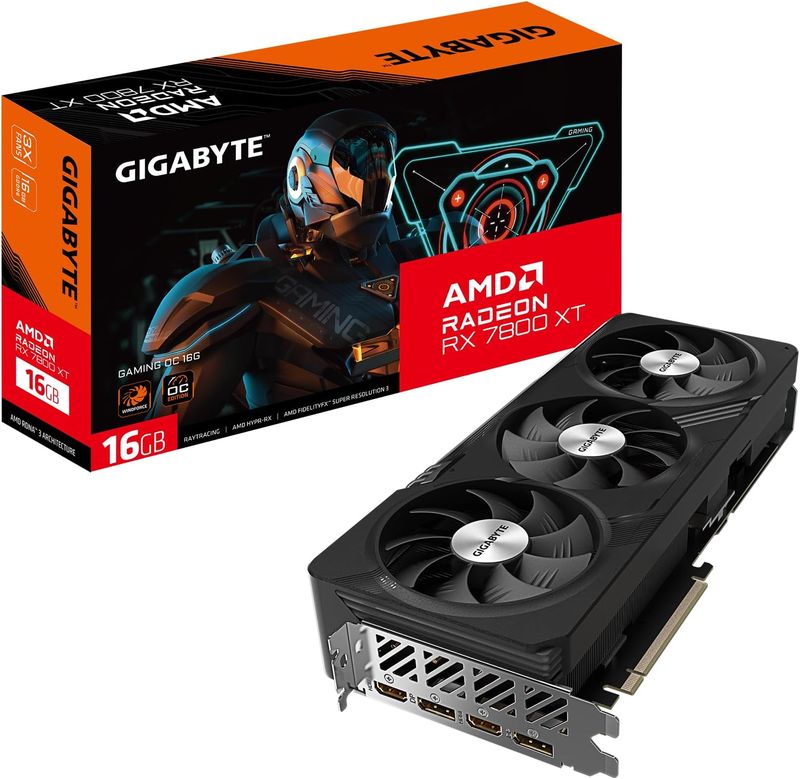
AMD Radeon RX 7800 XT 16GB
16GB high-end graphics card, 263W draw, 280mm long, FSR 3.1.
Best AMD value 1440p card. 16GB VRAM and strong raster. RT is okay but not its strength. Pair with non-RT-heavy games.
Official India stock. Full warranty through the brand's India service network, standard RMA if anything goes wrong.
Full specs
PSUs rated 700W+
Cases that fit 280mm
Where to buy AMD Radeon RX 7800 XT 16GB in India
Expect to pay roughly ₹46,100-50,900 for the AMD Radeon RX 7800 XT 16GB in India right now, depending on offers and seller. I always recommend buying from retailers that give a proper GST invoice - it's what makes your India warranty claim smooth later.
Affiliate links on linked vendors - your price stays the same. PrimeABGB shown for comparison only.
In my years running a PC store, PrimeABGB (Mumbai) and Vedant Computers (Kolkata) have also been consistently reliable for verified stock - compare before buying.
Available cards in India
Same chip, same FPS - what changes between these cards is the cooler, the length, the power connector, and the price. Pick by what fits your cabinet and budget.
AMD RX 7800 XT in India - 16GB of Raw Value for 1440p Gaming
The RX 7800 XT - AMD's Best Argument Against Spending More on a GPU
If I had to pick one GPU that represents the best raw value in the Indian PC gaming market right now, it would be the RX 7800 XT. Not the flashiest card, not the most feature-rich, not the one with the coolest tech demos - but the one that delivers the most frames per rupee spent, full stop.
At ₹42,000-48,000 in India, you get 16GB GDDR6 on a 256-bit bus, solid 1440p performance that trades blows with the RTX 4070, and enough VRAM headroom to not worry about texture memory for years. No DLSS, sure - but AMD's FSR 3.1 with frame generation has matured significantly, and for pure rasterization, this card punches well above its price class.
I've recommended the RX 7800 XT more than any other GPU in 2025. It's the default choice in my mid-range builds for buyers who don't care about Nvidia's ecosystem and just want the best gaming experience per rupee. Here's the complete picture.
Performance - The Rasterization King at Its Price
Let me be upfront about the RX 7800 XT's split personality. In pure rasterization (traditional rendering without ray tracing), this card is genuinely impressive - matching or beating the RTX 4070 in many titles while costing ₹8-12K less. In ray tracing, it falls behind significantly. Your preference between these two aspects determines whether this card is right for you.
The split is clear: in rasterization, the RX 7800 XT matches or beats the RTX 4070 - it's genuinely competitive at 1440p Ultra, delivering 75-100 FPS in current demanding titles. In ray tracing, it falls behind by 30-50%, which is a massive gap. AMD's ray tracing hardware simply isn't competitive with Nvidia's RT cores at this generation.
The practical impact? If you play games primarily without ray tracing - which is still most gamers - the 7800 XT delivers RTX 4070-class performance for ₹8-12K less. If you enable RT in games like Cyberpunk 2077 or Alan Wake 2, the experience drops noticeably below the Nvidia equivalent.
Price in India - The Value Proposition
The RX 7800 XT has been consistently well-priced in India:
Current pricing (May 2026):
- Budget AIBs (Sapphire Pulse, PowerColor Fighter): ₹42,000-45,000
- Mid-tier (Sapphire Nitro+, PowerColor Red Devil): ₹45,000-48,000
- Amazon/Flipkart sale prices: occasionally dipping to ₹39,000-41,000
For context, the RTX 4070 (non-Super) sits at ₹48,000 (indicative) and the RTX 4060 Ti 16GB at ₹42,000-46,000. The 7800 XT matches the 4070's rasterization performance at the 4060 Ti's price - that's the core value story.
The Sapphire Pulse RX 7800 XT at ₹42-44K is the value sweet spot - excellent cooling, quiet operation, and the lowest price. The Nitro+ at ₹46-48K is better built but the extra ₹3-4K buys marginal improvements. Sapphire's after-sales in India is handled through Acro Engineering, which has acceptable RMA turnaround. Check our vendor guide for details.
16GB VRAM - The Future-Proofing Argument
Here's where the RX 7800 XT genuinely differentiates itself from every Nvidia card under ₹70K. 16GB GDDR6 on a 256-bit bus means:
- No VRAM anxiety at 1440p - even the most demanding current titles max out at 10-12GB at 1440p Ultra. You have 4-6GB of headroom.
- Viable at 4K textures - while the GPU itself can't push high 4K frame rates, you can use 4K texture packs without memory issues. Useful for games where you use FSR upscaling from 1440p internal resolution but want 4K-quality textures.
- Content creation breathing room - video editing, 3D rendering, and AI workloads benefit from the extra VRAM.
Compare this to the RTX 4060 Ti's 8GB (a genuine limitation), the RTX 4070's 12GB (adequate but tight), or the RTX 5060's 12GB. At ₹42-48K, no other card gives you this much memory.
FSR vs DLSS - The Upscaling Compromise
Let me be honest: DLSS is better than FSR. Nvidia's AI-powered upscaling produces cleaner images, better handles ghosting and artifacts, and DLSS 3/4 Frame Generation is more mature than AMD's equivalent. This is the main thing you give up by choosing the RX 7800 XT.
That said, FSR 3.1 is much better than its reputation suggests. Frame generation works, native upscaling quality has improved dramatically, and in most games at 1440p, the visual difference between DLSS Quality and FSR Quality requires side-by-side comparisons to notice. FSR is also open-source and works on any GPU, which means broader game support over time.
If upscaling quality is your top priority and you frequently play at lower-than-native resolution to hit frame rate targets, Nvidia is the better ecosystem. If you primarily play at native resolution and use upscaling as an occasional boost, FSR 3.1 is perfectly adequate.
Power and Cooling - 263W and the Indian Summer
At 263W TDP, the RX 7800 XT is a moderately power-hungry card. It draws more than the RTX 4070 (200W) and RTX 4070 Super (200W) for similar rasterization performance - this is one area where AMD loses to Nvidia's Ada Lovelace efficiency.
PSU: A quality 650W unit is the minimum recommendation, with 750W preferred. AMD GPUs can have sharper transient spikes than their Nvidia counterparts, and a 650W unit with thin transient handling can trigger shutdowns during load spikes. Our PSU guide has models tested with RDNA 3 cards.
Thermals: Expect 70-78°C at 35-40°C Indian ambient temperatures. The Sapphire Pulse model handles thermals well; the PowerColor Fighter can be slightly noisy under full load. Three-fan models provide more cooling headroom. See our cooling guide for Indian conditions.
The RX 7800 XT is the default GPU in our T05 - ₹1L 1440p Entry Build and works as a budget-saving swap in the T06 - ₹1.3L 1440p Build, freeing up ₹10-15K for a better CPU or monitor. Pair with Ryzen 5 7600 for the best price-to-performance ratio.
Price we have actually seen
Up 2.9% since we started tracking. Every point is a price our crawler recorded at an Indian retailer - no estimates, no MSRP. Tracking began recently, so the window grows week by week.
Questions
In pure rasterization performance, yes - the 7800 XT matches or slightly beats the RTX 4070 while costing ₹8-12K less. It also has 16GB vs 12GB VRAM. But the RTX 4070 wins in ray tracing (30-50% faster), has DLSS (better upscaling than FSR), and draws less power (200W vs 263W). If ray tracing matters to you, the RTX 4070 or 4070 Super are better choices. If raw rasterization value is your priority, the 7800 XT is the better buy.
The RX 7800 XT is 25-35% faster than the RTX 4060 Ti 8GB and has double the VRAM (16GB vs 8GB) for roughly the same price. Even versus the 16GB RTX 4060 Ti (₹42-46K), the 7800 XT is faster, has better VRAM bandwidth, and matches on price. The RTX 4060 Ti only wins if you absolutely must have DLSS and ray tracing - and even then, the 7800 XT's rasterization advantage is massive. See our RTX 4060 Ti article for more detail.
Yes. FSR 3.1 frame generation is supported in a growing list of titles and works well at 1440p. Image quality is slightly behind DLSS 3, but the difference is minor in motion. FSR 3.1 is open-source and has broader game adoption over time. At 1440p, where the 7800 XT already delivers 75-100 FPS natively, FSR frame gen pushes perceived frames past 120-150 FPS - more than enough for high-refresh monitors.
It's decent. The 16GB VRAM helps in DaVinci Resolve, Blender, and Premiere Pro for 1440p and light 4K work. However, AMD GPUs lack CUDA support, which means some applications (Premiere's GPU-accelerated effects, some Blender render engines) work better on Nvidia. If content creation is your primary use case, the RTX 4070 or 5070 are better choices for the CUDA ecosystem. If gaming is primary and content creation is secondary, the 7800 XT is fine.
Ryzen 5 7600 (~₹16K) is the perfect match - a budget CPU with a budget-value GPU, on the AM5 platform with upgrade headroom. At 1440p, the GPU bottleneck means the 7600 performs within 5% of a 7800X3D. Intel i5-14400F (~₹13.5K) works too but puts you on a dead-end platform. If you can afford more, the 7800X3D (~₹38.5K) is ideal but might be overkill for this GPU tier.
If you can wait and the RX 9070 XT launches at ₹55-62K as expected, it should be 30-40% faster with FSR 4 and ML upscaling. But that's ₹10-18K more, and India availability may be limited initially. If you need a card now and want maximum value per rupee, the 7800 XT at ₹42-44K is hard to beat. If you can wait 3-6 months and stretch your budget, the 9070 XT is the better long-term investment.