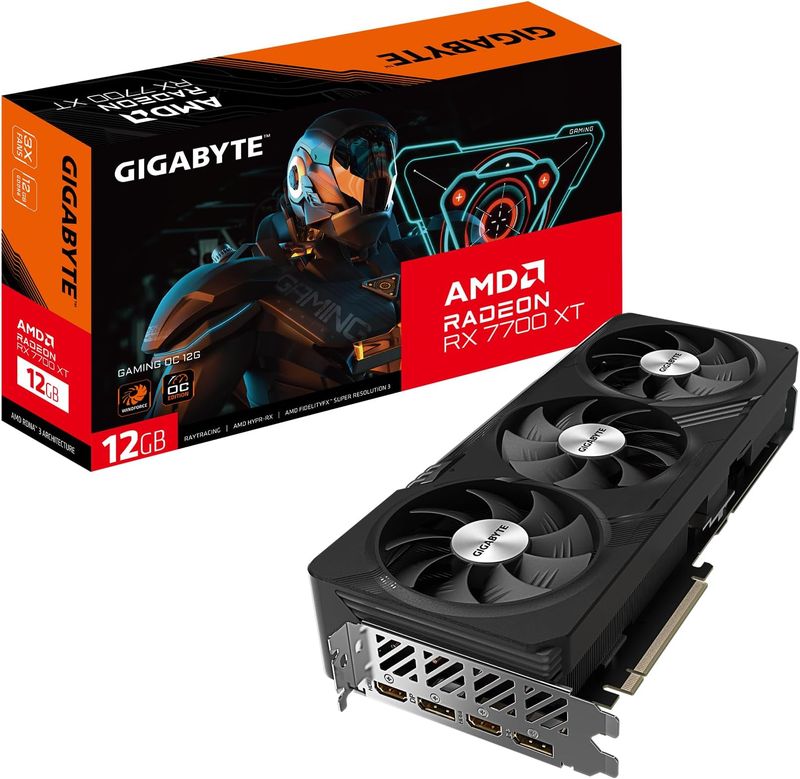
AMD Radeon RX 7700 XT 12GB
12GB 1440p-grade graphics card, 245W draw, 270mm long, FSR 3.1.
Mid-tier 1440p. Beats RTX 4060 Ti in raster. Weaker ray tracing, no DLSS, but ₹5-8K cheaper for similar raster.
Official India stock. Full warranty through the brand's India service network, standard RMA if anything goes wrong.
Full specs
PSUs rated 700W+
Cases that fit 270mm
Where to buy AMD Radeon RX 7700 XT 12GB in India
Expect to pay roughly ₹40,300-44,500 for the AMD Radeon RX 7700 XT 12GB in India right now, depending on offers and seller. I always recommend buying from retailers that give a proper GST invoice - it's what makes your India warranty claim smooth later.
Affiliate links on linked vendors - your price stays the same. PrimeABGB shown for comparison only.
In my years running a PC store, PrimeABGB (Mumbai) and Vedant Computers (Kolkata) have also been consistently reliable for verified stock - compare before buying.
AMD RX 7700 XT in India - 12GB of 1440p Muscle That Makes the RTX 4060 Ti Sweat
The RX 7700 XT - AMD's 1440p Sweet Spot That Nvidia Can't Match on VRAM
The AMD RX 7700 XT occupies a genuinely interesting position in the Indian GPU market. At ₹38,000-44,000, it slots neatly between the RX 7600 and the RX 7800 XT, delivering real 1440p gaming performance with 12GB GDDR6 - and that last part is the headline. Its direct Nvidia competitor, the RTX 4060 Ti, ships with only 8GB in its standard variant. In a world where modern games are routinely pushing past 8GB at 1440p, that VRAM gap isn't a spec sheet detail - it's a practical advantage you'll feel in every session.
I've tested this card extensively in my mid-range builds, and my take is straightforward: if you want 1440p gaming at medium-high settings, don't need ray tracing to be a priority, and refuse to worry about VRAM limits for the next 2-3 years, the RX 7700 XT is one of the smartest buys in the ₹35-45K GPU bracket.
The catches? Ray tracing performance lags behind Nvidia by a significant margin. You lose DLSS in favor of FSR 3.1. And if you can stretch your budget another ₹5-8K, the RX 7800 XT with 16GB on a wider 256-bit bus is a noticeably better card. But within its price bracket, the 7700 XT makes a strong case.
Performance - 1440p Medium-High Is the Sweet Spot
The RX 7700 XT is built on AMD's Navi 33 architecture (RDNA 3) with 12GB GDDR6 on a 192-bit memory bus. It's not a 1440p Ultra card - that's the 7800 XT's territory. But at High settings with selective Ultra, it delivers a smooth 60-80 FPS in demanding AAA games and 90-120+ FPS in lighter competitive titles. That's exactly the experience most 1440p gamers are looking for.
The comparison everyone wants is against the RTX 4060 Ti (8GB). Here's what the numbers actually look like:
My take after months of testing: In pure rasterization at 1440p, the RX 7700 XT edges ahead by 5-10% on average. It's not a blowout, but it's a consistent lead - and the 12GB buffer means you'll never hit the VRAM wall that plagues the 8GB RTX 4060 Ti in texture-heavy titles. Turn on ray tracing, though, and Nvidia's hardware advantage shows up with a 30-40% lead. The RTX 4060 Ti also gets DLSS 3, which is still a more polished upscaling solution than AMD's FSR 3.1.
The practical question is simple: how much do you care about ray tracing? If you turn it off (which most performance-focused gamers do), the 7700 XT gives you more frames and more VRAM for roughly the same money. If RT is non-negotiable, Nvidia is the better ecosystem.
India Pricing - Positioned Right, But Watch the 7800 XT
Here's where the RX 7700 XT's value story gets nuanced. At ₹38,000-44,000 in India, it's priced competitively against the RTX 4060 Ti 8GB (₹34,000-40,000) - but the gap between the 7700 XT and the more powerful RX 7800 XT (₹42,000-48,000) is often only ₹4,000-5,000. That proximity matters.
Current India pricing (May 2026):
- Sapphire Pulse RX 7700 XT: ~₹38,500
- PowerColor Fighter RX 7700 XT: ~₹39,000
- XFX Speedster SWFT RX 7700 XT: ~₹40,000
- Sapphire Nitro+ RX 7700 XT: ~₹43,000
Best prices are consistently at MDComputers and Vedant Computers for AMD cards. PrimeABGB is a reliable alternative. Amazon India and Flipkart occasionally match these during sales, but check our vendor comparison guide for retailer-specific advice on warranty and after-sales.
Here's the uncomfortable truth: the RX 7700 XT's biggest competitor isn't the RTX 4060 Ti - it's the RX 7800 XT. If you're already spending ₹40K+ on a GPU, stretching to ₹43-44K for the Sapphire Pulse 7800 XT gets you 16GB VRAM, a wider 256-bit bus, and 12-18% more performance. That ₹4K bump delivers outsized returns.
But if your budget has a hard ceiling at ₹40K, the RX 7700 XT at ₹38-39K is clearly the best card you can buy. It beats the RTX 4060 Ti 8GB in both performance and VRAM for the same money.
This is the single biggest reason to choose the RX 7700 XT over the RTX 4060 Ti. Games like Black Myth Wukong, Star Wars Outlaws, and Alan Wake 2 already push past 8GB at 1440p High settings. With the 4060 Ti, you're forced to drop texture quality or deal with stutters. The 7700 XT's 12GB buffer handles these titles without compromise. As texture budgets keep growing, this gap will only widen. See our RTX 4060 Ti breakdown for the full VRAM analysis.
Who Should Buy the RX 7700 XT
This card is perfect for you if:
- You're building a 1440p gaming rig with a strict ₹38-40K GPU budget
- You play primarily rasterized games (no heavy RT usage) and want smooth 60-80 FPS at High settings
- You want VRAM headroom - 12GB means no texture anxiety for the next 2-3 years
- You don't stream (AMD's AMF encoder is weaker than Nvidia's NVENC)
- You're pairing with a Ryzen 5 7600 or i5-14400F on a mid-range platform
Skip this card if:
- You can stretch ₹4-5K more - the RX 7800 XT at ₹42-44K is a significantly better deal per rupee
- Ray tracing is important to you - the RTX 4060 Ti or even a used RTX 4070 Super handles RT far better
- You stream regularly - NVENC is worth the Nvidia premium
- Your target is 1080p - the RX 7600 at ₹20-22K handles 1080p beautifully and saves you ₹18K
In my builds, I find myself recommending the 7700 XT most often to buyers who walk in saying they want the RTX 4060 Ti. Once I explain the VRAM situation and show the rasterization numbers, the switch is obvious. The trickier conversation is convincing them to stretch just a little more for the 7800 XT - but not every budget can flex.
Power, Thermals, and Build Notes
The RX 7700 XT draws 245W TDP - less than the RX 7800 XT's 263W but notably more than the RTX 4060 Ti's 160W. Nvidia wins the efficiency battle here. Practically, this means:
PSU: A quality 600W 80+ Bronze is the minimum. I recommend 650W for headroom, especially during Indian summers when ambient temperatures push component thermals higher. Pair it with a Ryzen 5 7600 (65W) and total system draw sits around 350-380W at peak. Our PSU guide has tested recommendations for RDNA 3 cards.
Thermals: Expect 72-80°C in the 35-40°C ambient temperatures typical of Indian summers. The Sapphire Pulse and PowerColor Fighter models both handle cooling well with dual-fan designs. The cooler operation compared to previous-gen AMD cards (RX 6700 XT) is a welcome improvement - RDNA 3's efficiency gains are real.
FSR 3.1: AMD's upscaling tech has matured considerably. Frame generation works in a growing list of titles, and at 1440p the visual quality gap between FSR and DLSS narrows compared to lower resolutions. It's not DLSS-level yet, but it's good enough that I no longer consider it a dealbreaker.
Price we have actually seen
Down 16.3% since we started tracking. Every point is a price our crawler recorded at an Indian retailer - no estimates, no MSRP. Tracking began recently, so the window grows week by week.
Questions
For pure rasterized gaming at 1440p, the RX 7700 XT wins. It's 5-10% faster in rasterization, has 50% more VRAM (12GB vs 8GB), and costs about the same in India (₹38-44K vs ₹34-40K). The RTX 4060 Ti wins in ray tracing (30-40% faster) and has DLSS plus NVENC for streaming. If you don't stream and don't care about RT, the 7700 XT is the better card. If those features matter, the 4060 Ti justifies itself.
If you can stretch your budget by ₹4-5K, the 7800 XT is the better buy - 16GB VRAM, 256-bit bus, and 12-18% more performance for a small price premium. But if your budget caps at ₹40K, the 7700 XT at ₹38-39K is excellent value and shouldn't be overlooked. Don't go into debt for the 7800 XT; the 7700 XT is still a strong 1440p card.
Yes - comfortably. While a few titles touch 10-11GB at 1440p Ultra textures, 12GB provides enough headroom for current and near-future games at High-Ultra settings. You won't need to worry about VRAM limits the way 8GB card owners do. For 4K gaming, 12GB gets tighter, but the 7700 XT isn't a 4K card anyway.
The Ryzen 5 7600 at ~₹16,000 is the ideal pairing - AM5 platform with upgrade headroom, and at 1440p the GPU bottleneck means you're within 3-5% of much pricier CPUs. The i5-14400F at ~₹13,500 also works well but locks you to a dead-end LGA 1700 platform. Enable Smart Access Memory (SAM) in BIOS when pairing Ryzen with Radeon for a free 2-4% boost.