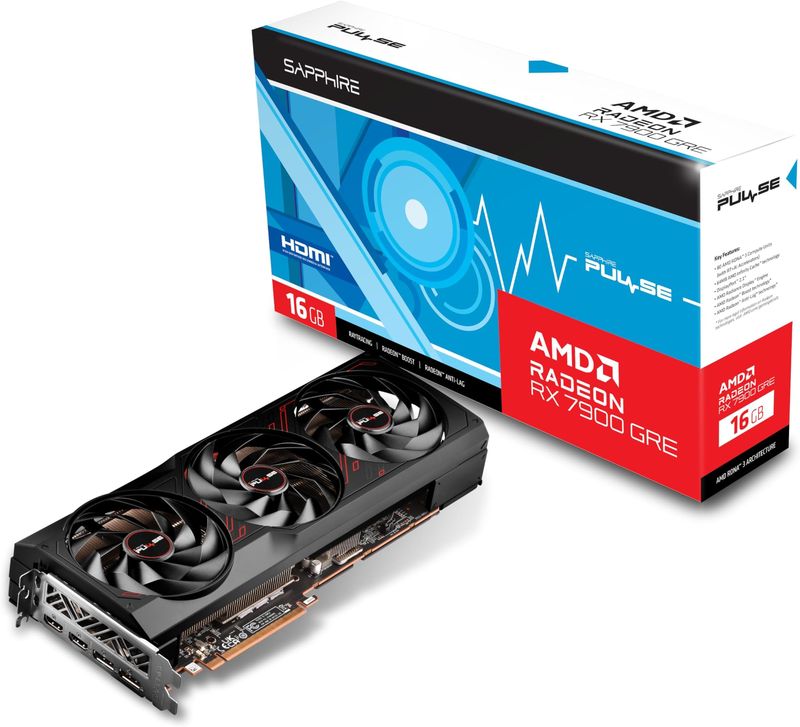
AMD Radeon RX 7900 GRE 16GB
16GB high-end graphics card, 260W draw, 280mm long, FSR 3.1.
1440p high-refresh sweet spot. Sits between 7800 XT and 7900 XT. 16GB at strong raster performance for the price.
Official India stock. Full warranty through the brand's India service network, standard RMA if anything goes wrong.
Full specs
PSUs rated 750W+
Cases that fit 280mm
Where to buy AMD Radeon RX 7900 GRE 16GB in India
Expect to pay roughly ₹55,700-61,500 for the AMD Radeon RX 7900 GRE 16GB in India right now, depending on offers and seller. I always recommend buying from retailers that give a proper GST invoice - it's what makes your India warranty claim smooth later.
Affiliate links on linked vendors - your price stays the same. PrimeABGB shown for comparison only.
In my years running a PC store, PrimeABGB (Mumbai) and Vedant Computers (Kolkata) have also been consistently reliable for verified stock - compare before buying.
RX 7900 GRE 16GB India Review: The ₹70,000 Sweet Spot?
What the RX 7900 GRE Actually Is
The RX 7900 GRE (Golden Rabbit Edition) was designed for the Chinese market when AMD needed a GPU to sit between the 7900 XT and 7800 XT. It uses the same Navi 31 die as the 7900 XTX - AMD's flagship die - but with fewer compute units enabled: 80 CUs vs the XTX's 96. VRAM stays at 16GB GDDR6 on a 256-bit bus (same as RTX 4080/4080 Super).
Because it wasn't intended for the Indian market, availability here is through grey channels or retailers who imported stock directly. This complicates the warranty situation, which I'll address directly below.
Performance-wise: it sits between the RTX 4070 Super and RTX 4070 Ti Super in most benchmarks - closer to the Ti Super in AMD-friendly titles, closer to the regular 4070 Super in others. At ₹65,000–75,000 in India, it offers strong value if you can secure proper warranty coverage.
Performance: Capable at Both 1440p and 4K
The RX 7900 GRE is an excellent 1440p card and a competent 4K card. At 1440p max settings, it consistently delivers 80–110fps in demanding AAA titles - smooth on any 1440p 144Hz display. At 4K, you're looking at 55–75fps in demanding games, which is adequate for a 4K 60Hz display and workable with FSR upscaling on a 4K 144Hz panel.
The RX 7900 GRE clearly belongs in the tier below the RTX 4070 Ti Super but comfortably above the RTX 4070 Super. At ₹65,000–75,000 India pricing, that performance tier is good value - the RTX 4070 Ti Super costs ₹70,000–80,000 and is only 10% faster on average.
The Warranty Problem in India - Be Direct About This
Here's the thing I need to say plainly: the RX 7900 GRE was not officially launched in India. There's no authorized Indian distribution through Rashi Peripherals or Acro Engineering for this specific SKU in most cases. What you're buying is either:
- A grey import that a retailer brought in directly from China or another market
- A card sold by a retailer who has established their own limited warranty policy
This is different from buying, say, an RTX 4080 Super where Rashi or Acro provides backend warranty support. With the 7900 GRE, warranty is typically what the retailer offers directly - which is often just a DOA (dead-on-arrival) exchange and nothing more.
Before buying, ask the retailer explicitly: "What is the warranty on this card, and who handles it if there's a fault at 8 months?" If they say "3-year manufacturer warranty," ask them to prove it. If they can't - or if the price seems too good - walk away. A ₹65,000 GPU with no functional warranty is a ₹65,000 risk.
PrimeABGB and MDComputers have been more transparent about warranty terms on grey-import products than some other sellers. They're my first stops to check if I were buying this card.
India Pricing
In India, the RX 7900 GRE trades at ₹65,000–75,000 when available. Stock is inconsistent - it appears and disappears depending on import batches. You may find it in stock at MDComputers or PrimeABGB one week and nothing the next.
If you're set on this card, check stock regularly and buy when it's available from a seller whose warranty policy you've confirmed. Don't wait for a "better deal" that may not materialize.
Who Should Buy the RX 7900 GRE
Buy this if: You've confirmed proper warranty coverage from the retailer, you're gaming at 1440p and want excellent headroom without paying RTX 4070 Ti Super prices, and you're comfortable with the slightly higher-effort buying process of sourcing a grey-import product. The value is real - 1440p performance competitive with cards that cost ₹10,000–15,000 more, 16GB VRAM, and a Navi 31 die that AMD's driver team continues to support.
Skip this if: You want the simplicity of buying from a retailer with full authorized warranty support. In that case, the RX 7800 XT at ₹45,000–55,000 is the proper authorized AMD option for 1440p, or the RTX 4070 Super at ₹55,000–65,000 is the Nvidia equivalent with full authorized warranty.
Also skip if you need ray tracing performance - the GRE shares the 7900 XTX's RDNA 3 ray tracing weakness. It's noticeably behind RTX 40-series in RT-heavy titles.
16GB VRAM: Genuinely Useful Here
Unlike the 4080 Super discussion where 16GB vs 24GB is mostly academic for gaming, the RX 7900 GRE's 16GB matters more because it competes with the RTX 4070 Super's 12GB. At 4K in texture-heavy games, 12GB can hit its limit - you'll see stuttering or forced quality reductions. 16GB avoids that ceiling. For 1440p gaming, 12GB is fine in 2025, but the extra VRAM is a meaningful future-proofing argument when the alternative has 12GB.
Price we have actually seen
Down 3.8% since we started tracking. Every point is a price our crawler recorded at an Indian retailer - no estimates, no MSRP. Tracking began recently, so the window grows week by week.
Questions
Not as an official AMD India launch product. It's available through retailers who import it, often from China. Availability is intermittent and warranty terms vary by seller. Always confirm before buying.
At similar pricing (₹65,000–70,000), the 7900 GRE wins on rasterization performance and VRAM (16GB vs 12GB). The RTX 4070 Super wins on ray tracing, DLSS 3 availability, and warranty simplicity. If you want the easier purchase with full authorized support, get the RTX 4070 Super. If you've confirmed warranty and want the raw performance edge, 7900 GRE.
Yes - not flawlessly in the most demanding titles at max settings, but well with FSR Quality mode enabled. At native 4K, expect 55–70fps in demanding games. With FSR Quality, you gain roughly 30–40% more fps with minimal quality loss. For 4K 60Hz, it's fine native. For 4K 144Hz, use FSR.
Sapphire Pulse and XFX Speedster variants are the most commonly imported. Both use solid cooler designs adapted from the larger 7900-series cards.