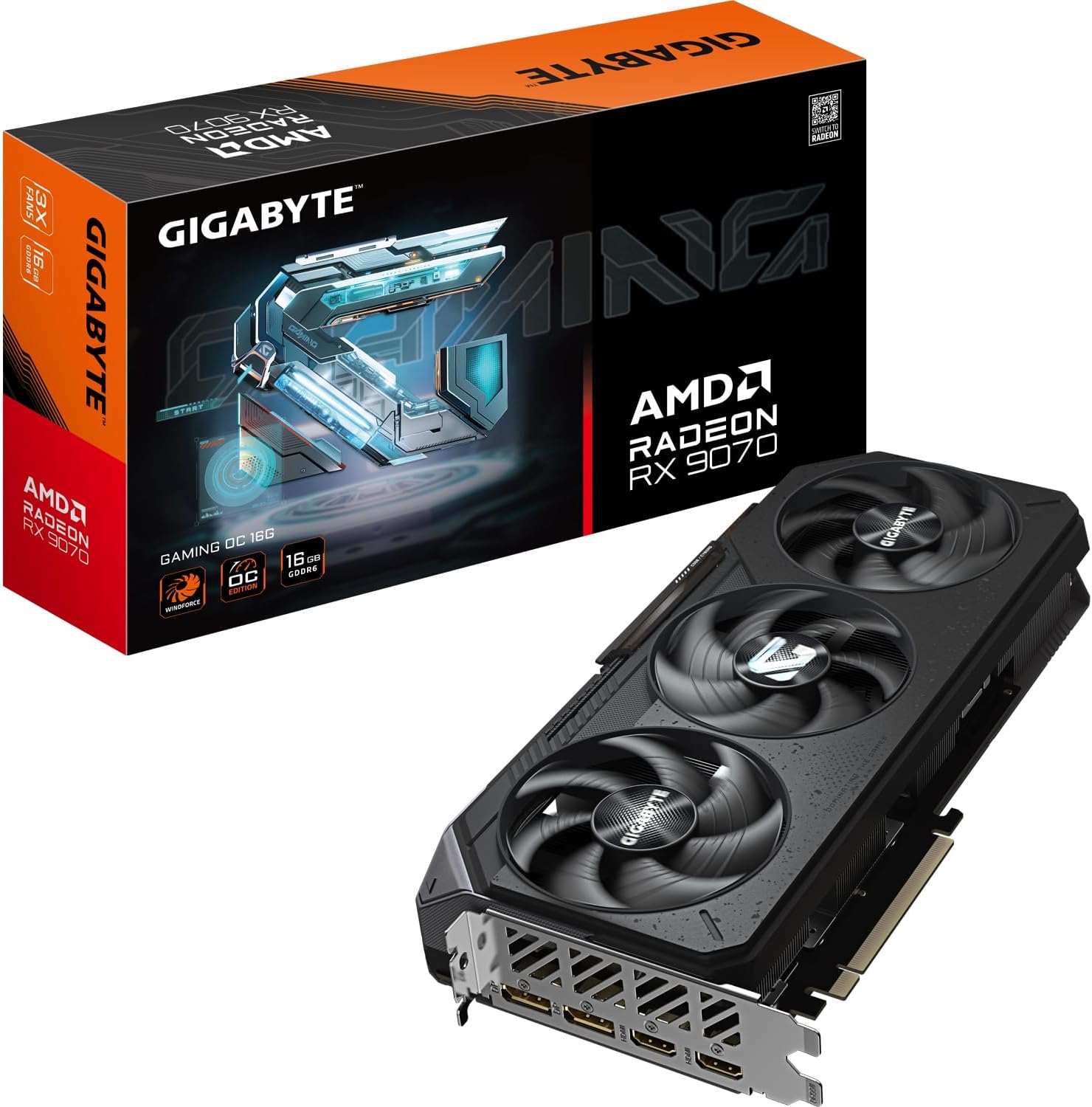
AMD Radeon RX 9070 16GB
16GB 1440p-grade graphics card, 220W draw, 300mm long, FSR 4.
RDNA 4 non-XT. 16GB VRAM advantage over RTX 5070's 12GB. Competitive raster performance.
Official India stock. Full warranty through the brand's India service network, standard RMA if anything goes wrong.
Full specs
PSUs rated 650W+
Cases that fit 300mm
Where to buy AMD Radeon RX 9070 16GB in India
Expect to pay roughly ₹56,200-62,000 for the AMD Radeon RX 9070 16GB in India right now, depending on offers and seller. I always recommend buying from retailers that give a proper GST invoice - it's what makes your India warranty claim smooth later.
Affiliate links on linked vendors - your price stays the same. PrimeABGB shown for comparison only.
In my years running a PC store, PrimeABGB (Mumbai) and Vedant Computers (Kolkata) have also been consistently reliable for verified stock - compare before buying.
AMD RX 9070 in India - The Sensible RDNA 4 Card for 1440p Gaming
The RX 9070 - AMD's Most Compelling Mid-Range Card in Years
Every GPU generation has a card that flies under the radar while its flashier sibling gets the headlines. The AMD Radeon RX 9070 is that card for RDNA 4. While the RX 9070 XT grabbed launch-day attention and review coverage, the non-XT quietly slotted in at ₹48,000-55,000 in India - delivering roughly 85-90% of the XT's performance for ₹7,000-10,000 less. That math changes everything.
I've been building and recommending PCs for Indian gamers long enough to know that the "best" GPU is rarely the fastest one. It's the one that leaves enough budget for a quality PSU, decent RAM, and a monitor that does justice to the frames you're pushing. The RX 9070 is that card - RDNA 4, 16GB GDDR6, 256-bit bus, improved ray tracing, FSR 4, and a power envelope that won't roast you in a Delhi summer. All at a price that fits a balanced ₹1L build.
Here's why the RX 9070 deserves your attention - and who should skip it.
Performance - 85-90% of the XT, 100% of the Practicality
The RX 9070 uses the same RDNA 4 architecture as the XT but with trimmed compute units and clocks. In practice, that's a 5-15% deficit versus the 9070 XT - a gap that's nearly invisible at 1440p High-Ultra where both cards are GPU-limited.
At 1440p High-Ultra (no upscaling), the RX 9070 delivers 85-115 FPS across current AAA titles. That's solidly in the range where a 144Hz monitor feels smooth. Enable FSR 4 Quality mode and you're looking at 120-160+ FPS perceived - high-refresh territory without dropping to Medium settings.
Compared to the RX 7800 XT, the RX 9070 is 20-25% faster in rasterization while drawing less power. In ray tracing, the improvement is dramatic - RDNA 4's revamped RT hardware closes roughly half the gap that existed between AMD and Nvidia last generation.
Here's the key takeaway from those numbers: the RX 9070 outperforms the RTX 5060 Ti by 8-10% in rasterization while sitting at a comparable or slightly higher price. In ray tracing, the 5060 Ti holds a 10% edge thanks to Nvidia's more mature RT hardware - but that gap has shrunk enormously from last generation. For gamers who play with RT off (which is most people at this price tier), the 9070 is simply the faster card.
Against its own sibling, the 9070 trails the 9070 XT by 10-12% in rasterization and ~10% in ray tracing. For ₹7,000-10,000 less, that's a trade most budget-conscious builders should make without hesitation.
India Pricing and Availability - Patience Is Paying Off
The RX 9070 had a rough start in India. AMD's distribution has historically lagged behind Nvidia's, and launch-day availability was poor - most retailers had zero stock for weeks. As of May 2026, the situation has improved significantly:
AIB Partner Pricing (May 2026):
| Model | Price | Notes |
|---|---|---|
| Sapphire Pulse RX 9070 16GB | ₹48,000-50,000 | Best value pick. Dual-fan, reliable cooling. |
| PowerColor Fighter RX 9070 16GB | ₹48,500-51,000 | Compact design, good thermals. |
| XFX Speedster SWFT RX 9070 16GB | ₹49,000-52,000 | Solid all-rounder, quiet fans. |
| Sapphire Nitro+ RX 9070 16GB | ₹52,000-55,000 | Premium cooler, factory OC. |
| PowerColor Red Devil RX 9070 16GB | ₹53,000-55,000 | Best cooling, slight premium tax. |
Stock is available through MDComputers, PrimeABGB, and Vedant Computers - though specific models come and go. Amazon India and Flipkart carry listings but typically at ₹2,000-4,000 above specialized retailer prices. Set stock alerts and check our vendor comparison guide for current deals.
The RX 9070 at ₹48-50K (Sapphire Pulse or PowerColor Fighter) is the best value 1440p GPU in India right now. It beats the RTX 5060 Ti in rasterization, matches it in RT, offers 16GB VRAM on a wider 256-bit bus, and costs roughly the same. The only reason to pick the 5060 Ti instead is if you specifically need DLSS 4 Multi Frame Generation or CUDA for creative/AI workloads.
Value Analysis - Where the 9070 Makes Sense (and Where It Doesn't)
At ₹48,000 for a Sapphire Pulse, the RX 9070 delivers the best rupee-to-frame ratio of any 1440p GPU in India right now - edging out the RTX 5060 Ti and significantly undercutting both the 9070 XT and RTX 5070.
Who should buy the RX 9070:
- 1440p gamers on a budget who want the best rasterization performance under ₹50K
- Builders who prioritize VRAM - 16GB on a 256-bit bus is more capable than the 5060 Ti's 16GB on 128-bit
- Linux users and open-source advocates - AMD's RDNA 4 drivers are upstreamed into the Linux kernel with day-one support
- Anyone building a balanced ₹85K-1.1L system where the GPU shouldn't eat more than half the budget
- Gamers who play primarily with RT off and want maximum rasterization value
Who should skip the RX 9070:
- Ray tracing enthusiasts - if you enable RT in every title, the RTX 5060 Ti or RTX 5070 with DLSS 4 is a better experience
- Content creators relying on CUDA - Premiere Pro, After Effects, and AI/ML workloads still favor Nvidia's ecosystem
- Streamers using NVENC - AMD's encoder has improved but NVENC remains the standard for hardware encoding quality
- Buyers who can comfortably afford ₹55K+ - at that budget, the RX 9070 XT is only ₹7-10K more for 10-12% more performance, which starts to make sense
Power, Cooling, and Build Fit
The RX 9070 draws ~180-190W TDP - a significant efficiency improvement over the RX 7800 XT's 263W. A quality 600W PSU handles this comfortably, and 650W gives headroom for transient spikes. Check our PSU guide for recommendations.
In Indian ambient conditions (35-40°C), expect 60-68°C GPU temperatures under load with dual-fan AIB models. Both the Sapphire Pulse and PowerColor Fighter stay under 70°C in non-AC rooms during summer. Read our cooling guide for Indian climate.
The RX 9070 fits naturally into our T05 - ₹1L 1440p Entry Build. Pair with a Ryzen 5 7600 (~₹16K) for the sweet spot - at 1440p, the GPU is the bottleneck regardless. For a premium pairing, the Ryzen 7 7800X3D at ~₹38.5K is future-proof if you plan to upgrade the GPU later. See our first-build mistakes guide before ordering.
Price we have actually seen
Down 13.6% since we started tracking. Every point is a price our crawler recorded at an Indian retailer - no estimates, no MSRP. Tracking began recently, so the window grows week by week.
Questions
At similar prices (₹48K vs ₹42-48K), this is genuinely close. The RX 9070 wins in rasterization by 8-10% and has a wider 256-bit memory bus. The RTX 5060 Ti wins with DLSS 4 MFG, better ray tracing, and CUDA support. If you game with RT off, the 9070 is faster. If you rely on DLSS, CUDA, or NVENC, the 5060 Ti makes more sense.
For most builders, no. The 9070 delivers 85-90% of the XT's performance for 85% of the price. The XT only makes sense if your budget is already ₹55K+ for the GPU and you want every last frame. If stretching to the XT means cutting your PSU or RAM budget, stay with the non-XT and build a balanced system. Our T06 - ₹1.3L Build accommodates the XT if you have the headroom.
FSR 4's ML-based upscaling is a massive leap over FSR 3.1 and approaches DLSS 4 Quality mode in most titles. The gap is narrow enough that you won't notice during gameplay. DLSS 4 still edges ahead in artifact handling and game support breadth. FSR 4's ML upscaling is exclusive to RDNA 4 - older AMD GPUs stay on FSR 3.1.
MDComputers, PrimeABGB, and Vedant Computers are your best bets for competitive pricing and reliable stock. Amazon India and Flipkart carry listings but typically at a ₹2,000-4,000 markup. Sapphire and PowerColor models are most consistently available through AMD's Indian distribution partners (Acro Engineering, Rashi Peripherals). Set stock alerts - specific models still sell out during restocks. Track retailer pricing through our vendor comparison guide.