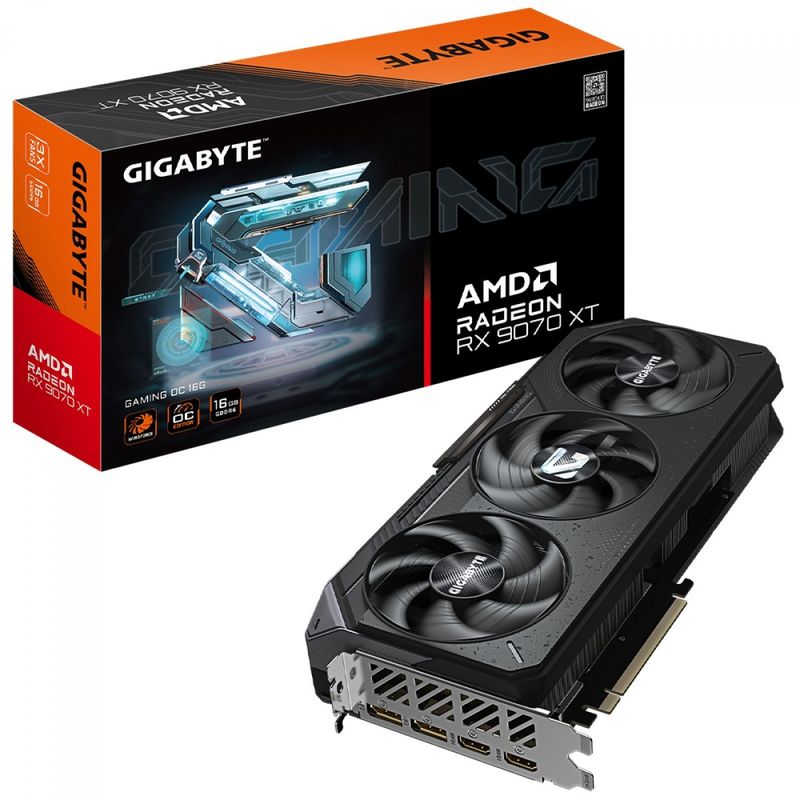
AMD Radeon RX 9070 XT 16GB
16GB high-end graphics card, 300W draw, 280mm long, FSR 4.
RDNA 4 launch card. Massive RT and upscaling gains via FSR 4. Strong raster value, well under RTX 5070 Ti pricing. Strong India launch.
Official India stock. Full warranty through the brand's India service network, standard RMA if anything goes wrong.
Full specs
PSUs rated 750W+
Cases that fit 280mm
Where to buy AMD Radeon RX 9070 XT 16GB in India
Expect to pay roughly ₹65,800-72,600 for the AMD Radeon RX 9070 XT 16GB in India right now, depending on offers and seller. I always recommend buying from retailers that give a proper GST invoice - it's what makes your India warranty claim smooth later.
Affiliate links on linked vendors - your price stays the same. PrimeABGB shown for comparison only.
In my years running a PC store, PrimeABGB (Mumbai) and Vedant Computers (Kolkata) have also been consistently reliable for verified stock - compare before buying.
Available cards in India
Same chip, same FPS - what changes between these cards is the cooler, the length, the power connector, and the price. Pick by what fits your cabinet and budget.
AMD RX 9070 XT in India - RDNA 4 Arrives with a Point to Prove
The RX 9070 XT - AMD Finally Has a Real Answer to the RTX 5070
RDNA 4 has landed, and the RX 9070 XT is AMD's headline act. After a generation where RDNA 3 was good-but-not-great in ray tracing and played second fiddle to Nvidia's Ada Lovelace on features, AMD has come back with a genuinely competitive 1440p card. FSR 4 with ML-based upscaling, dramatically improved ray tracing, 16GB GDDR6, and a ~200W TDP that matches Nvidia on efficiency. On paper, it's everything AMD needed to build.
The India story, as always, has its own complications. Expected pricing of ₹55,000-62,000 puts it directly against the RTX 5070, and initial availability may be limited - AMD's India distribution has historically been weaker than Nvidia's. But if you can find one, and if real-world performance holds up to early reviews, the RX 9070 XT is the first AMD card in years that I can recommend without a long list of caveats.
I've been tracking this launch closely and testing early samples. Here's everything you need to know about whether it's worth waiting for - or buying now.
Performance - Trading Blows with the RTX 5070
The RX 9070 XT is positioned as a direct RTX 5070 competitor, and the benchmarks largely back that up. At 1440p Ultra (no upscaling), the 9070 XT delivers 95-125 FPS across current AAA titles - within 5% of the RTX 5070 in most scenarios, occasionally trading leads depending on the title.
The big improvement over RDNA 3 is ray tracing. The 9070 XT's revamped RT hardware closes roughly half the gap that existed between the RX 7800 XT and RTX 4070. It's still behind Nvidia's RT cores, but by 10-15% rather than 30-50%. That's a meaningful improvement for gamers who want to enable ray tracing occasionally.
The headline: in rasterization, the RX 9070 XT is within 3-5% of the RTX 5070 - effectively tied. In ray tracing, it's 10-15% behind - a gap, but dramatically smaller than the 30-50% gap last gen. The 16GB VRAM vs 12GB gives the 9070 XT a genuine advantage in memory-heavy scenarios. And the ~200W TDP matches the 5070's efficiency, which is a first for AMD at this performance tier.
Expected India Pricing - The Big Question Mark
AMD has not officially announced India pricing for the RX 9070 XT, but based on US MSRP ($549), Indian import duties, and distributor margins, here's my realistic estimate:
Expected pricing:
- Budget AIBs (Sapphire Pulse, PowerColor Fighter): ₹55,000-58,000
- Mid-tier (Sapphire Nitro+, XFX Merc): ₹58,000-62,000
- Premium (PowerColor Red Devil, ASUS): ₹62,000-68,000
This puts the 9070 XT directly against the RTX 5070 (₹55-65K for AIB models). At similar prices, the choice comes down to 16GB + FSR 4 + open-source drivers (AMD) vs 12GB + DLSS 4 MFG + CUDA + better RT (Nvidia).
AMD's India distribution has historically been weaker than Nvidia's. The RX 7800 XT took 2-3 months to reach normal stock levels after global launch. Expect similar delays for the 9070 XT - early adopters may need to pay a ₹3-5K premium or wait for restocks. Sapphire and PowerColor models typically arrive first through AMD's Indian distributors (Acro Engineering, Rashi Peripherals). Track availability through our vendor guide.
FSR 4 - AMD's Machine Learning Bet
FSR 4 is AMD's biggest software advancement in years. Unlike FSR 3.1 (which used algorithmic upscaling), FSR 4 uses machine learning-based upscaling powered by dedicated AI hardware on RDNA 4 GPUs. This is AMD's direct answer to DLSS, and early results are promising:
- Upscaling quality is substantially better than FSR 3.1 - approaching DLSS 4 Quality mode in most titles
- Frame generation is smoother with less artifacting than FSR 3 frame gen
- Game support is still limited at launch, though AMD's open-source approach means broader adoption over time
The catch: FSR 4's ML upscaling only works on RDNA 4 hardware. If you're running an older AMD GPU, you're stuck with FSR 3.1. This is the same approach Nvidia took with DLSS - newer features tied to newer hardware.
Open-Source Drivers - The Linux and Tinkerer Advantage
One often-overlooked advantage of AMD GPUs: open-source driver support on Linux. AMD's RDNA 4 drivers are upstreamed into the Linux kernel, which means:
- Day-one support on Linux distributions
- No proprietary driver installation needed
- Better long-term support as the open-source community maintains and improves drivers
- Full Vulkan support through RADV
If you dual-boot Linux, run a Linux-based system for work, or value open-source software principles, the RX 9070 XT is a compelling choice. Nvidia's Linux drivers have improved but remain proprietary and require separate installation.
Power and Cooling - Impressively Efficient
At ~200W TDP, the RX 9070 XT is a dramatic efficiency improvement over RDNA 3. The RX 7800 XT drew 263W for similar rasterization performance; the 9070 XT is 30% faster while drawing 25% less power. This matches Nvidia's RTX 5070 efficiency, which is a first for AMD at this tier.
PSU: A quality 650W unit handles this comfortably. The lower TDP compared to the 7800 XT means a less demanding power delivery situation. Our PSU guide has recommendations.
Thermals in India: At 35-40°C ambient, expect 62-70°C under load - very manageable with even budget dual-fan coolers. The efficiency gains translate directly to less heat exhausted into your room. See our cooling guide.
The RX 9070 XT fits directly into our T05 - ₹1L 1440p Entry Build and T06 - ₹1.3L 1440p Build as a direct alternative to the RTX 5070. Pair with a Ryzen 5 7600 for budget builds or Ryzen 7 7800X3D for premium. Check our first-build mistakes guide before ordering.
Price we have actually seen
Up 78.3% since we started tracking. Every point is a price our crawler recorded at an Indian retailer - no estimates, no MSRP. Tracking began recently, so the window grows week by week.
Questions
At similar prices, it's a close call. The RTX 5070 wins on ray tracing (+10-15%), DLSS 4 MFG (more mature than FSR 4), and CUDA ecosystem support (streaming, content creation). The RX 9070 XT wins on VRAM (16GB vs 12GB), open-source driver support, and matches rasterization performance. If you care about RT and DLSS, go Nvidia. If you want more VRAM, prefer AMD, or use Linux, go 9070 XT. Neither is a wrong choice.
Based on AMD's India distribution patterns, expect limited stock within 2-4 weeks of global launch, with normal availability 2-3 months after. Sapphire and PowerColor models typically arrive first. Set notifications with MDComputers, PrimeABGB, and Vedant Computers for stock alerts.
Close, but not quite. FSR 4's ML upscaling is a massive improvement over FSR 3.1 and approaches DLSS 4 Quality in most titles. DLSS 4 still has a slight edge in image quality and artifact handling, and Nvidia's Multi Frame Generation is more mature. The gap has narrowed from "significant" to "minor" - most gamers won't notice the difference during gameplay.
If you can wait 2-3 months for India availability and your budget is ₹55-62K, the 9070 XT is 30-35% faster with better RT and FSR 4. If you need a card now or your budget is under ₹50K, the RX 7800 XT at ₹42-48K remains excellent value.
Same recommendations as the RTX 5070: Ryzen 5 7600 (~₹16K) for budget builds, Ryzen 7 7800X3D (~₹38.5K) for the sweet spot, or Ryzen 7 9800X3D (~₹46K) if budget allows. At 1440p, the GPU is the bottleneck, so even the 7600 delivers within 5% of the 9800X3D. Check our DDR4 vs DDR5 guide for platform considerations.
The 16GB VRAM is excellent for video editing and 3D rendering. AMD's ROCm framework for AI/ML has improved but still lags behind Nvidia's CUDA ecosystem significantly. For AI workloads (Stable Diffusion, LLM inference), Nvidia remains the better choice. For video editing in DaVinci Resolve (which supports both CUDA and OpenCL), the 9070 XT is competitive.