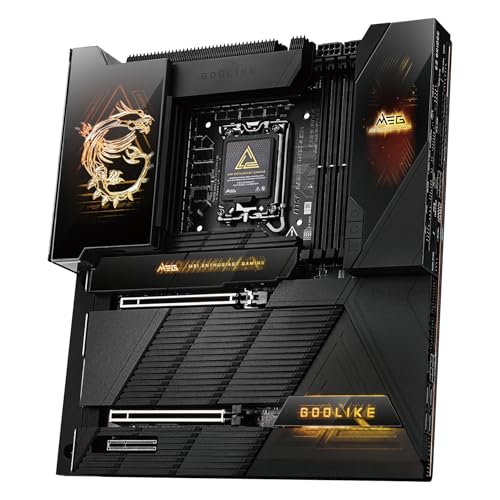
MSI MEG X870E Godlike
ATX X870E board for AM5 CPUs, DDR5 memory, BIOS Flashback included.
The MSI MEG X870E Godlike costs ₹143,499-148,299 in India. It is, by a wide margin, the most expensive AM5 motherboard I've covered on this site, and one of the most expensive motherboards for any consumer platform currently sold here.
Official India stock. Full warranty through the brand's India service network, standard RMA if anything goes wrong.
Full specs
Compatible CPUs
DDR5 memory kits
Where to buy MSI MEG X870E Godlike in India
Expect to pay roughly ₹1,37,800-1,52,100 for the MSI MEG X870E Godlike in India right now, depending on offers and seller. I always recommend buying from retailers that give a proper GST invoice - it's what makes your India warranty claim smooth later.
Affiliate links on linked vendors - your price stays the same. PrimeABGB shown for comparison only.
In my years running a PC store, PrimeABGB (Mumbai) and Vedant Computers (Kolkata) have also been consistently reliable for verified stock - compare before buying.
MSI MEG X870E Godlike Review India 2026 — The Most Expensive AM5 Board You Can Buy
Setting the Context — Why I'm Starting Here
Before this article, GetPC had zero X870E coverage. That's not a small gap — X870E is AMD's current flagship AM5 chipset, the successor to X670E, and it's what you get paired with the newest Ryzen 9000X3D CPUs when a manufacturer wants to claim the absolute top spec. Every X870E board mandates PCIe 5.0 on both the GPU slot and primary M.2 slot, plus native USB4 support baked into the chipset rather than bolted on with a third-party controller. That's a real, meaningful step up from X670E, where those features were inconsistent between vendors.
The Godlike sits at the very top of that stack, and MSI's naming isn't subtle about it. This is the board equivalent of a manufacturer saying "we're not competing on price here."
What ₹1.45 Lakh Actually Buys You
I'll go through this honestly rather than just reciting a spec sheet, because at this price the details matter more than the marketing.
VRM: The Godlike runs an extreme power stage design, well beyond anything a Ryzen 9950X3D or 9950X will actually draw even under sustained all-core load. This isn't headroom you'll use for stability — it's headroom for extreme overclockers running sub-ambient cooling (LN2, phase change) who need a board that won't be the limiting factor when they're chasing world records. If that's not you, you're paying for capability you won't touch.
E-ATX form factor: This is a large board. Before you buy, check that your case supports E-ATX dimensions — a lot of mid-tower cases marketed as "ATX compatible" do not have the extended mounting holes E-ATX boards need. This trips people up more than any other spec on this board.
Networking: Dual LAN with both 10GbE and 5GbE, plus WiFi 7. This is genuinely useful if you're running a home server or NAS alongside your main rig and want to saturate a fast local network without a separate NIC.
Storage: Five M.2 slots on the board itself, and MSI includes an M.2 Xpander-Z Gen5 expansion card in the box — an add-in card that gives you additional PCIe 5.0 M.2 slots off a PCIe slot, for people who want six-plus NVMe drives without touching a separate HBA.
The OLED front panel: MSI puts a small OLED display on the Godlike's I/O shield, similar to what you see on MEG Ace-tier boards, showing temps, clocks, or custom graphics. It's a nice-to-have, not a performance feature, but it's part of what you're paying for at this tier.
The Honest Take on Value
I don't think the Godlike is a "smart buy" in the way I'd normally use that phrase on this site. At ₹143,499-148,299, you could buy a Crosshair X870E Hero and put the difference toward a significantly better GPU, and your gaming performance would be identical or better. The Godlike's advantages — extreme VRM headroom, dual 10G/5G LAN, the Xpander-Z card, the OLED panel — are real, but they're aimed at a narrow slice of buyers: extreme overclockers, people building a genuine home lab alongside their gaming rig, or buyers who simply want the best MSI makes regardless of cost.
If you're in that slice, the Godlike delivers. If you're not sure whether you're in that slice, you're probably not, and that's fine — the Crosshair X870E Hero or Aorus Master will serve you better per rupee spent.
Boards at this price point in India often move through smaller specialty retailers or parallel import channels rather than mainstream e-commerce. Confirm you're buying MSI India-warrantied stock, not a grey import, before paying ₹1.4 lakh-plus for a motherboard. Read our parallel import warranty guide and stick to computechstore.in, krgkart.com, or other verified authorized sellers.
Who Should Buy the MEG X870E Godlike
Buy this if you're an extreme overclocker who needs VRM headroom beyond anything a normal build requires, you're consolidating a home server and a high-end gaming rig onto one E-ATX board with dual 10G/5G LAN, or you simply want the best AM5 board that exists and price isn't part of the decision. Buy this if your case is confirmed E-ATX compatible — check this before ordering, not after.
Skip this if you're building around a single GPU for gaming, even at 4K. Skip this if ₹100,000+ feels like a lot to spend on a motherboard relative to your GPU budget — it should, and that instinct is correct for the vast majority of builds. Skip this if you don't already know you need dual 10G LAN or an E-ATX case; if you're asking, you don't need it. Look at the Crosshair X870E Hero or Gigabyte X870E Aorus Master instead.
Price we have actually seen
Down 9.8% since we started tracking. Every point is a price our crawler recorded at an Indian retailer - no estimates, no MSRP. Tracking began recently, so the window grows week by week.
Questions
For gaming and general high-end builds, no — the Hero gets you the same PCIe 5.0/USB4 baseline at roughly half the price. The Godlike is worth it specifically for extreme overclocking headroom, dual 10G/5G networking, and E-ATX expansion capacity. If none of those apply to your use case, save the money.
Yes, effectively. It's E-ATX, which is physically larger than standard ATX. Confirm your case's spec sheet explicitly lists E-ATX support and check the motherboard tray dimensions, not just "supports large boards" marketing language.
Ryzen 9 9950X3D is the obvious pairing for anyone treating this as a no-compromise gaming-plus-workstation build. If you're an extreme overclocker chasing benchmark records, the non-X3D Ryzen 9 9950X is often preferred since it clocks higher without the 3D V-Cache thermal constraints. Either way, verify BIOS version supports your exact CPU's microcode before first boot — see our AM5 BIOS update guide.
If you need six or more NVMe drives in one system, yes — it's a genuinely useful included accessory that would otherwise cost extra. If you only need the board's five onboard M.2 slots, it's a nice-to-have you're already paying for as part of the bundle.