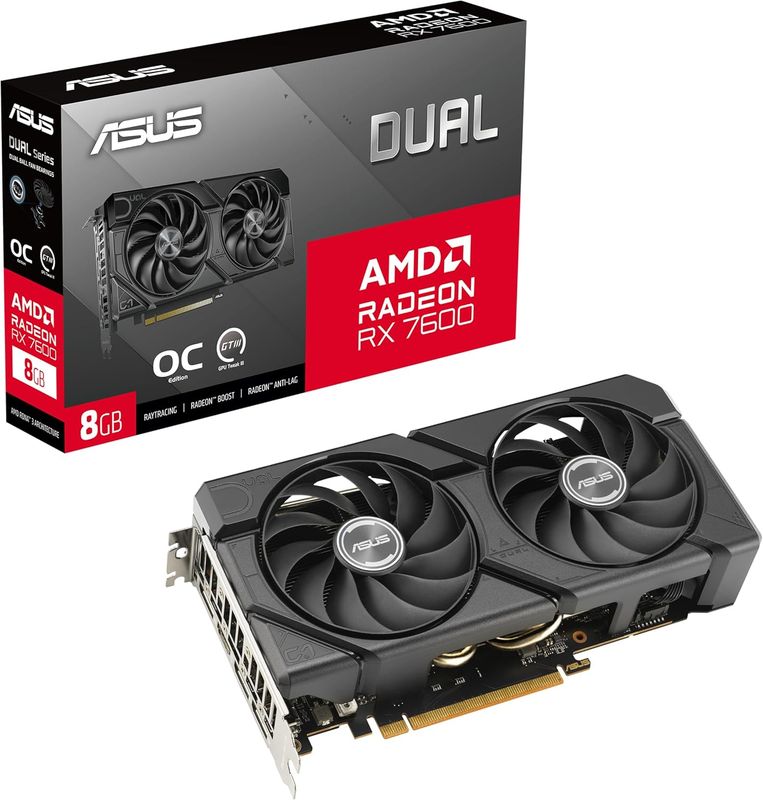
AMD Radeon RX 7600 8GB
8GB 1080p-grade graphics card, 165W draw, 240mm long, FSR 3.1.
Capable 1080p card, but poor new value near ₹38,000. GetPC previously sold it around ₹26,000 and now recommends the RTX 5060 for a fresh build. A tested used unit can make sense around ₹22,000–26,000.
Official India stock. Full warranty through the brand's India service network, standard RMA if anything goes wrong.
Full specs
PSUs rated 550W+
Cases that fit 240mm
Where to buy AMD Radeon RX 7600 8GB in India
Expect to pay roughly ₹36,500-40,300 for the AMD Radeon RX 7600 8GB in India right now, depending on offers and seller. I always recommend buying from retailers that give a proper GST invoice - it's what makes your India warranty claim smooth later.
Affiliate links on linked vendors - your price stays the same. PrimeABGB shown for comparison only.
In my years running a PC store, PrimeABGB (Mumbai) and Vedant Computers (Kolkata) have also been consistently reliable for verified stock - compare before buying.
Available cards in India
Same chip, same FPS - what changes between these cards is the cooler, the length, the power connector, and the price. Pick by what fits your cabinet and budget.
RX 7600 Price in India (2026): New vs Used Buying Guide
RX 7600 India price and buying advice from GetPC builds. See why it is poor value near ₹38,000, when used makes sense, and why RTX 5060 is better new.
A capable 1080p card trapped at the wrong new price
The Radeon RX 7600 is a proper 1080p gaming GPU with 8GB of memory, modest power requirements and no recurring hardware problem in the systems GetPC built. At the approximately ₹26,000 price we once sold it for, it was a reasonable option. Near ₹38,000 today, it is not. Buy the newer RTX 5060 for a new build. Consider the RX 7600 used only when the condition and ₹22,000 to ₹26,000 price survive a careful comparison.
Good GPU, bad current new price. Keep it if you own one. For a fresh retail purchase, choose the RTX 5060. A tested used RX 7600 can still make sense for a focused 1080p build.
That is the resolution AMD designed and markets this card around.
The level at which we previously sold RX 7600 systems.
The RTX 5060 is the stronger new purchase around this budget.
The key question is not whether the RX 7600 can still run games. It can. The question is whether an older 8GB card is worth its current Indian asking price when a newer GPU is available in the same spending range. Those are different judgments, and the second one is what should decide the purchase.
GetPC did not build enough RX 7600 systems to claim experience across hundreds or thousands of cards. Our conclusions here are deliberately limited to the units we handled, current retailer observations, official specifications and the buying decisions we would make today.
The card stayed useful while its value disappeared
The RX 7600 made sense when its price created a clear saving. We sold it at around ₹26,000 in systems aimed at 1080p gaming. The lower GPU spend could be used for a better power supply, more storage or a stronger platform without giving up the target gaming resolution.
That value argument no longer works when new listings approach ₹38,000. The hardware has not become faster, gained more memory or moved into a higher performance class. Only the market price has changed. Scarcity and remaining inventory can make an old product more expensive without making it a better product.
Continue using it at 1080p
A working RX 7600 remains a sensible 1080p card. There is no need to replace it simply because the retail recommendation changed.
Choose the RTX 5060
At roughly the same current spending level, the newer NVIDIA option is the purchase we would make for a fresh build.
This distinction also matters for search results. A page showing a live price is not automatically recommending that price. GetPC's retailer table tells you what sellers are asking. The editorial section tells you whether that asking price makes sense.
Our RX 7600 systems were straightforward AM5 gaming PCs
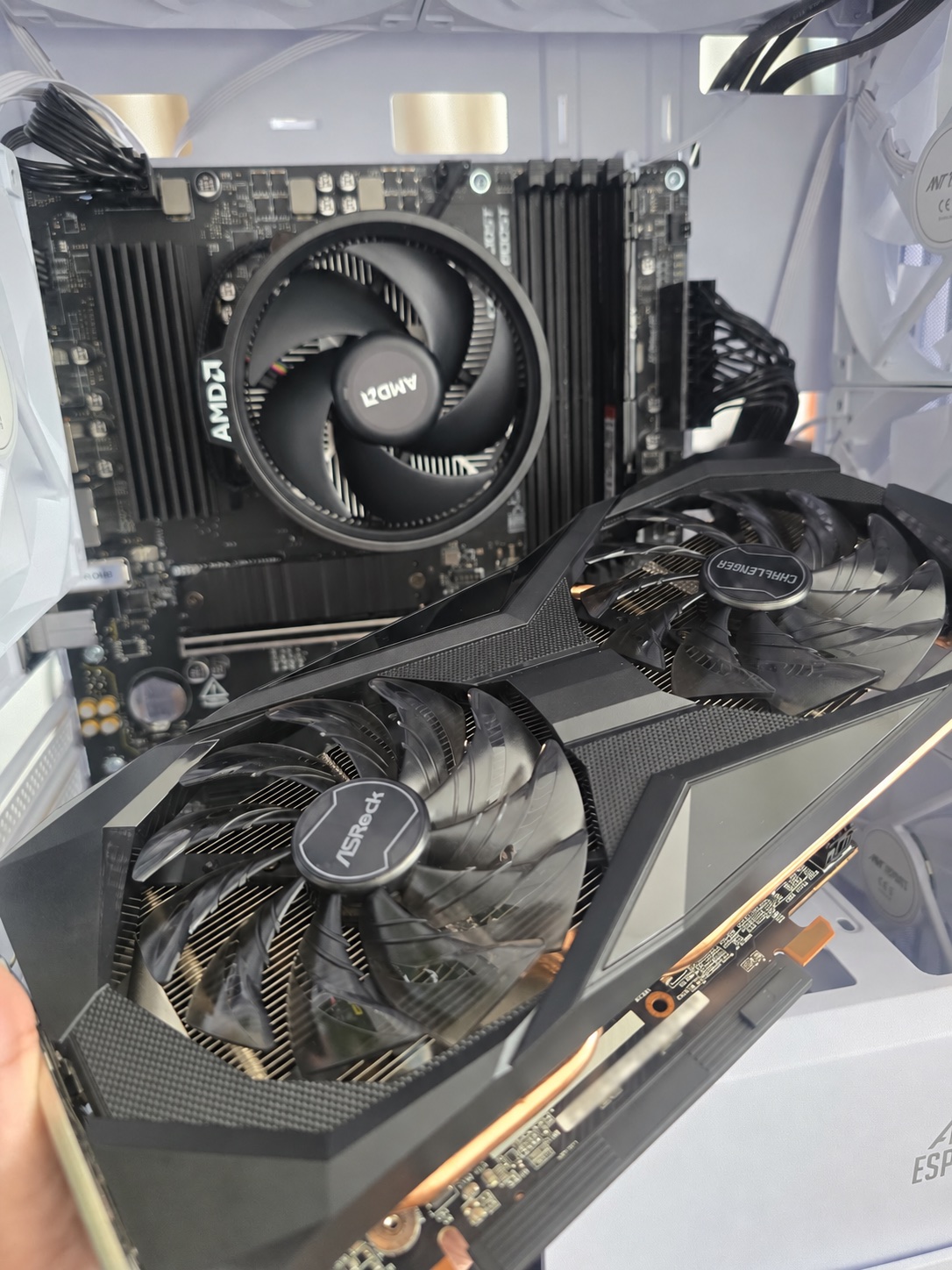
We did not sell many RX 7600 systems. The model we handled most was an ASUS RX 7600. The photograph on this page shows an ASRock Challenger RX 7600 from a real system, which is why the cooler design differs from the ASUS cards mentioned in our store experience.
A common platform used a Ryzen 5 7500F, B650M Gaming WiFi motherboard, 16GB of DDR5 memory and an MSI 650W 80 Plus Bronze power supply. That combination was intended for a balanced 1080p gaming PC with a modern AM5 upgrade path.
The Ryzen 5 7500F has no integrated graphics, so the system depends on the discrete GPU for display output. Plug the monitor into the RX 7600 rather than the motherboard. Sixteen gigabytes is workable for a gaming-focused machine, although buyers who keep many applications open or play memory-heavy titles may prefer 32GB when the budget permits.
Do not copy this parts list blindly. Check the exact motherboard, BIOS support, memory kit, cabinet clearance and PSU connectors for the components being purchased. B650 is an AM5 chipset and cannot be used with older AM4 processors such as the Ryzen 5 5600.
AMD positions the RX 7600 as a 1080p graphics card
AMD lists 32 compute units, 2,048 stream processors, 32 ray accelerators and a boost frequency of up to 2,655MHz for its reference RX 7600 specification. The card has 8GB of GDDR6 on a 128-bit interface, up to 288GB/s of memory bandwidth and 32MB of Infinity Cache.
The official board-power figure is 165W. AMD recommends a minimum 550W system power supply and specifies one 8-pin supplementary power connector for the reference design. Individual ASUS, ASRock, Sapphire, PowerColor, Gigabyte and other partner cards can use different dimensions, coolers and clock settings.
AMD also lists AV1 encoding and decoding, DisplayPort 2.1 capability and HDMI 2.1 support. These features are useful, but they do not change the central purchasing question. A feature list cannot repair a new price that places the card against a newer and stronger alternative.
The old version of this article stated a 150W figure. That has been corrected to AMD's official 165W typical board power. It also treated RX 7600 and RX 7600 XT searches too loosely. The RX 7600 XT is a different 16GB product with a different power profile and should not be confused with this 8GB card.
Use the live price as evidence, not as permission to buy
The live retailer panel on this page should be the first place to check the current RX 7600 price in India. Confirm the final checkout amount, seller, exact model, stock status, GST invoice and Indian warranty. Search snippets and cached product pages can show prices that are no longer available.
GetPC's historical store reference is approximately ₹26,000. That was a defendable price for the card when it sat clearly below more expensive alternatives. Our current observation is around ₹38,000 following the price increase. At that amount, we would not buy it.
GetPC's RX 7600 price rule
A temporary discount deserves a fresh comparison, but do not compare GPU prices alone. Warranty, seller quality and the cost of the complete PC still matter.
A high listing from one marketplace seller does not establish the value of every RX 7600. Equally, one unusually cheap listing may be out of stock, imported without useful Indian warranty or attached to a different model. The complete product name matters. RX 7600 8GB and RX 7600 XT 16GB are not interchangeable.
Price, used-card value and current Indian availability are the questions this page must answer first. The practical conclusion is direct: the RX 7600 is not worth approximately ₹38,000 merely because a retailer still lists it.
The RTX 5060 is the better new purchase
This comparison does not require a fabricated universal percentage. Game performance changes with the title, driver, settings, CPU and test method. The buying decision is simpler: when the RX 7600 approaches RTX 5060 money, GetPC would choose the RTX 5060.
The RTX 5060 is a newer Blackwell product with 8GB of GDDR7 memory, 3,840 CUDA cores, 145W total graphics power and a 550W required-system-power specification from NVIDIA. It also brings the current NVIDIA feature stack, including DLSS 4 and newer encoding hardware.
The RX 7600 retains some practical positives. It uses a conventional 8-pin connector, has competent 1080p raster performance and supports AMD's current Radeon software features. Those advantages matter to an owner or a used buyer. They do not justify paying around ₹38,000 for new old-generation stock.
Radeon RX 7600
- Architecture
- RDNA 3
- Memory
- 8GB GDDR6
- Board power
- 165W
- Target use
- 1080p gaming
- GetPC decision
- Keep or buy used carefully
GeForce RTX 5060
- Architecture
- Blackwell
- Memory
- 8GB GDDR7
- Graphics power
- 145W
- Feature generation
- DLSS 4
- GetPC decision
- Buy for a fresh build
Do not confuse “AMD versus NVIDIA” with a permanent brand rule. The recommendation is about these products at today's prices. A future RX 7600 clearance could change the value calculation, which is why the live retailer table and a same-day comparison remain important.
It is acceptable for the card's intended 1080p role
Eight gigabytes is workable for the 1080p gaming systems in which we used this card. It is not an automatic failure point, and an owner should not panic because newer products advertise more memory. Game settings and actual behaviour matter more than an isolated capacity number.
The limit becomes relevant when a game uses high-resolution textures, heavy ray tracing, large mod packs or a higher output resolution. In those cases, the user may need to reduce texture quality or another memory-heavy setting. A card can have enough processing performance for a scene while still encountering a memory constraint.
1080p with sensible settings
Eight gigabytes is generally acceptable for the role. Tune demanding games individually instead of forcing one preset everywhere.
High-end 1440p or 4K
The GPU tier and memory capacity can both require compromises. This is not the card we would choose for a new high-resolution build.
Upscaling and frame-generation features can help supported games, but they do not add physical VRAM. They also should not be used to promise one result across every title. Start from the native performance and image quality you find acceptable, then treat software features as additional tools.
We used a reputable 650W Bronze unit for the complete PC
AMD's official minimum is 550W for the reference recommendation. GetPC normally paired the card with an MSI 650W 80 Plus Bronze power supply. The additional capacity gave the full system reasonable headroom and made a future component change easier.
That does not mean every box marked 650W is suitable. Efficiency certification is not a complete quality review. Check the exact PSU model, protections, warranty, connector availability and credible technical testing. An unknown 650W unit can be a worse choice than a well-built lower-wattage model used within its limits.
Use one dedicated PCIe power cable if the selected card and PSU documentation call for it. Seat the 8-pin connector fully and avoid questionable adapters. Verify the specific partner card because factory-overclocked models and cooler designs can differ from AMD's reference dimensions.
The ASRock Challenger in our photograph is not proof that every RX 7600 fits the same case. Measure available GPU length and thickness, account for front fans or radiators, and leave enough space for airflow and cable routing.
We saw no recurring hardware fault in the units we handled
GetPC did not encounter a repeat fan, temperature or card-failure pattern in the RX 7600 systems we built. The sample was limited, so this should be read as our store observation rather than a statistical failure-rate claim.
AMD's Radeon software can occasionally create a software-side problem. A driver update, profile conflict or corrupted installation may cause instability without indicating failed hardware. If a previously stable system begins crashing after a driver change, record the error, return clocks to stock, remove conflicting overlays and test a clean driver installation before condemning the card.
Do not respond to every issue by repeatedly installing random driver versions. Establish a baseline first. Check Windows reliability history, temperatures, power connections, memory stability and whether the fault appears in more than one game. A complete PC can crash because of the GPU driver, but it can also crash because of RAM, CPU tuning, PSU behaviour or damaged game files.
Used is the most interesting way to buy this card now
The used market can restore the price advantage that the inflated new market removed. It is now the most credible reason to consider this card, but only when the saving is large enough and the individual unit is healthy.
GetPC considers approximately ₹22,000 to ₹26,000 a possible used range, provided the exact card passes testing and the price is compared against current new alternatives on the same day. The upper end should come with excellent condition, credible purchase history and useful remaining warranty. A weak or out-of-warranty card should not command the same amount.
Used RX 7600 decision
The condition, remaining warranty and same-day new pricing decide whether a particular unit belongs inside this range.
Test the card under sustained GPU load rather than accepting a desktop screenshot. Watch for artifacts, driver resets, crashes, unexpected clock drops, abnormal fan noise and temperatures that continue rising. Test every display output you expect to use. Inspect the PCB edge, cooler, screws and connectors for damage, corrosion or repair marks.
Match the serial number on the card, box and invoice when those items are available. Verify warranty with the relevant Indian distributor or board partner instead of relying on the seller's statement. Never publish a serial-number photograph online; the barcode in GetPC's editorial image was intentionally obscured for that reason.
Pay through a method that leaves appropriate evidence, document the seller and keep a short video of the working test. Read the complete used PC parts buying guide before meeting a seller.
Build for the target frame rate, not a “zero bottleneck” label
The Ryzen 5 7500F was a suitable partner in our AM5 systems, but it is not the only CPU that can work with an RX 7600. The right processor depends on the game, desired frame rate, background workload and future upgrade plan.
At 1080p competitive settings, the CPU may matter more because the system is trying to produce a high frame rate. In a demanding single-player game at higher visual settings, the GPU is more likely to become the limit. No single bottleneck percentage describes both situations honestly.
An AM5 build with B650 and DDR5 costs more than a reused AM4 platform, but it offers a newer upgrade path. A buyer who already owns a sound Ryzen 5 5600-class system does not need to replace the whole platform merely to use an RX 7600. A buyer starting from nothing should compare the entire system cost, not only the processor label.
Use two memory modules where practical to enable the intended memory-channel configuration. Confirm that EXPO or the selected memory profile is stable rather than assuming the advertised kit speed is guaranteed by every CPU and motherboard combination.
Precise-looking charts are not a substitute for evidence
The old article contained exact FPS bars, ray-tracing percentages, full-build totals and performance-per-price claims without a retained GetPC test record. Those graphics looked authoritative but were not reproducible as GetPC measurements. They have been removed.
This rewrite keeps the sources separate:
- Product specifications and positioning come from AMD.
- RTX 5060 specifications come from NVIDIA.
- Price observations come from GetPC's retailer tracking and Ashutosh's store experience.
- Build and reliability guidance comes from the RX 7600 systems GetPC actually handled.
The old copy also claimed that unusually cheap units were “almost certainly” parallel imports. Price alone cannot prove import status, so that statement has been removed. Verify the invoice and distributor warranty directly.
It described the RX 7600 XT inaccurately and allowed XT queries to blur the purpose of the page. The RX 7600 XT is a separate 16GB model, not a higher-clocked version of the same 8GB specification. Buyers should open its dedicated product listing rather than using this article's price threshold.
Buy the condition and price, not the old recommendation
The 1080p value is real
- You already own a stable RX 7600
- Your target is primarily 1080p gaming
- A used card is approximately ₹22,000 to ₹26,000
- The unit passes sustained testing
- Warranty and seller evidence are credible
The new price has climbed too high
- A new RX 7600 is near ₹38,000
- The RTX 5060 costs a similar amount
- The seller cannot verify the exact model or warranty
- You are planning a high-end 1440p or 4K system
- The used price leaves no meaningful saving
Before paying, check the exact model name, final price, card dimensions, power connector, warranty provider, invoice and return terms. For a used card, add sustained testing and serial verification. For a new build, compare the RX 7600 and RTX 5060 in the same retailer window so a stale result does not distort the decision.
Frequently asked questions
What is the RX 7600 price in India in 2026?
Use the live retailer table on this page for today's tracked offers. GetPC previously sold the card at approximately ₹26,000, while recent pricing has risen to around ₹38,000. We do not consider it good value near ₹38,000.
Is the RX 7600 worth buying in 2026?
Not at its current inflated new price. It remains useful for existing owners and can make sense used at approximately ₹22,000 to ₹26,000 after proper testing. For a new purchase, GetPC recommends the RTX 5060.
Is the RX 7600 good for 1080p gaming?
Yes. AMD positions it as a 1080p graphics card, and that matches the systems GetPC built. Exact performance depends on the game, settings, CPU and driver, so we do not promise one universal FPS figure.
Is 8GB VRAM enough for the RX 7600?
Eight gigabytes is acceptable for its intended 1080p role. Some demanding games, high-resolution texture packs or higher output resolutions can require reduced settings.
What is the RX 7600 TDP?
AMD specifies 165W typical board power for the desktop RX 7600. The company recommends a minimum 550W system power supply for its reference guidance.
Does the RX 7600 need a 650W PSU?
AMD's official minimum recommendation is 550W. GetPC commonly used a reputable MSI 650W 80 Plus Bronze unit for complete systems because it offered sensible headroom. The final requirement depends on the CPU and the rest of the PC.
What is a fair used RX 7600 price?
Approximately ₹22,000 to ₹26,000 can be worth considering, depending on condition, remaining warranty and current new-GPU prices. Compare the upper end carefully with a new RTX 5060 before paying.
Which RX 7600 model did GetPC use?
We mostly handled an ASUS RX 7600. The real build photograph on this page shows an ASRock Challenger RX 7600. Partner models can differ in dimensions, cooler design, noise and warranty handling.
Does the RX 7600 have driver problems?
We did not see a recurring hardware fault in the limited number of systems we built. AMD software can occasionally cause a driver or profile issue, so diagnose cleanly before assuming the graphics card has failed.
RX 7600 or RTX 5060: which should I buy?
Buy the RTX 5060 for a new system when pricing is similar. Consider the RX 7600 only when it is meaningfully cheaper, particularly as a tested used card.
Is RX 7600 the same as RX 7600 XT?
No. The RX 7600 covered here has 8GB of memory. The RX 7600 XT is a separate 16GB product with different specifications and pricing.
Can I pair an RX 7600 with Ryzen 5 7500F?
Yes. GetPC used that combination with a B650M motherboard and DDR5 memory. Because the Ryzen 5 7500F lacks integrated graphics, connect the monitor to the RX 7600.
Where can I verify the official specifications?
Read AMD's official Radeon RX 7600 product page and NVIDIA's official RTX 5060 specifications. Retail prices and partner-card dimensions should be checked again immediately before purchase.
Price we have actually seen
Down 11.3% since we started tracking. Every point is a price our crawler recorded at an Indian retailer - no estimates, no MSRP. Tracking began recently, so the window grows week by week.