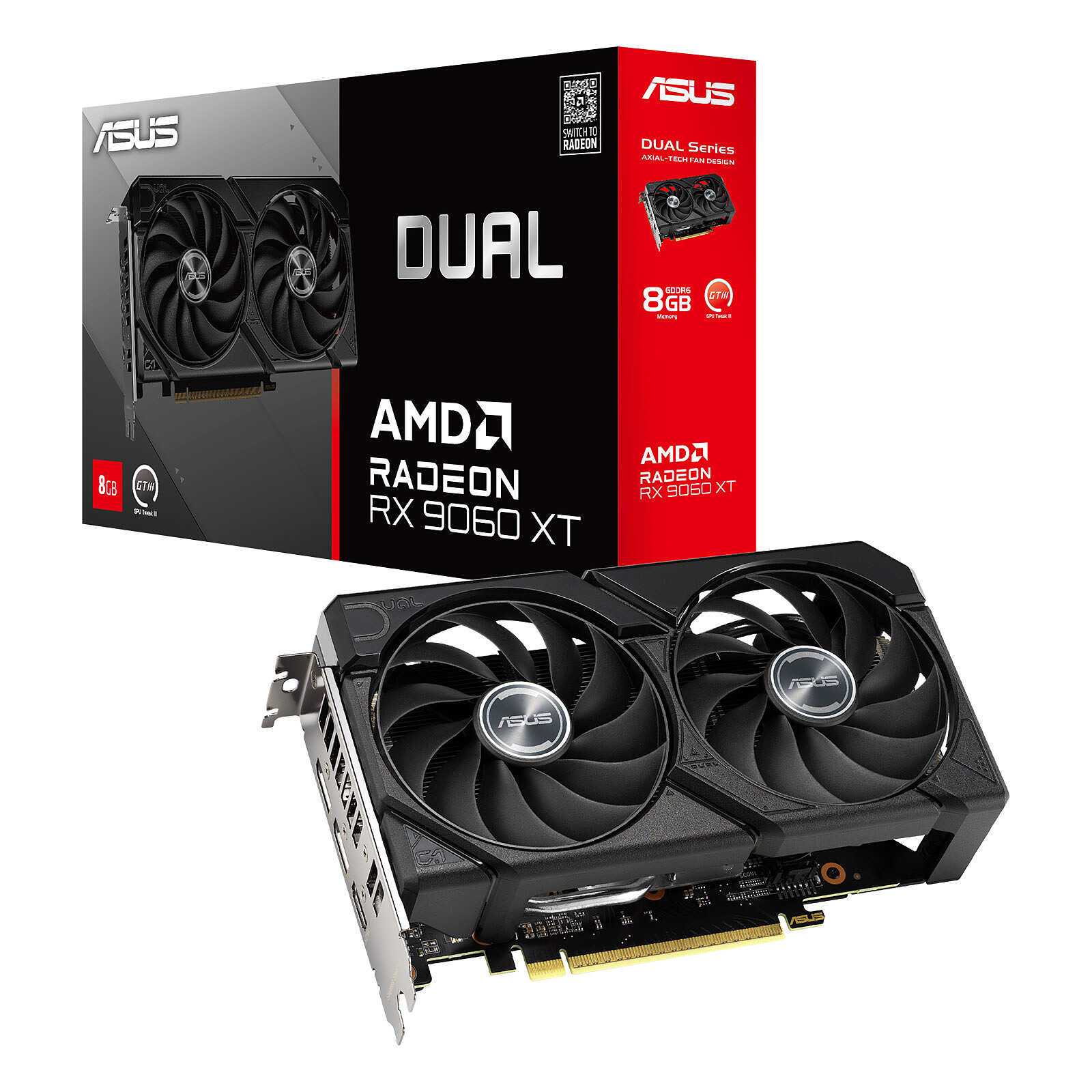
AMD Radeon RX 9060 XT 8GB
8GB 1080p-grade graphics card, 150W draw, 240mm long, FSR 4.
Budget RDNA 4. Competes with RTX 5060. Strong raster performance at 1080p.
Official India stock. Full warranty through the brand's India service network, standard RMA if anything goes wrong.
Full specs
PSUs rated 450W+
Cases that fit 240mm
Where to buy AMD Radeon RX 9060 XT 8GB in India
Expect to pay roughly ₹28,800-31,800 for the AMD Radeon RX 9060 XT 8GB in India right now, depending on offers and seller. I always recommend buying from retailers that give a proper GST invoice - it's what makes your India warranty claim smooth later.
Affiliate links on linked vendors - your price stays the same. PrimeABGB shown for comparison only.
In my years running a PC store, PrimeABGB (Mumbai) and Vedant Computers (Kolkata) have also been consistently reliable for verified stock - compare before buying.
Available cards in India
Same chip, same FPS - what changes between these cards is the cooler, the length, the power connector, and the price. Pick by what fits your cabinet and budget.
AMD RX 9060 XT in India - RDNA 4's Budget Entry That Changes the ₹25K Segment
RX 9060 XT: RDNA 4 Finally Reaches India's Most Competitive GPU Price Point
The ₹25,000 GPU segment is where most Indian builders are spending money, and it's historically been the most contested price point in the market. The AMD RX 9060 XT's arrival at approximately ₹25,000 in India changes what that money can buy.
RDNA 4 - the architecture that powers the RX 9070, 9070 XT, and now the 9060 XT - brings a meaningful IPC leap over RDNA 3. The RX 9060 XT with 16GB GDDR6 (in the full-VRAM variant) is the first card at this price that gives you both competitive GPU performance and VRAM headroom that won't embarrass you in 2028.
This is new hardware - I'm writing this at launch window, and the benchmark landscape is still being populated. What I can tell you is: this card is the reason to avoid buying a used RTX 3060 Ti or RX 6700 XT at ₹22,000–25,000 right now. Buy new, get warranty, get RDNA 4 efficiency.
What the RX 9060 XT Is - And What It Isn't
The RX 9060 XT sits below the RX 9070 in AMD's stack, using a smaller RDNA 4 compute die with fewer CUs but the same architecture fundamentals - improved ray tracing, FSR 4 (machine learning upscaling), AV1 encode, and RX 9070-class efficiency improvements. It's not a cut-down flagship; it's a dedicated mainstream chip.
Important variant note: the RX 9060 XT ships in 8GB and 16GB VRAM configurations. This is a real distinction. The 8GB variant is available at a lower price, but in 2026 I'd argue strongly for the 16GB version - games are pushing past 8GB at 1080p High in 2025–2026 titles. If you're buying the 9060 XT, pay the extra ₹1,500–2,500 for 16GB. It's worth it.
RDNA 4 Architecture: What Actually Changed
I won't bore you with a full architecture breakdown, but a few things are genuinely worth knowing for a buying decision.
Ray tracing improvement: RDNA 3 (RX 7000-series) was AMD's weakest generation for RT performance - noticeably behind Nvidia in RT-heavy scenes. RDNA 4 closes that gap substantially. The RX 9060 XT's RT performance at 1080p is meaningfully better than the equivalent RX 7600. Not on par with RTX 4060 in all scenarios, but much closer than RDNA 3 was.
FSR 4: The RX 9060 XT supports FSR 4, AMD's machine learning upscaling that uses the RDNA 4 AI accelerators. FSR 4 quality is significantly better than FSR 3.1 and approaches DLSS 4 quality. For FSR adoption, you need the game to support it - but the list is growing fast. This is a meaningful upgrade over FSR on older AMD cards.
Power efficiency: RDNA 4 at the mainstream level is dramatically more efficient than RDNA 3. The RX 9060 XT draws ~120–135W gaming TDP - close to the RTX 4060's 115W, which was one of Ada's standout features. For Indian summers and UPS-protected setups, lower power draw is a genuine win.
India Availability and Pricing Reality
The RX 9060 XT is a new launch and stock is building in India. As of May 2026, it's available at MDComputers and Vedant Computers in select AIB variants (Sapphire Pulse, PowerColor Hellhound). Expect pricing to stabilize around ₹25,000 for the 16GB variant as more stock arrives.
A note on the 8GB vs 16GB decision: the 8GB variant will likely be ₹2,000–3,000 cheaper. For 1080p gaming on a tight budget, the 8GB is fine today but will show VRAM limits sooner - probably by 2027–2028 in demanding titles. Given the small price gap, the 16GB is the default recommendation unless budget genuinely forces otherwise.
This card competes directly with the RTX 5060 Ti (RTX 50-series Blackwell budget card) at around ₹38,000–42,000. The 9060 XT is cheaper and has 16GB VRAM vs the 5060 Ti's 8GB or 16GB depending on variant. For straight value, the 9060 XT is the better buy at its price.
The 2026 budget GPU recommendation
The RX 9060 XT 16GB at ~₹25,000 is the best new GPU you can buy under ₹30,000 in India right now. It beats the RTX 4060 in gaming performance, has more VRAM than the 5060 Ti, and costs less than both. If your total GPU budget is ₹25,000 and you want new hardware with warranty, this is the card. Don't buy a used 6700 XT or 3060 Ti at this price point when a new RDNA 4 card exists.
Who Should Buy It
Right GPU if:
- GPU budget is ₹23,000–28,000 and you want new hardware with warranty
- 1080p gaming is your primary use case - this is an excellent 1080p card
- FSR 4 quality matters to you - a meaningful upgrade over FSR 3.1
- You're building the T02 1080p gaming build or the T03 eSports rig and need a budget GPU option
Skip it if:
- You can reach ₹33,000 - the RX 7800 XT is a proper 1440p card
- DLSS 4 matters more than FSR 4 - stick with Nvidia RTX cards for that
- You want 4K gaming - this is firmly a 1080p/light 1440p card
Price we have actually seen
Down 32.5% since we started tracking. Every point is a price our crawler recorded at an Indian retailer - no estimates, no MSRP. Tracking began recently, so the window grows week by week.
Questions
At similar prices: the RX 9060 XT 16GB wins. More VRAM, competitive performance, FSR 4 support. The RTX 4060 has DLSS 4 advantage and arguably a more established driver track record at this tier. But for pure value, the 9060 XT's 16GB vs the 4060's 8GB is the story - especially for future-proofing to 2028.
For 1080p–1440p video editing with Premiere Pro, DaVinci Resolve, or Kdenlive: yes, it's capable. AMD's AMF hardware encoder supports AV1, which is useful for export. GPU-accelerated effects in Premiere Pro work well on RDNA 4. It's not a professional workstation GPU, but for hobby or semi-pro video work on a budget build, it handles light editing workflows comfortably.
16GB if the price difference is under ₹3,000 - which it should be between variants. At 1080p today, 8GB is sufficient, but the 16GB version adds meaningful longevity. By 2027–2028, 8GB will feel tight in some AAA titles at High settings. The 16GB variant is better value over a 3–4 year ownership window. If you find the 8GB for ₹22,000 and the 16GB for ₹27,000 - the 16GB is still worth the premium.