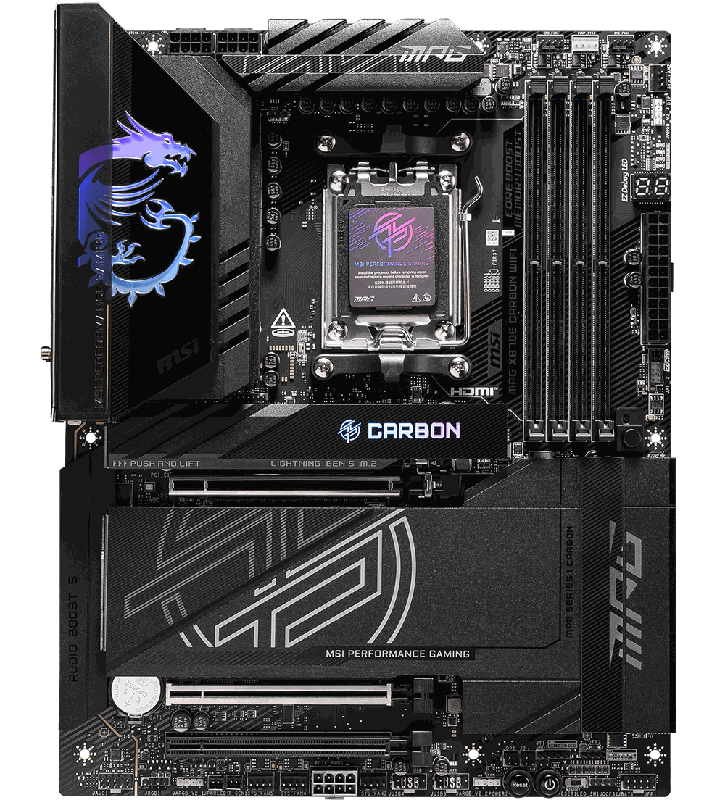
MSI MPG X870E Carbon WiFi
ATX X870E board for AM5 CPUs, DDR5 memory, BIOS Flashback included.
MSI X870E flagship board with USB4, WiFi 7, dual LAN and four M.2 slots. Intended for premium AM5 builds that will use the additional PCIe and I/O headroom.
Official India stock. Full warranty through the brand's India service network, standard RMA if anything goes wrong.
Full specs
Compatible CPUs
DDR5 memory kits
Where to buy MSI MPG X870E Carbon WiFi in India
Expect to pay roughly ₹43,200-47,700 for the MSI MPG X870E Carbon WiFi in India right now, depending on offers and seller. I always recommend buying from retailers that give a proper GST invoice - it's what makes your India warranty claim smooth later.
Affiliate links on linked vendors - your price stays the same. PrimeABGB shown for comparison only.
In my years running a PC store, PrimeABGB (Mumbai) and Vedant Computers (Kolkata) have also been consistently reliable for verified stock - compare before buying.
MSI MPG X870 Carbon WiFi Review India 2025 - AM5 Enthusiast Flagship Before X870E
MSI's AM5 Enthusiast Statement Before You Hit X870E Pricing
The MPG tier in MSI's lineup sits above MAG and below MEG. The MPG X870 Carbon WiFi at ₹38,000–48,000 is the board for serious Ryzen 9 9950X and 9900X3D overclocking that does not want to pay X870E MEG board prices at ₹55,000–70,000. It is MSI's AM5 enthusiast flagship in the practical sense - the board that handles everything without requiring you to spend extreme case money just on the motherboard.
MPG vs MAG - Where the Premium Goes
The MPG X870 Carbon WiFi's key upgrades over the MAG X870 Tomahawk come down to three things: VRM, connectivity, and build quality.
VRM: The Carbon WiFi uses an 18+2+1 phase design with 90A DrMOS stages versus the Tomahawk's 14+2+1 with 60A stages. For the Ryzen 9 9950X running PBO with scalar 10x, or manual overclocking pushing 280–300W sustained, the 90A stages provide meaningfully more thermal headroom. The VRM heatsink on the Carbon is larger and better-coupled. In sustained workloads - 30-minute Blender renders, long video exports, extended Cinebench loops - the Carbon maintains consistent boost clocks where the Tomahawk may begin to thermal-limit the VRM slightly.
Connectivity: 10G LAN versus 2.5G LAN. Thunderbolt 4 port on the rear I/O. Five M.2 slots (two PCIe 5.0, three PCIe 4.0) versus three on the Tomahawk. The 10G LAN is relevant for NAS users and multi-machine networks; Thunderbolt 4 is relevant for external GPU setups, 40Gbps storage, and TB docks. Five M.2 slots handle the most demanding storage configurations without PCIe adapter cards.
Build quality: The Carbon's PCB uses a thicker, higher-grade substrate. The heatsinks are larger and heavier. The I/O shield is built-in (backplate integrated into the PCB). These are marginal differences for most users but matter for premium build longevity.
India Pricing and Availability
MDComputers prices the MPG X870 Carbon WiFi at ₹39,000–46,000. PrimeABGB carries it in the same range. Vedant Computers and select Nehru Place dealers stock it. Amazon India runs it at ₹42,000–48,000 - the Amazon premium is ₹2,000–4,000 over grey market, but the return policy is cleaner on high-value boards.
MSI distributes through Rashi Peripherals - three-year warranty, consistent with all MSI boards in India. At this price point, the warranty matters significantly. Rashi's premium board handling has been better in my experience than budget board warranty claims - they prioritise the higher-value units.
The MPG Carbon is not as widely stocked in tier-2 cities as the MAG Tomahawk. Online orders from MDComputers and PrimeABGB with proper packaging are the safest route for buyers outside major metro areas.
Who Should Buy This Board
Buy the MPG X870 Carbon WiFi for sustained Ryzen 9 9950X overclocking, content creation workstations that need 10G LAN for NAS connectivity, and builds where Thunderbolt 4 is a functional requirement. The five M.2 slots serve video editors and 3D artists who need multiple high-capacity NVMe drives without adapter cards.
Skip it if you are building around a Ryzen 7 9700X or 9800X3D - those CPUs do not benefit from the Carbon's VRM headroom, and ₹45,000 saved on a board goes toward a better GPU. Skip it if you do not overclock and do not need 10G LAN or Thunderbolt 4 - the MAG X870 Tomahawk at ₹28,000–35,000 handles the same CPUs at stock with no meaningful performance difference.
Price we have actually seen
Down 0.0% since we started tracking. Every point is a price our crawler recorded at an Indian retailer - no estimates, no MSRP. Tracking began recently, so the window grows week by week.
Questions
Yes. AM5 socket compatibility covers Ryzen 7000 (Zen 4), 8000G (Zen 4 with integrated graphics), and 9000 (Zen 5) series. The Carbon WiFi works with everything from a Ryzen 5 7600 to a Ryzen 9 9950X. Running a Ryzen 5 7600 on this board is technically correct but economically wasteful - you are paying for VRM and connectivity the 7600 never needs.
For most home users in India with 1G internet or slower, 10G LAN provides no benefit on the WAN side - your ISP connection is the bottleneck. The benefit is on the local network: transferring 200GB of footage from a 10G NAS to a 10G-equipped PC takes 3–4 minutes rather than 30+ minutes over 1G. Indian content creators working with 4K RAW footage increasingly use NAS systems from Synology and QNAP, where 10G LAN is a practical time-saver.
Yes. Thunderbolt 4 is backward compatible with USB4, USB 3.2, and USB 2.0 devices - it falls back to the appropriate protocol automatically. A regular USB-C cable to a USB 3.2 Gen 2 device works fine on the TB4 port at 10Gbps. You only get the 40Gbps TB4 speed with a certified Thunderbolt 4 cable and a TB4 device on the other end.