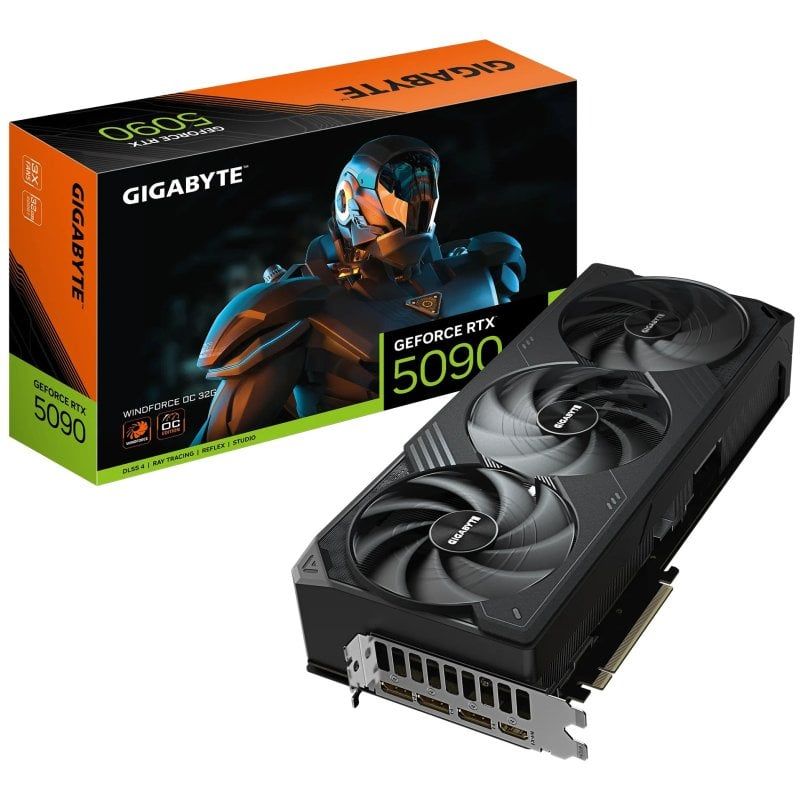
NVIDIA GeForce RTX 5090 32GB
32GB high-end graphics card, 575W draw, 355mm long, DLSS 4.
Flagship Blackwell GPU — 32GB GDDR7, 576-bit bus. Triple-slot, 350mm+ — check case clearance. Official India warranty via ASUS, MSI, Gigabyte AIBs.
Both official and parallel-import stock circulate. Official costs more but has full India warranty support. Confirm with seller which variant.
Full specs
PSUs rated 1200W+
Cases that fit 355mm
Where to buy NVIDIA GeForce RTX 5090 32GB in India
Expect to pay roughly ₹4,32,000-4,77,000 for the NVIDIA GeForce RTX 5090 32GB in India right now, depending on offers and seller. I always recommend buying from retailers that give a proper GST invoice - it's what makes your India warranty claim smooth later.
Affiliate links on linked vendors - your price stays the same. PrimeABGB shown for comparison only.
In my years running a PC store, PrimeABGB (Mumbai) and Vedant Computers (Kolkata) have also been consistently reliable for verified stock - compare before buying.
NVIDIA RTX 5090 Price in India 2026 - 32GB GDDR7 Review
Nvidia GeForce RTX 5090 price in India, 32GB GDDR7 specs, 4K benchmarks, India warranty guide, and honest verdict on who should actually buy it.
The RTX 5090 in India - Let's Be Honest About This Card
Let's be honest: the RTX 5090 price in India starts at ₹4,50,000 (indicative) and climbs to ₹7,00,000 for premium liquid-cooled AIB models. This is not a card I recommend to most builders. Not even most serious builders. The Nvidia GeForce RTX 5090 is the fastest consumer GPU ever manufactured, and in India, it carries a price tag that puts it squarely in used-car territory.
But if you're reading this page, you already know all of that - you've done the research, you understand where it sits, and you're trying to figure out how to buy it smartly in India without getting burned on pricing, warranty, or compatibility. That's what this article is for.
I'll say this upfront: unless you're a content creator billing ₹5L+ per month, an AI/ML professional who needs local GPU compute, or someone who genuinely keeps GPUs for 4-5 years and wants the absolute best - the RTX 5080 at ₹1.1L gives you roughly 80% of the performance at a fraction of the cost. I've written extensively about why the 5080 is the real flagship for most people. If you have any doubt about whether you need the 5090, you probably don't.
Still here? Good. Let's get into it.
Performance - The Fastest Consumer GPU Ever Made
There's no ambiguity here. The Nvidia RTX 5090 is in a class of its own. 32GB of GDDR7 on a 512-bit memory bus, a massive shader count, and Blackwell architecture pushed to its absolute limit. The numbers are staggering: 4K 120+ FPS at Ultra settings in virtually every current title, viable 8K gaming when paired with DLSS 4 Multi Frame Generation, and workstation-class performance in AI/ML inference, 3D rendering, and video production.
Compared to the RTX 4090 it replaces, the 5090 is 70-80% faster in rasterization and even further ahead in ray tracing workloads. Against the RTX 5080, it holds a consistent 20-25% lead at 4K - a gap that widens at 8K and in VRAM-heavy professional tasks where the 32GB buffer versus 16GB becomes the deciding factor.
Where the 5090 truly separates itself from everything else is in professional workloads. The 32GB GDDR7 means you can run large language model inference locally, handle 8K video timelines in DaVinci Resolve without proxies, and render complex Blender scenes that would choke a 16GB card. If the RTX 5080 is a gaming GPU that can do professional work, the RTX 5090 is a workstation GPU that happens to be incredible at gaming.
The 5090's 32GB on a 512-bit bus is not just "double the 5080." The bandwidth is in a different league - over 1.7 TB/s. For gaming, this means 8K textures and massive open worlds load without a hitch. For AI/ML, it means you can run 13B-parameter models locally for inference. For video editors, it means scrubbing 8K RAW timelines without building proxies first. At this price point, the VRAM is the feature that actually justifies the premium over the 5080.
RTX 5090 Price in India - The Real Numbers
Here's where the RTX 5090 price in India gets uncomfortable. The Founders Edition MSRP is ₹2,09,000, but finding one at that price in India is essentially impossible - Nvidia's direct sales are almost non-existent here. The actual market breaks down into very distinct tiers:
My recommendation: If you're set on the RTX 5090, the budget AIB tier (Zotac, Inno3D) at ₹2,00,000-2,50,000 delivers 99% of the gaming performance of a ₹5L+ liquid-cooled card. The mid-tier MSI Gaming Trio or ASUS TUF at ₹2.5L-3.5L are the sweet spot if you want a better cooler - which you will, given this card's 575W TDP in Indian conditions.
Everything above ₹3.5L is paying for aesthetics, marginal overclocking headroom, or exotic cooling solutions that don't meaningfully change the gaming experience. The liquid-cooled editions at ₹5L-7L are collector's items, not rational purchases.
I cannot stress this enough. At the ₹1.8-2.1L price point, a parallel import from Dubai or Singapore saves you ₹20-40K but carries zero manufacturer warranty in India. This is a 575W card running at extreme power levels - component failure is not hypothetical, it's statistical. When a ₹2L GPU dies at month 8, you're looking at ₹10-15K international shipping for an RMA that may be rejected outright. The savings are not remotely worth the risk. Read our parallel import guide (G01) and RMA guide (G10) before even considering this route.
System Requirements - This Card Demands Everything
The RTX 5090 is not a GPU you drop into an existing build. It demands a system designed around it from the ground up. Here's what you need:
Power Supply: 1200W, non-negotiable. The RTX 5090 has a 575W TDP. Pair that with a Ryzen 9 9950X (170W), drives, fans, and peripherals, and your sustained system draw sits at 800-850W. Transient spikes on Blackwell can briefly pull 700W+ from the GPU alone. A 1200W 80+ Gold PSU handles this with adequate headroom. A 1000W unit is the absolute minimum, and I'd only recommend it if you're pairing with a lower-power CPU like the 9800X3D (120W). Anything below 1000W is asking for shutdowns and OCP trips. See our PSU guide (G04) for specific 1200W models available in India.
Power Connector: 16-pin 12VHPWR. The 5090 uses a single 16-pin connector, and every AIB card ships with an adapter for older 8-pin PSUs. At this wattage, I strongly recommend a PSU with a native 12VHPWR connector - adapter cables at 575W sustained are a point of failure you don't want. Corsair HX1200, Seasonic Prime TX-1200, and be quiet! Dark Power 13 1200W all have native connectors.
Physical Size: Massive. Most RTX 5090 AIB cards are triple-slot designs, 355mm or longer. Some premium models push 3.5 slots. You need a full-tower or large mid-tower case with at least 360mm of GPU clearance. Measure your case before ordering. A GPU support bracket is not optional - at this weight (1.8-2.2 kg depending on model), PCIe slot sag is a real concern over time.
CPU: Ryzen 9 9800X3D or 9950X minimum. Anything less is leaving performance on the table. The 9800X3D is the best pure gaming CPU and pairs perfectly if the build is gaming-focused. The 9950X (16 cores) is the pick if you're doing professional workloads alongside gaming. Pairing a ₹2L+ GPU with a Ryzen 5 or an older Intel chip is wasting money - you'll bottleneck the card at every resolution below 8K.
Cooling: Critical in India. At 575W, the RTX 5090 generates enormous heat. In a 22°C lab, reviewers see 75-82°C under load. In an Indian summer room at 38-42°C, expect 85-90°C - uncomfortably close to the thermal throttle point. A high-airflow case is mandatory, not optional. The Lian Li Lancool III, Fractal Torrent, or Corsair 5000D Airflow with a full fan complement are the minimum. Air conditioning in your gaming room is honestly a practical requirement with this card during May-July. Our cooling guide (G07) covers this in detail.
Who Should Actually Buy the RTX 5090
This is where I have to be direct, because too many people buy this card for the wrong reasons.
The RTX 5090 makes sense for:
- Professional content creators billing ₹5L+ per month - video editors handling 6K/8K RAW footage, 3D artists rendering in Blender/Maya commercially, motion graphics professionals. For these users, the 32GB VRAM and raw compute power directly translate to billable hours saved. The card pays for itself.
- AI/ML professionals who need local GPU compute for inference on 13B+ parameter models, fine-tuning, or Stable Diffusion at scale. The 32GB VRAM is the differentiator here - the 5080's 16GB hits a wall with larger models.
- Competitive gamers who absolutely must have 4K 120Hz+ and are willing to pay any premium for it. With DLSS 4 MFG, the 5090 pushes 200+ perceived FPS at 4K - genuinely transformative for competitive play on a 4K 240Hz OLED panel.
- People who keep GPUs 4-5 years and want the longest possible relevance window. The 32GB VRAM buffer will age significantly better than 16GB as games and applications grow more demanding.
The RTX 5090 does NOT make sense for:
- "Future-proofing" on a ₹3L total budget. If your entire build budget is ₹3L, spending ₹2L+ on the GPU alone means cutting corners on the CPU, PSU, cooling, and monitor - every one of which will bottleneck the card. The RTX 5080 at ₹1.1L in a properly balanced ₹2L build will outperform a 5090 strangled by a cheap PSU and inadequate cooling.
- 1440p gaming. At 1440p, the 5090 is absurd overkill. The RTX 5080 already pushes 140-160 FPS at 1440p Ultra. You're paying double for frames your monitor can't display.
- Bragging rights. If the primary motivation is telling people you have a 5090, I'd rather you put that money into a better total system.
The value chart tells the story plainly. The RTX 5090 costs 61% more per frame than the RTX 5080 at 4K. For pure gaming value, it's the worst proposition in the current Nvidia lineup. The only way to justify it is if you need the 32GB VRAM, the professional compute capability, or the absolute highest frame rates regardless of cost.
Buying the RTX 5090 in India
Stock is limited and allocation is unpredictable. Here's how to approach the purchase:
MDComputers and PrimeABGB get the earliest allocation from distributors and are the most reliable sources. They stock AIBs from all major brands and honor manufacturer warranties without fuss. If a budget AIB Zotac or Inno3D model is in stock at ₹2L-2.5L, buy it from one of these two.
Amazon India 3P sellers consistently charge a 20-30% premium over retailer pricing. A card listed at ₹2.5L on MDComputers might be ₹3L+ from an Amazon third-party seller. Unless it's fulfilled by Amazon with clear return policy, avoid it.
DO NOT buy from unknown sellers. At ₹2L+, scams and refurbished-as-new schemes are financially devastating. Stick to authorized retailers and verify the card's serial number with the manufacturer's warranty portal before unboxing ends.
RMA matters enormously at this price. ASUS, Gigabyte, and Zotac warranties in India are handled through Acro Engineering and Rashi Peripherals respectively. MSI's India service is through Acro Engineering. All three distributors have improved their service timelines, but RMA on a high-end GPU still takes 2-4 weeks. Our RMA guide (G10) walks through the process for each brand - read it before you buy, not after something goes wrong.
Price we have actually seen
Down 60.8% since we started tracking. Every point is a price our crawler recorded at an Indian retailer - no estimates, no MSRP. Tracking began recently, so the window grows week by week.
Questions
For gaming alone - yes, absolutely. At 4K, the RTX 5080 delivers 80% of the 5090's performance at roughly half the price. The 5090 only becomes the rational gaming pick if you're targeting 4K 240Hz (where every frame matters) or if gaming is secondary to professional workloads that benefit from the 32GB VRAM. For 1440p gaming, the 5090 is beyond overkill - the RTX 5070 Ti handles 1440p at 120+ FPS Ultra.
The RTX 5080. I say this without hesitation for 90% of people asking this question. The 5080 at ₹1.1L in a well-balanced ₹2L build (our T08 template) is a better gaming experience than a 5090 crammed into a build where you've cut corners on the PSU, cooling, or monitor to afford it. The 5090 only wins if your total build budget is ₹3.5L+ AND you need 32GB VRAM for professional work. Our ₹3L flagship build (T10) is designed around the 5090 with every supporting component matched to it.
Barely, and only under specific conditions. A high-quality 1000W 80+ Gold PSU can technically handle the 5090 if paired with a lower-power CPU like the Ryzen 7 9800X3D (120W TDP). Your sustained system draw would sit around 750-800W, leaving thin headroom for transient spikes. I've seen users report intermittent shutdowns with 1000W units during heavy gaming loads. At the price you're paying for the GPU, spending ₹5,000 more on a 1200W PSU is the obvious decision. Don't gamble your ₹2L+ GPU on power delivery. See our PSU guide (G04).
Zotac operates its own service center in Gurugram and generally has the fastest turnaround (7-14 days). ASUS and Gigabyte go through Rashi Peripherals - reliable but slower (14-21 days). MSI uses Acro Engineering, which has significantly improved in the last two years. At the ₹2L+ price tier, warranty service quality should be a primary factor in your AIB choice, not aesthetics. Keep your invoice, register the product on the manufacturer's portal within 7 days, and photograph the card during installation. Our RMA guide (G10) covers the complete documentation process.
For inference on large models - yes, the 32GB VRAM is the differentiator. You can run 13B-parameter LLMs locally at usable speeds, which the 5080's 16GB cannot handle. For Stable Diffusion workflows, the 5090 generates images faster and handles larger batch sizes. For actual model training, however, even the 5090 is limited - serious training requires multi-GPU setups or cloud compute. The 5090 is best positioned as a local inference and fine-tuning card for AI professionals who want to avoid cloud costs.
At this GPU tier, anything less than a 4K 240Hz OLED is leaving performance on the table. The Samsung Odyssey OLED G8 (4K 240Hz) or ASUS ROG Swift PG32UCDM are the dream pairings - they can actually display the frame rates the 5090 produces with DLSS 4 MFG enabled. Expect to spend ₹80,000-1,20,000 on a monitor worthy of this card. A 4K 144Hz panel works too but caps the 5090's output in competitive titles. See our monitor pairing guide (G05) for the full recommendation matrix.
The risk is catastrophic at this price point. A parallel-imported RTX 5090 from Dubai at ₹1.8L saves you ₹20-40K, but carries zero manufacturer warranty in India. These are 575W cards operating at extreme thermal and electrical loads - the failure rate, while low in absolute terms, is non-zero. If the card fails, international RMA shipping costs ₹10-15K each way with no guarantee of acceptance. You're risking ₹1.8L+ on a product with no safety net. The ₹20-40K saving represents roughly 10-15% of the purchase price while eliminating 100% of your warranty protection. The math is terrible.